
New vote recount – a new race against time: Who is responsible for the manipulations?
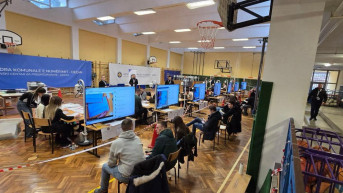
Kosovo is once again racing against time. The recount of votes for parliamentary candidates at all polling stations is expected to last two weeks, pushing the formation of the new parliament into the next month. This delays the adoption of the 2026 budget, while the deadline for electing the President of Kosovo—4 March—is fast approaching. These are just some of the headaches resulting from evident manipulations during the vote-counting process. How did they occur, and will anyone be held accountable? These are questions awaiting answers from the judiciary.
Written by: Dusica Radeka Djordjevic
Some parliamentary candidates from the largest Albanian parties have improved their results after the new scrutiny of ballots, while others have lost votes.
Recounts are not new in Kosovo, but former Central Election Commission president Valdete Daka points out that there have never been discrepancies of this magnitude before.
At some polling stations, the recount of votes for parliamentary candidates following the parliamentary elections held on 28 December began on 13 January. In ten of Kosovo’s 38 municipalities, recounts were conducted in full; in the remaining 28 municipalities, recounts covered 10 percent of polling stations.
It emerged that discrepancies in vote counts were substantial. The most extreme case, according to Kreshnik Radonjiqi, Chair of the Central Election Commission (CEC), occurred in Prizren. There, a new recount deducted 29,343 votes that had initially been recorded for candidates and added 16,366 votes that had not been properly registered in the first round.
As a result, the CEC yesterday ordered a recount at all 2,557 regular polling stations.
According to Radonjiqi, the new recount will not affect the allocation of seats among parties that entered parliament, as the results for political entities were correctly counted and presented.
How Are Manipulations Possible?
Aleksandar Rapajic, Program Director of the NGO Center for Advocacy of Democratic Culture from North Mitrovica, explained to Kosovo Online that votes for parties are counted at polling stations, while votes for individual candidates are counted at separate counting centers where all votes from a municipality are aggregated.
He says he cannot state with certainty how manipulations occur.
“My assumption is that some board members from certain parties favor their preferred candidate, probably by additionally marking that candidate’s number,” he said, adding that the electoral system is now fully recorded, including the counting at the counting centers.
However, he stresses that it is very difficult to prove concrete responsibility for identified irregularities.
“The fact that irregularities have been identified does not mean that responsibility has been established. That is the harder part. Even if you roughly know who may have done it, proving concrete responsibility is extremely difficult. I fear these irregularities will not result in judicial outcomes but will only lead to stricter controls in future elections,” he said.
Up to Five Years in Prison
National Elections Coordinator of the Kosovo prosecution service Laura Pula announced yesterday that she had requested chief prosecutors of all basic prosecution offices to begin collecting relevant information and evidence proving the commission of any criminal offenses related to the electoral process. She also announced that parliamentary candidates would be summoned for questioning as part of the investigation.
Senior researcher at the Kosovo Law Institute, Gezim Shala, pointed out that falsifying election results is a criminal offense clearly sanctioned by law, punishable by up to three years in prison, or up to five years in serious or aggravated cases.
“What happened is one of the biggest scandals regarding the integrity of the electoral process since the elections of 2000 and 2010. In this specific case, prosecutorial action is necessary,” he said.
According to Vullnet Bugaçku of the Kosovo Democratic Institute, vote manipulation seriously undermines electoral integrity.
“This is an absolutely illegal and unacceptable phenomenon, as it can damage and seriously undermine the integrity of elections, given that Kosovo is considered a country that organizes relatively peaceful and credible electoral processes, where political actors accept the results,” he said.
Rapajic emphasized that the manipulations do not affect party results, only the order of candidates within party lists.
“Changes can occur only in the ranking of parliamentary candidates within a single party; there can be no change in party election results. That part has already been completed and confirmed,” Rapajic said.
Assistant professor at the Faculty of Political Sciences in Belgrade Stefan Surlic also said that it is essentially clear who won the elections, viewing the new recount of votes for parliamentary candidates as a matter of respecting legal and technical procedure.
“It is an absolute victory for Self-Determination. The election results are clear, and I assume that Self-Determination will very easily form a new government once the final voting results are announced,” he told Kosovo Online.
Voter Confidence
Surlic believes that voters will not lose confidence in the electoral process because certain irregularities were detected and votes for parliamentary candidates are being recounted.
“Of course there are some doubts, but even if voting were repeated, it would not lead to any significant change in the results,” Surlic said.
Rapajic even believes that voters show little interest in these issues, as they concern intra-party changes that matter less to them, except for those actively involved in party work.
What concerns voters—especially public sector employees and pensioners—is when Kosovo will finally adopt the 2026 budget. Under the rules, the Law on Budget Allocations from the previous fiscal year cannot, under any circumstances, be extended for more than three months into the following fiscal year.
There will be no new budget until the Assembly is constituted, and Rapajic warns that the recount of votes for parliamentary candidates will delay the Assembly’s formation.
“Until the exact composition and structure of the Assembly are determined, it cannot be constituted,” he stressed.
Political analyst Artan Muhaxhiri expects the CEC to complete the repeated counting process as soon as possible, in time for the presidential election.
“I think the CEC bears responsibility and is under great pressure to finish this process quickly. They have staff and teams to complete it before 5 March, because it would be a major political catastrophe if Kosovo were left without a parliament, a president, and a government. The Constitution does not even provide a scenario for such a situation. That would be devastating for Kosovo’s political system. I believe Kosovo’s politicians have enough decency not to put the country in such an awkward position,” Muhaxhiri told Kosovo Online.



comments