
Bishop Hilarion: Christmas is the recognition of kinship with God, Serbs in Kosovo face a fiery trial and temptation
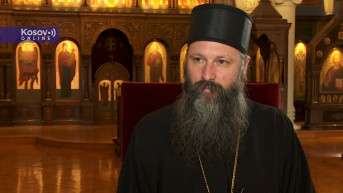
Christians realize through Christmas that they are created to become kin with God, which is why they celebrate this holiday with the message "God is with us, may there be goodwill among men, and in the heavens, glory to God should be exalted." The Serbs in Kosovo and Metohija send a message to themselves and to everyone else in the world that through a fiery trial and temptation comes true maturity, emphasizes Bishop Hilarion of Novo Brdo in a Christmas interview for Kosovo Online, vicar of the Serbian Patriarch.
"Through Christmas, we realize that we are created to 'become related' with God, that the uncreated God wanted to unite with the world He created, to be born in it. And He was born in a wonderful way. He was born as all on earth are born, his mother gave birth to Him. Lord Christ, the Logos of God, is eternally born from the Father without a mother, while in time and space He was born of a mother without a father on earth. Christmas is the fruit of the marriage of God and created nature. Therefore, Christians can rightly exclaim: 'God is with us! The glory of God has kissed the earth and brought it peace, so because of this embrace, there can finally be goodwill among men!' This heavenly touch of God and the world has given birth to the blessed life for which man was created," stresses Bishop Hilarion.
He explains that the beauty of Christmas lies in the fact that Christians experience it in an ordinary setting, in the circle of the family.
"Lord Christ was born in a humble cave, in a remote corner because there was no room at the inn for the 'Holy Family.' They found refuge where humble shepherds watched their flocks, and where, guided by the light of a star, wise men from the east came to worship the newborn King of Peace on behalf of all humanity. In the simplicity of customs that take us back to play and childhood, in the warmth of the home hearth, in the harmonious singing of all family members, Christians experience the grace of the Bethlehem cave. It is no coincidence that Christmas customs are tied to the family because it is there that we should recognize God, experience Him. Christmas leads us through: Children’s Day, Mother’s Day, Father’s Day... which seem to tell us that God has become one of us, has become our relative, a member of our household," emphasized the bishop of Novo Brdo.
He advised that Christians should be encouraged by the message "God is with us" and that despite "suffering and poverty," this is best felt at every liturgy in Kosovo.
"We should encourage one another with the exclamation that God is with us. Despite suffering and poverty; despite often being exposed to an absurd everyday life and the horrors that the world, which lies in evil, serves us, the grace of Christmas and the light of the Bethlehem star, the warmth of Christ's manger conquer. This is felt at every Holy Liturgy in Kosovo and Metohija," says Bishop Hilarion.
"Constant in suffering"
Asked how he could describe the current situation of the Serbian community in Kosovo, Bishop Hilarion uses the phrase "constant in suffering," but that "only where it is terrible and where one is tested by the fire of trials does true maturity come."
He emphasizes that this is also the message of the Serbs from Kosovo to the whole world.
"In times of suffering, which are constant in Kosovo and Metohija, we must continually encourage ourselves with the resurrection and transformation of our Church and our sanctities, which we touch with our hands and see with our eyes. Serbs in Kosovo and Metohija live and survive by this, and we should be able to hear their message to the whole world: 'It is difficult for us but we are well when we are with God'. It is difficult to exist in a terrible place, but only there where it is terrible, where our being is tested by the fire of trials, does one come to true maturity. In Kosovo and Metohija, someone who is brave, steadfast, is said to have a 'baked forehead' because they have been hardened and toughened in the fire of trials. May God grant us to be worthy of the endeavor in Kosovo and Metohija, may God give us the desire in our hearts to visit our holy land more often. Not just to encourage our brothers and sisters to survive on their hearths but also for us to receive at least a small wreath of victory and the blessing of our sacred land," concludes Hilarion.
"Metropoles of the margin"
The current life of Serbs in Kosovo is seen as "very dramatic and uncertain," but regardless that they have been "emptied" from cities and towns, they still experience the "margins" to which they have been reduced as metropolises.
"The life of Serbs is very dramatic and uncertain, as you might guess. Serbs have been almost completely displaced from cities and towns. Many times I have seen my brothers and sisters who were born in Pristina pass through a city they no longer recognize, which is no longer theirs, which has lost the outlines of their 'birthplace,' the cradle from which they sprang. Yet, life is indestructible; it continues. When there is no room at the inn, there is room in the cave, there is room in the stable, so the force of indestructible life is felt and seen even on the margins of the socio-political reality in Kosovo and Metohija. Our sanctities, our suburbs become metropolises," says this bishop of the SPC.
On the one hand, Serbs are oppressed, but because of this, the beauty of faith, cultural heritage, and liturgical gathering shines even brighter.
Thus, paradoxically, Serbs in Kosovo live in "parallel worlds."
"Pushed to the margins, the beauty of our faith, our cultural heritage, and our liturgical gathering shines even brighter. Decani Monastery, Gracanica, Visoki Decani, Banjska, Holy Archangels, Zociste and Velika Hoca, Prizren Seminary of Saints Cyril and Methodius, Draganac Monastery, where I spent a decade of my life, and other places of our congregation exude sanctity but also cosmopolitan brilliance. When their spirits falter, overwhelmed by bizarre, aggressive, absurd, and grotesque political realities, Serbs in Kosovo and Metohija can only find consolation in the Holy Altar and Liturgy, in the coming of Christ, who, by the mystery of His presence, changes our way of existence. Serbs could not survive in Kosovo and Metohija otherwise," assesses Bishop Hilarion.
"Dreadful Judgment"
Kosovo, the poet quotes, is a "dreadful judgment" where faiths, cultures, and many interests intersect.
"Indeed, Kosovo and Metohija, as the poet said, are a 'dreadful judgment' where different global political interests, various cultures, languages, and religions intersect, making life in Kosovo and Metohija unpredictable and dramatic. Today, as many times before, we are in a position to tell each other: 'Just a little longer! Let's endure another day, another month, another year... Everything will be fine with God's help!' It may be that we should always and everywhere live guided by these phrases. We all see what is happening in our world; how it is steeped in blood," emphasizes the Bishop of Novo Brdo and vicar of the Serbian Patriarch.
Speaking about constant pressures through attacks and accusations both on the Serbian community and the Serbian Orthodox Church, Bishop Hilarion says he gets the impression they are organized, but that the truth eventually always emerges.
"It seems that the continuous attacks on our people and the pressures from Pristina's institutions on the Serbian Orthodox Church, specifically the Pec Patriarchate and its Raska-Prizren Diocese, are planned and organized. There are constant attempts, with support from individuals abroad, to link our Church with political events, violent incidents, and supposedly, some subversive activities in Kosovo and Metohija. Thankfully, such attempts to compromise our Church do not succeed with people familiar with local conditions, whether they are from here or abroad. The Serbian Orthodox Church, with its centuries-old seat in the Pec Patriarchate and the Raska-Prizren Diocese, has preserved its reputation and dignity in these turbulent, and sometimes tragic, times by fulfilling its mission, serving God and witnessing to the whole world the Gospel of Christ," emphasizes Bishop Hilarion. Therefore, the SOC in Kosovo is of invaluable importance as a "refuge, support, and pillar of survival" for the people.
"Because of its openness to all people of good will, the Serbian Orthodox Church in Kosovo and Metohija is of invaluable importance as a refuge for our people; as support and a pillar of survival. It has happened before in history that empires have fallen, that earthly institutions have been suppressed, changed, or disappeared, but the Church has survived, testifying that goodwill should prevail among people," says Ilarion.
Respect with Albanians
With Albanians in Kosovo, it is necessary to build a relationship of respect and recognition of differences where neither will be a threat or a stumbling block but - a new possibility.
"We need to live together with our Albanian neighbors, respecting each other and honoring the differences between us. We should not be obstacles, threats, stumbling blocks, or the usual suspects to each other, but a new possibility and hope for a better tomorrow," is convinced Bishop Hilarion.
Attacks on the SOC, especially the Raska-Prizren Diocese, are seen as an attempt to create unbearable living conditions for the Serbian community to force them to relocate.
Such attempts sometimes appear as brutal force, and other times as a form of institutional pressure or state terror.
This is not something new, and for Serbs in Kosovo, he emphasizes, it has lasted the past 100 or 150 years.
"The goal is to practically disable life for Serbs in Kosovo and Metohija, to make it so unbearable that they relocate. Sometimes this is done through brutal force, and other times through some form of institutional pressure or state repression, not to use a harsher word. Some behaviors can even be characterized as a form of state terror. And unfortunately, this is also a constant, unfortunately something that exists continuously, not since yesterday. Serbs in Kosovo and Metohija have suffered for the past 100 or 150 years, but have survived. And I hope that we will be able to overcome all these challenges and that together with all people of good will we will be able to build an environment where we can all live together."
Sad and dangerous appropriation
Commenting on the increasingly frequent claims by some Albanian historians that Serbian churches and monasteries in Kosovo are Albanian legacies, Bishop Hilarion says that such claims are sad primarily for those who make them because there are no significant differences in the origins of Serbs and Albanians, but there are when it comes to identity markers.
"In Albanian society in Kosovo and Metohija, for some reason, a lot of attention is paid to various quasi-historians and their unserious and unfounded hypotheses, which is sad and can also be dangerous. On the other hand, serious scientific engagement reveals our similarities and mutual kinships that exist alongside the differences. No one has an exclusive, greater right than another to live in any area. Of course, there are fundamentally important identity markers based on the free choice of each of us," says Ilarion.
0 comments