
Dasic: In Belgrade-Pristina negotiations, EU is more often a "firefighter" than an "architect"
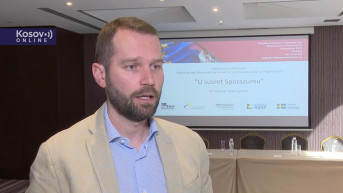
Marko Dasic, a lecturer at the Faculty of Political Sciences, assesses that the European Union, in relation to the mandate assigned to it in the Belgrade-Pristina negotiations, has achieved some results, but that the problem lies in the perception of excessive expectations and desires for it to be an "architect," although it functions more as a "firefighter" in this process.
"To reach a final solution, the parties in dispute must come to it themselves, and the EU merely manages the 'hoses' that should lead to the point, which is the normalization of relations between Belgrade and Pristina," Dasic says for Kosovo Online.
He reminds that there was an expectation that complete implementation of the agreement would occur a year ago, first with the draft agreement in Brussels, followed by its concretization in Ohrid.
"However, today we see that there is nothing in terms of the full implementation of the agreement, although perhaps we were too gullible to believe that such implementation would indeed happen. Mediation is a managerial intervention in the diplomatic process, but one should not harbor illusions that the mediator's role is crucial and decisive in this process," Dasic emphasizes.
He explains that there are several lines of argumentation supporting the thesis that the EU is still achieving certain results as a mediator in the dialogue.
"The first is the construction of excessive expectations that the EU, as a mediator, will be able to first formulate and make decisions within a short period and then persuade the parties in dispute to implement them as agreed. This is an illusory expectation, especially considering the mandate assigned to the EU in this mediation process, which is only to facilitate dialogue," Dasic points out.
The second position is based on hypothetical reasoning about what would happen if there were no EU mediation.
"Often you will hear, even from some European officials, that they would really like to play the role of an 'architect' assigned to them. 'Architects' in terms of proposing a framework agreement that would later be negotiated in detail. However, they often play the role of firefighters because crisis situations arise," Dasic says.
He emphasizes that the EU's crisis management in Kosovo deserves praise.
"It seems to me that the EU's crisis management deserves praise, considering the fact that they have successfully prevented any further escalation of something that could have been the seed of a much stronger conflict between Belgrade and Pristina, mainly on Kosovo territory," Dasic believes.
He assesses that the reasons for the stall in implementing the agreed-upon, including the formation of the Community of Serb Municipalities, should be sought "in the internal political relations" of Kosovo.
"I think the political elites in Kosovo are not ready to do something like that. Kurti made it clear during all the pre-election campaigns and then in his political actions when he was already in office. I have argued several times that during Kurti's mandate, the formation of the Community of Serb Municipalities will not happen, at least not in the form that the Serbian community would truly be satisfied with," Dasic says.
When asked if the EU could influence a change in such a stance by the authorities in Pristina, Dasic says it is doing so.
"But, in line with the 'levers' of influence, I believe it is achieving its maximum. The EU even tried to sanction Kurti, albeit quite symbolically, in the form of some diplomatic pressure, such as some diplomatic representatives of EU member states not meeting with him and publicly speaking against his policies. They tried to reason with him, but it was not enough pressure for Kurti to change his policy, and his reactions to further pressures will not be significantly different. He will remain consistent with a policy that is entirely detrimental to the Serbian community in Kosovo," Dasic emphasizes.


0 comments