
Dendias and Rama are by far the most frequent political guests of Pristina
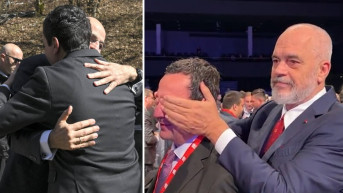
The most frequently seen foreign politicians in Kosovo are not only the officials of the countries that recognized Kosovo, but the Greek Minister of Foreign Affairs, Nikos Dendias, is foremost among them. According to data from Pristina, the Greek minister has already visited Kosovo six times, and one Albanian media commented on his last visit with the words, "Dendias in Kosovo is like at home."
Behind Dendias is Albanian Prime Minister Edi Rama, although his visits do not include official meetings with representatives of the authorities in Kosovo. Rama was in Prizren with his wife and son in mid-February, while last summer he visited the parents of the former president of Kosovo, Hashim Thaci.
Analyst Nexhmedin Spahiu agrees that Dendias is one of the politicians who most often visits Kosovo, and in his opinion, this is good for Kosovo.
"What can be concluded is that the Greek Minister of Foreign Affairs comes most often. It is certainly good for Kosovo because it shows that recognition by Greece is on the horizon. I expect Greece to recognize Kosovo soon. Of course, before making any concession, every country wants to gain something from it. Now, what kind of concessions Greece wants, in exchange for the recognition, has not been disclosed and we can only guess, but it is suspected that Greek diplomacy wants to gain something in return for the recognition. Serbia demands the same," Spahiu says for Kosovo Online.
As for Rama, Spahiu says that he comes for private business purposes because his relations with Albin Kurti are strained and not the best.
Vladislav Jovanovic, a former diplomat and Minister of Foreign Affairs of the FR Yugoslavia, states that Pristina is most often visited by politicians from the former Yugoslav republics who, as he says, were always on the side of the Albanians even during the existence of Yugoslavia.
When it comes to the visits of Greek Foreign Minister Nikos Dendias, Jovanovic says that Greece is the thinnest link in the chain of five European countries that have not recognized Kosovo because it is the most dependent on America and the most resistant to its pressures, given Greece's permanent and increasing weakness in relation to Turkey.
"Greece relies more and more on American protection, and every protection has its price, and America has certainly factored into its price the greater flexibility of Greece regarding Kosovo and Metohija, especially since Greece does not have an immediate reason for it, but it has a wider one concerning Cyprus which is part of the wider Greek community," Jovanovic said.
However, as he adds, Cyprus protected itself in one way by being admitted to the EU "pretending to be a country that it is not for 50 years".
"On that side, Greece can count on the EU in terms of Cyprus, and in terms of its national interests, it will have to come to terms with the American attitude and pressure. It is procrastinating and will procrastinate for some time," Jovanovic says.

He notes that among the regular visitors to Pristina are also those who are ready to assist the Americans in strengthening the general image that an independent Kosovo is increasingly present and acceptable.
"The Americans want to build that image, and those who are directly subjected to American influence or pressure, or who have their own interests, are happy to join the ranks of regular visitors to Pristina," Jovanovic says.
When it comes to the reasons for their visits to Pristina, Jovanovic says that "you strike the iron while it is still hot" and that this is exactly why they are trying to add to the "policy of definitive separation of Kosovo from Serbia" with frequent visits.
"It's all a psychological-tactical game that should contribute to the creation and strengthening of the overall atmosphere that Kosovo is lost to Serbia forever and through that contribute to strengthening the general impression in the international community, and also among the public in Serbia, that this is an unchangeable fact. Unfortunately, there are individuals and groups in our public who carelessly and uncritically fall for this kind of claim, but it is still an insignificant minority in the total number," Jovanovic believes.
He adds that the battle for definitive Serbian acceptance or non-acceptance of the truth of the West continues and believes that Serbia should not have a pessimistic attitude regarding the final outcome because, as he says, the historical, legal, political, and geopolitical facts are in Serbia's favor, and only the facts of the “physical force” are in favor of the position on the definitive loss of Kosovo.
"Between those two machines, we should believe in our machine, which is invincible as far as the facts are concerned, and count on the factor of time, which is less and less an ally of Albanian and Greater Albanian politics and their protectors in the West, because the overall balance of power on the world stage is changing quite quickly and radically and certainly the attitudes of the West and the Albanians cannot count on a perspective understanding and support of the wider international community," Jovanovic says.


comments