
Rakocevic: Our Notre Dame is the Monestry Visoki Decani, our Saint Denis is the Patriarchate of Pec
One of the KFOR commanders, the Frenchman Marcel Valentini, told us in a casual conversation: "You Serbs have to accept reality. We French did not accept the reality in Algeria and we disappeared!" Then someone asked him a question: "Excuse me, but is Notre Dame in Algeria?" He looked at us and was surprised at the stupid question. "Our Notre Dame is in Decani!", this man answered him. Perhaps this is the nature of our misunderstanding, or it is a force that does not notice the values and constitutive points of a nation, no matter how small or disenfranchised it is.
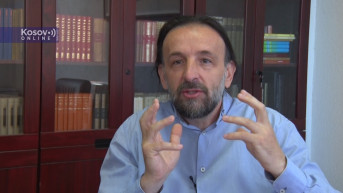
This is how Zivojin Rakocevic, a journalist and writer from Gracanica, tells in an interview for "Vesti", after a series of serious attacks on Serbs throughout Kosovo.
How would you describe the life of Serbs in Kosovo?
Ghetto is the key word to describe the life of Serbs in Kosovo and Metohija. It includes all shades of "soft prison", stunted institutions, all forms of fear, precisely demarcated space that provides apparent security, difficult to accept monotony and mutual intolerance of a world that has been living in isolation for two decades. An aggravating circumstance is the loss of basic contacts with the city and urbanity. For the first time in the post-conflict era of 1999, the city became a place of greatest insecurity. Throughout the 20th century and the last decades of the 19th century, Serbs fled from the countryside to the cities, where they sought a minimum of security in critical and uncertain times. The twenty-first century took away our cities for the first time in history and squeezed us into rural ghettos that vacillate between survival and disappearance. When we meet at some gatherings that are mostly organized by foreigners in Pristina, we immediately recognize each other by the mud on our shoes. If someone were to sit under the table and observe our shoes, they would know without fail who the Serbs were and where they came from.
What is the most difficult thing that Serbs face, especially south of the Ibar?
The pressure aimed at accepting someone else's freedom is the most difficult to bear. It covers every conscious and unconscious part of our life and is embedded in the way of behavior, institutions, public life and the concept of the final reckoning with Serbia and the Serbs. How to explain the nonsense that the only Serbian woman in Djakovica has to be guarded by the police and that there is no food for her in a city of several tens of thousands of Albanians. How is it possible that she represents a danger to Albanian national interests, that someone is bothered by being sick and lonely, that the whole city has turned against her? "You're still here, when are you going to Serbia?", they ask one of the few families still surviving in Pristina. They won't sell, they won't leave, they just want to stay in their town quietly and unnoticed. The worst thing is that this question has become normal and is asked by everyone, from lawyers to neighbors. It has become natural and no one, in the harsh inter-ethnic contact, notices how much it insults life itself and the possibility of choice.
New incidents, attacks on Serbs, since the beginning of this year have been changing like on a tape. What do you think is the cause of the growing violence?
The nature of the conflict and calamity in Kosovo is that it deeply encompasses all of our lives, our possessions and our sanctuaries. For the people who live in this area, the incidents seen by people from outside are part of everyday life where someone can see and notice their difficult situation. Shooting next to the monument to Milos Obilic in Gracanica is the "natural state" here. There isn't a day when someone doesn't throw things at girls who pass by the road or without horns from the car, someone always plays KLA songs through the open window of the car... People from the outside can't see it, we live it. There is a special level of discrimination in institutions, and there reigns reconciliation as if everything is completely normal. Serbs south of the Ibar simply say: "It's their time!" If one stone is thrown in the north, ten stones fly south of the Ibar.
Children are mostly the target. Isn't that more than a direct message to their parents?
It's not about messages to parents, it's about a message to a particularity and witnesses of the failed Kosovo system. Any progress or opportunity to improve life ends with the sentence: "We're going to hit you where it hurts the most!" In the past decades, three points of greatest pain have clearly emerged: children, the church and cemeteries. Tensions, the possibility of change, nationalist mobilization, incidents or decisions of tribal criminal structures end with an attack on these three sensitive and painful places. So, for example, the shots on Christmas Day this year struck at the heart of our fears and renewed crimes in Gorqzdevac, Livadice or Cernica. Let us remind you that children were killed in them. Patriarch Porfirije felt that pain and sent a clear message that those child victims have not been forgotten and that the sanctity of their suffering is a source of hope and our attitude towards everything that is defined as Serbian Jerusalem.
In such a situation, is there any life at all for Serbs in Kosovo and Metohija?
There is no basis for this question. Is there life for the Jews in Jerusalem or for the Greeks in Hagia Sophia? So the answer is: it was, it is and it will be! Vasiljka Peric from Djakovica always gave us this answer when we knocked on the door of the inn in the Assumption Monastery located in the center of this city. The life of Serbs encompasses these three times and, seemingly completely helpless, preserves the most important achievements of our civilization, art and statehood. It is the connective tissue of a huge mosaic that is difficult to understand, and it is even more difficult to answer the question from the outside: How is it possible that the Serbs survived? The musician Nele Karajlic once asked us in the Patriarchate of Pec: Why didn't we disappear like the Mayans or the Incas? How was it restored after its extinction in 1463 or after its second abolition? The miracle of renewal appears in everything that is devoted to the resurrection, in everything that has depth and faith that the power of God is shown in weakness. Today, Kosovo Serbs guard the Serbian Notre Dame, namely the Visoki Decani Monastery; in the courtyard of the Serbian Sistine Chapel, Our Lady Ljeviska, in the center of Prizren, Angelina Vukomanovic, a lonely priest's child, plays every day. Our Saint Denis is the Patriarchate of Peć and we can continue to do so for a long time... These are the values that the Serbs of Kosovo and Metohija preserve with their faith and patience.
A cynic would say that the only good in this evil is that the world can hear and see that Kosovo is not an example of "democracy and equality of nations"?
Most Western governments that supported the precedent of Kosovo's secession want to complete their project. They come here to hear their opinion and want to silence most of the voices that testify to the truth. "Turn to the Kosovo institutions, fight for your rights within them. Participate in the development of Europe's youngest democracy!" These are messages to Serbs, Goranians, Bosniaks, Roma and they essentially mean the disappearance of these entities because Kosovo is an empty shell without content and looks like a sick man who is kept alive by the infusion of those who dropped bombs on this area.
How interested are foreign media in general in the events in Kosovo and Metohija, especially the position of non-Albanian communities?
Lone voices are breaking through about our history, but most still report the way their governments want them to. They report in a way that they would never talk about a problem within their country's borders. A pernicious balance is made and a measurement is made of who did something evil in the past and the present is measured accordingly. The cycle of evil is thus not broken, but new opportunities for conflict and misfortune are opened. "Who wasted my rights?", asks a young Kosovo Serb born a year after the war.
The Prime Minister of Kosovo Albin Kurti recently set six conditions for the formation of the CSM, and the last one is that it will be done after Serbia recognizes Kosovo?
Albin Kurti wants to speed up the processes supported by the international community that lead to the disappearance of any influence of Serbia and Serbs in Kosovo and Metohija. All the agreements that have been signed so far and in which there were some rights for the Serbs were not implemented because the international community told the leaders of the Kosovo Albanians: "You sign and immediately start violating them!" Albin Kurti is not interested in that process because he is trying to legalize the persecution and absence of all rights of Serbs. He wants to conclude the Serbian issue in Kosovo and finally start the practical realization of the unification of the Albanians and the creation of Greater Albania.
At the same time, Vjosa Osmani claims that "mutual recognition of Kosovo and Serbia is the only way to achieve peace". Do you believe that the attacks on Serbs will really stop then?
Even if Belgrade would officially recognize Kosovo and if all instances of Serbian society would sign and recognize the independence of Kosovo, there would be no peace, and there would be no security for the Kosovo Serbs. Kosovo Serbs are hostages of war and peace. The nature of this conflict cannot be appeased by signing papers and capitulating Serbia. The only possibility for peace is the sentence of the Kosovo Serbs: "Leave us alone!" It is necessary to leave two worlds, Serbian and Albanian, to develop democracy and potential within themselves. Only in this way is there a possibility for the two sides to meet in the future as citizens and communities for whom the freedom of others is as important as their own, personal and collective.
It seems that many moves by the authorities in Pristina are equally criticized by Western officials and opposition parties, but that they still have their way. How is it possible?
According to the estimations of those who wrote and implemented the Kosovo project, it is in its final phase. A eulogy of its success remains to be written. The problem is that Belgrade has to put its signature on that "success story". Everything else, including inter-Albanian frictions and quarrels, are only part of the modality that should lead to the final solution and Serbian defeat. The international community constantly repeats to Kurtia and Vjosa Osmani and to everyone in Kosovo: "We know better than you what you need!"
At the end of last year, it seemed that the territory of Kosovo was the closest to war since 1999. How realistic is the war epilogue?
There is no need for war here, because the low-intensity conflict has been going on for two decades. The atmosphere of fear and war freezes the entire life - wasn't the pogrom on March 17, 2004 a two-day war, aren't we aware that in times of peace and under the protection of foreigners, that war forever destroyed some lives, churches, towns and villages...
You will hardly find a politician in Serbia who says that "Kosovo is not his first concern" and that "unity is more important than bread". Then in the Serbian Parliament we see something completely different. Bishop Sergije says that this discord is "Serbian destiny"?
As far as Serbs and Serbian politics are concerned, Kosovo is like medicine: if you don't take it in the necessary doses, you will disappear; if you consume too much of it you will disappear! Kosovo is a balance in which all our opposites are reconciled through struggle and Orthodoxy, it is our national gospel.
What is your message from Gracanica to the Serbs in diaspora?
Kosovo is the largest mosaic and achievement of Serbian civilization, try to find one of your pieces in it. Make it culturally, spiritually and nationally aware - see its value and sanctity; put it in your life and let it guard and protect you. With it in Manhattan, you will be citizens of the world, independent and aware that in that world you have your own face and contribution to world civilization. That little cube is a personal Kosovo vow that will give you security and connection from the mine in Alaska to the administration building in Paris.
What about contemporary creation, when you already mention important places from the past?
Our literature, painting, theater in Kosovo and Metohija are better and more developed than in Nis, Uzive, and in some segments, there are achievements that surpass even Novi Sad. Culture is our true freedom and the place where struggle and pressure are transformed into creation, according to Njegos that "a blow finds a spark in a stone".
Constantly pointing the finger at Serbia, Albin Kurti tries in every way to compare the events surrounding Kosovo with those in Ukraine. Will he succeed in this?
The Kosovo precedent, sui generis, a unique case, gave its bloody results in Ukraine. Would there have been Crimea if Kosovo had not preceded it? Now, unfortunately, it is too late for millions of unfortunate people, just as it was too late for us, and for Serbs and Albanians, the moment the first bomb hit us in 1999.
In what way would the formation of the Community of Serb-majority Municipalities help the Serbs in Kosovo?
We have been talking about the Coomunity of Serb-majority Municipalities for a decade, and no one is clear about what it is or what those who have had everything taken away should get. The paradox of Kosovo Serbs is that what they do not have, they are asked to agree to someone else's freedom. In the Community, we can lose the last two segments of our security - health and education.
comments