
Brussels’ diplomatic “wild card”: Is the issue of missing persons diverting attention from the actual position of Serbs in Kosovo?
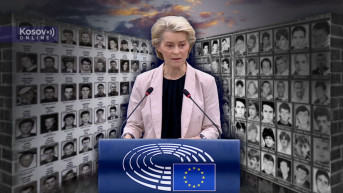
European Commission President Ursula von der Leyen’s statement that the agreement on missing persons demonstrates a positive shift in Pristina’s approach toward the Serbian community is an attempt by Brussels to present the reality in a more favorable light and preserve the appearance that the dialogue is producing results, Kosovo Online’s interlocutors believe. They stress that the issue of missing persons is often used as a diplomatic “wild card” to divert attention from the fact that the rights of Serbs in Kosovo are increasingly under threat and that interethnic trust has been deeply undermined.
Written by: Milena Miladinovic
Von der Leyen visited the Western Balkans last week, with Pristina among the stops on her tour. At a press conference with Kosovo Prime Minister Albin Kurti, she said, among other things, that she saw positive steps by the Kosovo government toward the Serbian community, citing as an example the agreement on abducted and missing persons reached within the Belgrade–Pristina dialogue.
According to Kosovo Online’s interlocutors, developments on the ground concerning the Serbian community in Kosovo cannot be described as progress, while the situation facing Serbs, they stress, is far from good.
They also point out that, despite the many important issues affecting Serbs in Kosovo that remain unresolved, the EU uses even the smallest “success” to portray Kosovo as making progress. They add that the issue of missing persons is frequently invoked when there is a desire to demonstrate that the dialogue is not merely “a dead letter,” even though, in their assessment, there has been no progress in the dialogue process since Self-Determination came to power.
Diplomatic “wild card”
Political scientist Ognjen Gogic said that the issue of missing persons was frequently used as a “wild card” in the dialogue and that von der Leyen had cited the agreement on that issue in Pristina as a step taken by Kosovo toward improving relations with the Serbian community in order to demonstrate that the dialogue had not completely collapsed.
Speaking to Kosovo Online, Gogic said that during her visit to Kosovo, von der Leyen had also stressed the need for the government in Pristina to preserve the multiethnic character of society, which, he added, meant that it was under threat.
“During her remarks in Pristina, von der Leyen called on Kosovo to preserve the multiethnic character of its society and said that the Kosovo government needed to rebuild trust with the Serbian community. That is the diplomatic way of saying that both of those things have been called into question. In other words, there are questions as to whether Kosovo still has a multiethnic character and whether relations with the Serbian community have deteriorated, which is why the government is being called upon to rebuild that trust,” Gogic said.
He noted that these were statements made between the lines, but that what they were alluding to was clear—that problems existed.
“Von der Leyen also said that there had been positive developments, and she cited cooperation on the issue of missing persons as an example. This is an issue that keeps resurfacing in the dialogue as a kind of wild card. In fact, whenever there is a desire to say that not everything has failed or collapsed, the negotiators are brought together to discuss the issue of missing persons. One year, a declaration is agreed; the next year, a commission is established. There has been some work on the ground, locations suspected of containing graves have been identified, some have been confirmed, so it can indeed be assumed that this resulted from the dialogue and the agreements reached,” the political scientist said.
He added that von der Leyen had wanted to convey that this example demonstrated that not everything had failed.
“She could equally have cited the example of the Foreigners Law. With European Union mediation, an agreement was reached on certain facilitations for the Serbian community. It was not implemented to the extent or in the manner agreed in March, but the harmful consequences of the law’s implementation have not been seen on the ground. In other words, the law has not resulted in restrictions on the rights of Serbs in Kosovo to reside, live and work there,” Gogic said.
He explained that in this case the European Union, through its mediating role, had devised a formula that enabled Kosovo, on the one hand, to begin implementing the law while, on the other, preventing its implementation from negatively affecting the position of the Serbian community.
“So she could, for example, have cited that case, which says more about the position of the Serbian community and demonstrates that positive steps can in fact be taken. Her statement should be interpreted in that way. She wants to point out that, when there is willingness, agreements can be reached and something positive can be done. But that does not suggest that the European Union is embellishing the situation. The overall communication, periodic statements and remarks coming from the European Union Office in Kosovo or from European Commission spokespersons in Brussels, as well as the Kosovo progress reports, do not create an image of an embellished reality. It could not be said that the European Union wants to conceal the real problems that exist in Kosovo, but neither could it be said that it is effectively contributing to resolving them,” he said.
The statement on missing persons, Gogic added, did not directly concern the present-day position of the Serbian community.
“It concerns locating the remains of missing persons and establishing what happened to them. That statement was probably made in the context of the discovery of human remains in Zubin Potok, meaning that the intention was to say that there are examples involving Pristina as well. She specifically chose an example that could be interpreted more positively by the public in Kosovo. Had she mentioned the Foreigners Law, someone might have used that against the current government and said, ‘There you have it—Kurti made concessions to the Serbs,’” Gogic said.
Smallest result presented as a major success
Aleksandar Rapajic, Program Director of the NGO Advocacy Center for Democratic Culture, said that the European Union was a bureaucracy that attempted to present even the smallest possible result as a major success, adding that this had been happening in Kosovo for years when it came to the Serbian community.
Speaking to Kosovo Online about von der Leyen’s statement, Rapajic said there had been no progress on the ground.
According to him, the agreement on missing persons was being presented as a major success even though Serbs in Kosovo faced numerous other problems.
“The situation is far from good and far from one in which there has been any progress. The European Union identifies some small process—I cannot say it is irrelevant, but compared with other problems it is much less important at this point—and then presents it as an enormous success. That is also how this agreement on missing persons is being presented. It is certainly very important, but given all the other problems currently facing Serbs in Kosovo, it is not of such immediate importance to the Serbian people in Kosovo, yet it is being presented as a major success, when in fact it is merely another agreement on something that had already been agreed before,” Rapajic said.
He said that in this way the European Union was trying to maintain a positive image of the Belgrade–Pristina dialogue.
“We are aware that since Self-Determination came to power, absolutely nothing has come out of the dialogue. We can only speculate about what is being said behind closed doors, but I believe—or at least hope—that there is some pressure from the European Union on the government in Pristina, although the results rather strongly suggest otherwise,” Rapajic said.
Champions at ignoring problems
Historian Aleksandar Gudzic believes that representatives of the international community seek to portray Kosovo as an orderly and well-functioning society in which the institutions respect the rights of minority and socially vulnerable communities.
He views von der Leyen’s statement in that context as well.
“Representatives of the international community have proven themselves to be champions at ignoring problems and pretending that Kosovo is an orderly, well-functioning state in which the institutions and the majority respect the rights of minority and socially vulnerable communities. That is how I interpret von der Leyen’s statement in which she says that official Pristina’s progress in its relations with communities is evident,” Gudzic told Kosovo Online.
He stressed that he welcomed every agreement concerning abducted and missing persons, but claimed that Albanians had never been punished for crimes.
“These are people whose fate we have known nothing about for 27 years. The families of abducted and missing Serbs and Albanians understand this best. For 27 years, they have relived the trauma every year on the anniversary of the abduction or disappearance of their loved ones. I welcome an agreement that will shed light on the fate of abducted and missing Serbs and Albanians, so that their families can finally learn what happened to those closest to them. Official Pristina and the political elites of the Kosovo Albanians have never in the past been punished for the violence they perpetrated, including, if you will, crimes against Serbs. In fact, the political elites of the Kosovo Albanians have in the past been rewarded for crimes,” Gudzic said.
„To su ljudi za koje 27 godina ne znamo šta je sa njihovom sudbinom. To najbolje razumeju porodice otetih i nestalih Srba i Albanaca. Oni 27 godina iznova proživljavaju traume svake godine na dan otmice ili nestanka njihovih najmilijih. Pozdravljam sporazum koji će rasvetliti sudbinu otetih i nestalih Srba i Albanaca, da konačno njihove porodice znaju šta je sa njihovim najmilijima i najbližima. Zvanična Priština i političke elite kosovskih Albanaca nikada nisu u prošlosti bili kažnjeni za nasilje koje su sprovodili, ako hoćete, i zločine nad Srbima. Zapravo su političke elite kosovskih Albanaca u prošlosti bile nagrađivane za zločine“, rekao je Gudžić.

comments