
Government and resignation – two readings of the law: Who benefits from unclear regulations?
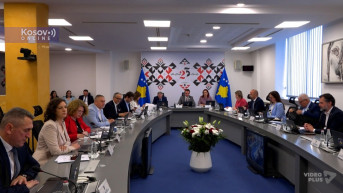
One law, different interpretations. For part of the expert public, there is no doubt: members of Albin Kurti's government who won parliamentary mandates in the elections on February 9th had to submit their resignations, as required by the Government Law. Quoting parts of the same regulation, Kurti argues that there was no need for a formal resignation because the mandate of each government member had already expired. With or without a formal resignation, the 'Kurti 2' government currently has a limited scope of action, and such a status, even for an extended period, is most beneficial for it, analysts believe.
Written by: Dusica Radeka Djordjevic
The Government Law came into force at the end of November 2022, during the second term of Albin Kurti's government, but only after more than two years, during the post-election reckoning of political parties, it became clear that depending on the situation, anyone could adhere to those members who suited them best.
On March 27th, the President of the Central Election Commission, Kresnik Radonjic, reminded the parties of Article 26 of the Government Law, which stipulates that members of the current government, who were elected as MPs in the new Assembly term, must submit their resignations before the election results are confirmed.
Article 26 states: "In the case that a government member is elected as an MP in the Assembly of the Republic of Kosovo, they must resign from their position as a government member before the election results are certified."
Among the government members elected to the new Assembly are Prime Minister Albin Kurti and several ministers.
Kurti, on the same day, March 27th, referred to the same law quoted by Radonjic, but focused on Articles 29 and 30, interpreting that according to them, the mandate of each government member ended on March 23rd, without the need for an additional formal resignation act. He announced that his government would continue to carry out its responsibilities related to the executive branch in accordance with the laws in force, respecting the limitations imposed by the law.
Some legal experts in Pristina pointed out that a legal vacuum had occurred, meaning that a government whose mandate had expired could not submit a resignation to a parliament whose mandate had also expired, but Dusko Celic, an associate professor at the Faculty of Law at the University of North Mitrovica, emphasized to Kosovo Online that there were no obstacles to submitting resignations.
He explains that the prime minister submits their resignation to the parliament not in terms of the term, but in terms of the institution of the parliament, and he assesses that Albin Kurti committed a legal violation by not submitting his resignation from this position. The Government Law, as he says, explicitly prescribes the submission of a resignation the moment a government member is elected as an MP, or when the relevant electoral body confirms the election result."
"This is about an imperative legal norm, which cannot be changed nor depend on our will. Simply put, Kurti had to submit, and must submit, a written resignation. It is completely irrelevant whether the new parliament has been constituted or not, he submits the resignation to the institution of parliament. His mandate is certainly within technical limits when it comes to the powers of the government, due to the fact that the mandate period has expired and new elections have been organized. But this provision further emphasizes, I would say, the requirement that there must be no conflict of interest, in this case, the mixing of the legislative and executive powers, the role of a government member, in this case, the prime minister and a member of parliament," says Celic for Kosovo Online.
Considering that the President of Kosovo, Vjosa Osmani, has called the constitutive session of the Assembly for April 15th, Celic says that on that day, Kurti cannot be both an MP and a prime minister in a technical mandate at the same time.
"That is probably 'D-day,' if I may say so, when he must make a decision because he cannot sit on both chairs. He cannot be both prime minister and an MP. At the constitutive session of the parliament, he will not be able to vote in his capacity as a member of parliament," points out Celic.
Lawyer and former secretary in the Ministry of Justice, Ardian Bajraktari, also points out that Article 26 of the Government Law clearly defines the obligation to submit a resignation if new members of the Kosovo Assembly are elected, but he notes that the law is not clear enough.
Bajraktari stated for Kosovo Online that the obligation of the current government to submit its resignation is a very controversial issue, although he believes it should be carried out.
"Since March 23, when the four-year mandate of the government ended, the Republic of Kosovo has a government which, in accordance with the Government Law, has a limited mandate in performing its functions and duties. Now the president and vice-president of the Assembly need to be elected, and then the formation of the government should take place as soon as possible," says Bajraktari.
Due to the situation in which Kosovo finds itself, where regulations are interpreted differently, and because of similar cases in the past, Marko Milenkovic from the NGO "New Social Initiative" says that there should be work on changing the law, i.e., harmonizing them.
He believes that the government in a technical mandate will last, and although the constitutive session of parliament is scheduled for April 15th, he notes that it is unlikely that the Speaker of the Assembly will be elected and that greater uncertainty may follow.
"The Speaker of the Assembly should be proposed by Self-Determination and elected by the majority of MPs, which at this point does not seem possible, but maybe it will change in the coming period. On the other hand, the opposition is not in a position to propose and elect the Speaker, so we are in a really strange position. There is a legal vacuum, and the Government Law complicates the entire situation. There are contradictions. On one hand, it is said that resignations must be verified by the Assembly, but there is another side of the law and the Constitution, which says that when government members become MPs, they lose the right to be members of the government," says Milenkovic for Kosovo Online.
As a solution to this situation, he sees two options - achieving a political compromise between Self-Determination and some opposition parties, or opposition parties or other political actors addressing the Constitutional Court to seek an opinion and guidelines on how to overcome this situation.
The current situation, according to Milenkovic's opinion, somewhat suits both the government and the opposition, but primarily Albin Kurti, since it will "buy additional time to try to form a new government and improve his position in that direction."
"It seems that Albin Kurti is using these legal vacuums to extend his mandate. If he fails to form a new government, I believe there is a possibility that elections will be unified in the fall, and along with local elections, new parliamentary elections could take place, which in my opinion would help Self-Determination in its attempt to achieve a better result, considering that local elections are a mechanism that allows you to work more on the ground and try to achieve a better result," says Milenkovic.



0 comments