
Ibar Bridge and Visoki Decani in KFOR's new "security architecture" – why are Serbs concerned?
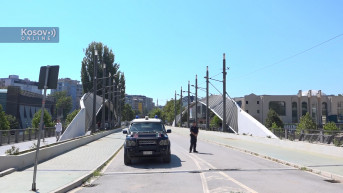
Why are the Carabinieri withdrawing from the main Ibar Bridge at this particular moment, and why are the Kosovo Police being involved in providing security for the Visoki Decani Monastery? This time, there has been no reaction from representatives of the international community, who until this year strongly opposed the idea of opening the main bridge, while Kosovo Online's interlocutors warn that the new security arrangements are being introduced at a time when Serbs' trust in the Kosovo Police is extremely low and concerns about security remain.
Written by: Veljko Nestorovic
KFOR personnel have been securing the main Ibar Bridge for 27 years, and they faced their first major challenge on August 8, 1999, when they managed to prevent a violent attempt by Albanians to enter the northern part of Mitrovica, which to this day remains the only urban area in Kosovo that continues to have a predominantly Serbian population.
In the years that followed, the bridge was always secured by NATO forces, including the Italian Carabinieri, and more than 1,000 incidents have been recorded on the bridge over the years.
Now, after 27 years, KFOR forces have begun a gradual withdrawal, with the Kosovo Police assuming responsibility for security. The bridge remains closed to vehicular traffic and can be crossed on foot, but according to announcements by politicians in Pristina, it could soon be reopened.
The Visoki Decani Monastery, built in the 14th century as an endowment of King Stefan Decanski, is under UNESCO protection and has been targeted in four armed attacks since NATO entered Kosovo, most recently in 2007. Although a Special Protective Zone has been established, works that posed a threat to the monastery have been carried out over the past several years, most recently just a few days ago. It should also be recalled that, after years of litigation, 24 hectares of land were returned to Visoki Decani.
Kosovo Online reporters visited the main Ibar Bridge today to speak with residents. They found one Carabinieri vehicle at the bridge, while three Kosovo Police officers were also present nearby.
Serbs and Albanians from Mitrovica expressed opposing views on KFOR's gradual withdrawal from the main bridge over the Ibar River, as well as announcements that it could be reopened to traffic. While Albanians welcomed the decision, Serbian residents stressed that they felt unsafe.
Aleksandar Rapajic, Program Director of the NGO Advocacy Center for Democratic Culture from North Mitrovica, told Kosovo Online that KFOR's withdrawal from one of the most important locations in the city is highly problematic for Serbs, adding that it is rather unusual for the Carabinieri to withdraw from the Ibar Bridge at a time when, according to him, the security situation is not particularly good.
"The fact that the Kosovo Police are now taking over responsibility for security on the bridge at a time when Serbs are not involved in the work of the police and when trust among Serbian citizens in the police is particularly low is highly unusual and sends a negative signal to the Serbian community," he said.
Rapajic pointed out that the Serbian population has greater trust in KFOR than in the Kosovo Police.
"I do not think security on the bridge itself is such a major problem. It is not particularly difficult to maintain security there because there is already another bridge nearby that vehicles cross without any problems. This has more symbolic significance. The Serbian population currently has greater trust in KFOR than in the Kosovo Police, so from that perspective, KFOR's withdrawal from one of the city's main symbolic locations is problematic," he said.
University professor Dorajet Imeri and security expert Mentor Vrajolli, however, assess that the gradual withdrawal of KFOR personnel is an indication that the security situation in Kosovo has improved.
Imeri told KosovaPress that the gradual withdrawal of KFOR personnel comes as a result of the continuous engagement of Kosovo's security institutions, particularly in combating illegal structures and other groups that, according to him, operated in accordance with instructions from Serbia.
He considers this a major success and an expression of the confidence that NATO, through KFOR, has in the Kosovo Police.
"The institutions of the Republic should continue with the same professional and comprehensive approach as before, continuously managing the situation in relation to risks through patrols and other practices already employed by the institutions of the Republic. The Kosovo Police have so far guaranteed security for all citizens, regardless of ethnic differences, demonstrating that this professional approach has produced results. This is a major success and, above all, an expression of the confidence that NATO, through KFOR, has in the Kosovo Police. It confirms an improvement in peace and security, as well as the increased capacity of the institutions of the Republic of Kosovo, particularly the security institutions, to assume these types of responsibilities," Imeri said.
Security expert Mentor Vrajolli said that Kosovo is safer than ever and that this could be one of the reasons behind KFOR's decision.
"Given that KFOR has officially stated that this is connected with the improved security situation, this development should be viewed from a positive perspective. It does not necessarily mean that there will be a conflict in the north or in other parts of Kosovo. The Kosovo Police are doing their job properly, providing security for all communities, and Kosovo is safer than ever, partly because extremely significant progress has now been made in the north. Perhaps that is precisely what influenced KFOR's decision to withdraw," Vrajolli said.
Historian Aleksandar Rakovic believes that malicious intentions lie behind the withdrawal of the Carabinieri from the main Ibar Bridge and the involvement of the Kosovo Police in providing security for Visoki Decani, with the aim of exerting further pressure on the Serbian people and creating another threat.
Rakovic also told Kosovo Online that the incident in Lipljan demonstrates how vulnerable the religious sites of the Serbian Orthodox Church are.
"The Albanians will pretend that they are capable of protecting Visoki Decani and securing the bridge in Kosovska Mitrovica, but that will last only until someone presses the 'on' button, when they are supposed to step aside as some kind of quasi-security force and allow the crowd through to threaten both Visoki Decani and the northern part of Kosovska Mitrovica. This is all a staged performance intended to demonstrate supposed progress, while very malicious intentions lie behind it—to exert further pressure on the Serbian people and create yet another threat," Rakovic said.

comments