
Haradinaj’s withdrawal as AAK leader after 26 years: Well-timed move or long overdue?
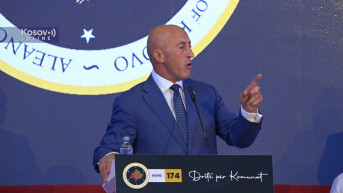
After 26 years at the helm of the Alliance for the Future of Kosovo (AAK), its first and only leader, Ramush Haradinaj, announced that he will no longer run for president of the party. Whether this move has come at the right moment as a tactical step that could position him, amid ongoing uncertainty over the election of Kosovo’s next president, to assume that office — or whether it is long overdue given the party’s poor performance in three electoral processes within a single year — remains a matter of debate. Interlocutors speaking to Kosovo Online cite both factors, while offering differing views on the party’s future.
Written by: Milena Miladinovic
In addition to the electoral results, Haradinaj cited the length of time he had spent in office as another reason for stepping down.
“The electoral process begins on 20 February. The novelty or change is that I will not run for president of the Alliance in these internal party elections. I have mentioned several reasons, and I will explain them to you as well. One reason is the long time spent in that position, the second is the electoral result. There is also the trust I have in the Alliance’s cadre,” Haradinaj said on 12 February.
On the same day, the Mayor of Gjakova and member of the AAK Presidency, Ardian Gjini, announced his candidacy for the leadership position and presented his program.
“We will work extremely hard to offer a political option that will return Kosovo to the right path,” Gjini wrote on Facebook.
Haradinaj told the media that he would not be a candidate for president of Kosovo, but that he would consider the possibility if requested by members of the Kosovo Assembly.
Support for Haradinaj in that regard came from party colleague Time Kadrijaj, who described his name as the most consensual option for president.
According to the analysts consulted, it is time for Haradinaj to step away from the party leadership, and they note that he has not always been consistent in his statements, suggesting it would not be surprising if he were to change his decision. When asked whether Haradinaj could become the next president of Kosovo, political observers say the decisive factor will be Prime Minister Albin Kurti.
As for the fate of the Alliance — a party that emerged from the Kosovo Liberation Army (KLA) in 2000 — without Haradinaj at its helm, opinions diverge. Some believe the party could consolidate under new leadership, while others argue it would struggle to pass the electoral threshold without him, and that new elections could amount to “political death” for AAK.
Time to Step Aside
Political science professor Basri Muja stated that it is time for Haradinaj to step down due to the poor electoral results over the past year, and that Ardian Gjini, whose candidacy has already been announced, is a good choice.
Muja told Kosovo Online that Haradinaj is unlikely to withdraw entirely from politics following his resignation and may continue to act as the party’s “unofficial” leader.
“It has long been discussed that Haradinaj would step aside from politics after these elections. I think this is more of a transition within the Alliance for the Future of Kosovo and that it is time for him to step away. The Alliance barely received just over five percent. I am certain that in the next elections it will struggle to reach that five percent needed to enter parliament. I assume this is more a tactical move, and I am not sure whether Haradinaj will truly withdraw from the political scene. I fear he will continue as the unofficial president of the Alliance,” Muja said.
He stressed that the party’s main problem is its limited geographic reach.
“The Alliance for the Future of Kosovo is a regional party, and Gjini is a well-known politician at both the central and local levels, having served two terms as mayor of Gjakova. He is educated and could be a good president. The Alliance’s other challenge is expanding into other regions of Kosovo, as being anchored in just one region is a vulnerability,” Muja added.
According to Muja, new elections would amount to “political death” for AAK, as it would likely fail to cross the five-percent threshold required to enter the Kosovo Assembly. Therefore, together with other parties, it will seek the best solution for the election of the next president of Kosovo.
“I believe Haradinaj and his party are interested in finding a solution that would prevent early elections, because they could mean political death for the party. I do not think this party could cross the five-percent threshold, and the Alliance is interested in finding a solution that would preserve its standing,” Muja concluded.
Inconsistent
Political analyst Ognjen Gogic emphasized that Haradinaj has not always been consistent in his statements and that it would not be surprising if he reversed his decision to step down as party leader.
Gogic told Kosovo Online that the Alliance for the Future of Kosovo has ended up on the political margins and is unlikely to survive without Haradinaj in a leadership role.
“It barely crossed the threshold, is not a significant factor in Kosovo’s political life, and does not have established leaders capable of succeeding Haradinaj. The party has no future, especially with four years of stable government under Albin Kurti ahead. It is possible that new leaders may emerge who could take over the Alliance, but it has been a leader-centric party, so it is unlikely to stand on its own without Haradinaj. However, Haradinaj is someone who is not consistent in his words; he is prone to political turns and has made more reversals than anyone else on Kosovo’s political scene, so it would not be surprising if he were to change his position,” Gogic assessed.
He added that Haradinaj’s announcement appears to be directed toward positioning himself as a potential candidate for president of Kosovo, as the Constitution stipulates that the president of Kosovo cannot simultaneously serve as leader of a political party.
“It seems more likely that he is presenting himself as an alternative in the discussion about who should be president of Kosovo. Haradinaj certainly has no alternative career. He will remain part of Kosovo’s political life in one way or another, regardless of the current moves he is making,” Gogic stressed.
Time for Consolidation
Miloš Pavkovic, Director of Strategy at the Center for European Policies in Belgrade, believes that under new leadership the Alliance for the Future of Kosovo will have time to consolidate before the next elections, while Haradinaj’s sudden withdrawal leaves room for him to become a candidate for president of Kosovo.
“As for the future, it will remain an opposition party with around six percent and a limited number of mandates, but given that there are unlikely to be new elections soon — as the government has just been formed — the party, under a new leader, will have time to consolidate,” Pavkovic told Kosovo Online.
He emphasized that AAK’s electoral result is not particularly poor compared to that of the Democratic Party of Kosovo (PDK) and the Democratic League of Kosovo (LDK).
“AAK won nearly six percent in the December elections, even though Fatmir Limaj left the party. That is a relatively solid result given their previous performance,” he said.
Pavkovic noted that the question remains why Haradinaj chose this moment to resign as party leader.
“Although there have been no announcements and he has denied negotiating over the presidency, Haradinaj has left the door open should such an offer arise. On the other hand, it seems that Kurti in some way owes a political debt to Vjosa Osmani, whose actions helped him secure an advantage in the December elections. Time will tell, but this kind of abrupt withdrawal from politics is not characteristic of Balkan politicians, suggesting that Haradinaj has left room for further political engagement,” Pavkovic said.
Regarding Haradinaj’s potential candidacy, Pavkovic added that the decisive factor will be Prime Minister Albin Kurti.
“It is difficult to predict at this stage whether and how he might be nominated. The president is elected by the Kosovo Assembly. He cannot nominate himself; he must be nominated by a group of MPs. Ultimately, it will depend primarily on Kurti’s assessment of his prospects with Vjosa Osmani. He will decide whether it is preferable to proceed with Haradinaj or perhaps with a third candidate,” Pavkovic concluded.



0 comments