
Kosovo in the "jaws" of transitional justice: Why is the anti-Serbian narrative on the rise?
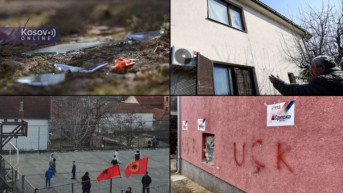
Ethnonationalism, anti-gender narrative, religious extremism, and anti-Serbian narrative in Kosovo are interconnected and on the rise, contributing to societal divisions, as reported at a regional conference in Pristina held at the end of last month. According to participants of Kosovo Online, the causes should be sought in the impunity of such behavior towards the Serbian community and the nationalist rhetoric that is still dominant in the public discourse in Kosovo.
Written by: Arsenije Vuckovic
In the study "Fighting Extremism in Kosovo: Trends, Challenges, and Countermeasures" funded by the Dutch Embassy and implemented by the NGO Sbunker, author Adelina Hasani assessed that ethnonationalism in Kosovo is a consequence of unresolved issues from the 1990s and war events, and that it dominates political discourse due to a lack of addressing transitional justice.
In just the first ten days of this month, several separate incidents targeting members of the Serbian community occurred in Kosovo.
In the latest, on February 10th, the Djoric family's house in Lipljan was stoned.
"It has happened before that they throw firecrackers, that they throw stones. My husband has reported it to the police and they have come, but nothing, they say they are small children, we can't do anything. This has been happening since the year 2000. Whether they are pressuring us because we are Serbs and in the hope that we sell the house...," Ljiljana Djoric told reporters from Kosovo Online.
She explained that before the war, 10,000 Serbs lived in Lipljan, but today there are only about 300.
"I work in a school, there is a very small number of students. We are all under pressure, not just our family, but everyone who has remained," Djoric explained.
In the yard of the primary school in the Serbian part of Orahovac on February 6th, flags of Albania and the former KLA were displayed, and on the same day on the wall of Nikola Jankovic's family home in Kosovo Kamenica, a graffiti "KLA" appeared.
"The house where I live in the village of Busince, connects two municipalities - Novo Brdo and the Municipality of Kosovo Kamenica. This morning when I went to work I saw that there are graffiti on the facade with the inscription KLA. Someone drew them. Also, they scratched the posters of the Serbian List. After that, I called the police and they came to our house, took statements and the case is under investigation," Jankovic told Kosovo Online.
He does not exclude the possibility that it was done because the President of Serbia, Aleksandar Vucic, baptized his son Lazar - the thousandth baby born in the maternity hospital in Pasjane.
Constant
Aleksandar Mitic, a research associate at the Institute for International Politics and Economy in Belgrade, believes that it is a "constant" in the treatment of the Serbian community in Kosovo.
"The anti-Serbian narrative that exists in the Albanian population in Kosovo and Metohija is something that is constant, something that led to the escalation of the crisis in the eighties, nineties, to conflicts and to the ethnic cleansing of Serbs from Kosovo and Metohija after June 1999, to the March 2004 pogrom. Of course, including the latest rounds of ethnic cleansing, primarily in the north of Kosovo and Metohija in recent years under the leadership of Albin Kurti. Unfortunately, this is something that is constant and we cannot say that this anti-Serbian narrative has just now emerged," Mitic stated for Kosovo Online.
Mitic points out that it's good that this issue is being highlighted, but he considers it a delayed reaction.
"This is a narrative that has been built among the broader Albanian population. Unfortunately, it will take a lot of time and effort to change it," emphasizes Mitic.
He specifies that "the Serbian question" currently serves political elites in Kosovo as a way to divert attention from other, far more significant problems.
"The issues that exist in Kosovo and Metohija, especially economic ones, are fundamentally important primarily for the Albanian population. The constant shifting of focus to threats coming from the Serbs, from Belgrade, especially in the last few years to threats supposedly from Russian disinformation or Serbian-Russian hybrid pressure has become very popular, primarily since 2022 in Albin Kurti's discourse," highlights Mitic.
Such a narrative, he stresses, cannot obscure the key problems in Kosovo.
"This is something that cannot mask the problems faced primarily by the economy in Kosovo and Metohija. The fact is that neither the USA nor the EU have managed to do enough to improve the economic situation in Kosovo and Metohija sufficiently to calm this rather extreme and anti-Serbian narrative," warns Mitic.
Ethnonationalism
On the other hand, Dragisa Mijacic, coordinator of the Working Group of the National Convention on the EU for Chapter 35, believes that the intensified anti-Serbian narrative is a result of ethnonationalism that has marked the tenure of current Prime Minister Albin Kurti.
"Ethnonationalism is the basis on which Kurti came to power. He certainly came to power in the Albanian electorate and on anti-corruption stances, but through his ethnonationalism, with unilateral actions in the north of Kosovo, he consolidated and reinforced his power in the electorate," Mijacic tells Kosovo Online.
He is convinced that if Kurti independently forms a government again, he will continue with policies that undermine interethnic relations in Kosovo.
He specifically points out four municipalities in the north.
"The current situation is truly unsustainable. We have special police forces, heavily armed, patrolling in municipalities with a Serbian majority in the north of Kosovo; we have Albanian mayors leading these municipalities. We are witnessing the destruction of institutions that have been built over the years, even institutions of interethnic cooperation. Such circumstances should not be forced in the coming period. Much will depend on who forms the government, but also on the international factor, which has been quite lenient towards all the moves this government has so far implemented," emphasizes Mijacic.
Impunity
For historian Aleksandar Gudzic from Gracanica, impunity is the key word in answering why the anti-Serbian narrative is on the rise in Kosovo.
"Kosovo Albanians have not been punished for their, to put it mildly, 'naughty' past," says Gudzic ironically in a conversation for Kosovo Online.
"They were not punished for open fascism and collaboration with Fascist Italy and Nazi Germany during World War II. But, they were not punished for the terrible and horrific violence committed against Serbs throughout the entire 19th century. This violence against Serbs carried out by Albanians is discussed in numerous reports from international diplomats who stayed in Kosovo and who were anything but favorable towards the Serbs," specifies this historian.
Commenting on the conclusions of the regional conference in Pristina, Gudzic believes that all non-governmental organizations and human rights activists in Kosovo are copying the German-French model and talk about reconciliation, but at the same time, they do not want to face the facts from the recent history of Kosovo Albanians about which there are written records and reports.
"The violence against Serbs during the 19th century is discussed in an Austro-Hungarian report. Austro-Hungary was anything but favorable towards Serbia and the Serbs. The suffering of Serbs during World War II by Albanian quislings is discussed in numerous Nazi reports, and Nazi Germany was certainly not favorable towards Serbia and the Serbs," reminds the historian.
He emphasizes that Albanians were not punished for the violence against Serbs during the 1990s, and then the expulsion of 200,000 Serbs in 1999.
The problem of impunity, he stresses, was most pronounced following the March 2004 pogrom.
"In the three-day pogrom against Serbs, more than 50,000 people, Kosovo Albanians, participated. This was ethnically motivated violence. For the pogrom against the Serbs, only a few hundred Albanians were sentenced to some prison terms," Gudzic points out.
He sees the solution in the strict sanctioning of all forms of nationalism and hate speech.
"Historical experience has shown that ethnically motivated violence pays off for Kosovo Albanians and that they will go unpunished for it. Because of this, the only way is for judicial institutions to respond to every form of nationalism and hate speech and to impose the strictest possible penalties on the perpetrators of these acts. Only in this way can we free ourselves from these forms of ethnonationalism and all forms of violence in the future," emphasizes Gudzic.


0 comments