
Kosovo's Goals in 2025: What is achievable?
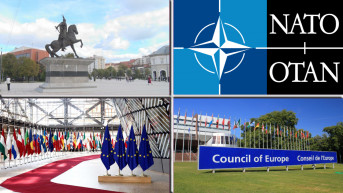
Entering the Council of Europe and NATO, as well as obtaining candidate status for membership in the European Union, remain Kosovo's goals for 2025. Considering the accession procedures, opening NATO's doors, and a new step in Euro-integration, these will be difficult to achieve, according to the evaluation of a Kosovo Online interlocutor, while lifting the barrier in the Council of Europe will remain tied to the issue of the Community of Serb Municipalities. All of this would be much easier if Kosovo could secure recognition from all EU states, or recognition from Serbia, which, according to one of our interlocutors, is actually Kosovo's fundamental goal.
Written by: Dusica Radeka Djordjevic
On the very first day of 2025, Kosovo's President Vjosa Osmani, congratulating Poland on taking over the presidency of the Council of the European Union, declared that it was time for Kosovo to be granted EU candidate status.
Kosovo's membership in the Council of Europe was highlighted as a priority by Foreign Minister Donika Gervalla Schwarz, while NATO membership tops the agenda for the opposition.
As a priority for Kosovo this year, DPK lawmaker Enver Hoxhaj views NATO membership, gaining new recognitions, and new memberships in international organizations. NATO membership is also imperative for Ramush Haradinaj, the president of the Alliance for the Future of Kosovo. He even promised that if he wins the elections, he would offer a plan for NATO membership within a year.
What from these ambitions is achievable?
Kosovo submitted its application for EU membership in 2022. According to political scientist Ognjen Gogic, the EU is unlikely to put the issue of granting candidate status to Kosovo on the agenda in 2025, in order to avoid divisions within the Union because a consensus of all member states is required, and five of them do not recognize Kosovo.
"For Kosovo, it is crucial to receive recognitions from non-recognizing states within the European Union and NATO. Primarily these states, and then all others. It wants to become a full member of the international community, and that can only happen when it also becomes part of the United Nations, and in that sense, the more immediate goal Kosovo aims for is recognition from Serbia. That is the fundamental goal to which Kosovo's Prime Minister Albin Kurti constantly points and about which he speaks very openly, that he wants a mutual recognition agreement, because he is aware that without Serbia's recognition, other states that do not recognize Kosovo won't either," Gogic stated for Kosovo Online.
However, as Kosovo is aware that it cannot obtain explicit recognition from Serbia, Kurti speaks about the need to sign the Brussels and Ohrid agreements from 2023, offering an interpretation to the international community that Serbia has finally recognized Kosovo, at least de facto.
Gogic believes that an alternative to Kosovo's goal of gaining recognition from Serbia is membership in international organizations such as the Council of Europe, NATO, UNESCO, and Interpol.
"During 2025, Kosovo will likely try to reactivate its attempt to enter the Council of Europe through its allies, although they have quite exhausted their credit with them. The goal is also NATO, but there is also the problem of non-recognizers, as Kosovo's admission requires consensus. For the Council of Europe, a two-thirds majority is sufficient, but it is not there either. These goals have always been present, such as entry into UNESCO and Interpol, but nothing has changed in favor of Kosovo and there is no greater willingness than before to admit Kosovo," our interlocutor assesses.
According to Blerim Canaj, a professor of political history in Pristina, Kosovo will continue to have the goals of membership in the Council of Europe and achieving candidate status for membership in the European Union this year.
Regarding the Council of Europe, he says, Kosovo will apparently have to send a draft statute of the Community of Serb Municipalities for assessment by the Constitutional Court.
"We all know that without this, there won't be much chance," Canaj stated for Kosovo Online.
Regarding entry into the EU, the path will be difficult and long because Kosovo still has many things to finish. Achieving candidate status for the EU is not feasible without the support of all member states, and the Serbian ambassador to Greece, Nikola Nedeljkovic, tells Kosovo Online that Greece, as one of the five non-recognizers of Kosovo within the European Union, finds this issue very problematic because
Athens has excellent relations with Belgrade.
He does not believe that Greece will move toward supporting Kosovo's independence in any way during 2025.
"Regardless of the fact that Athens and Pristina have raised the level of their offices to economic dimensions and there are attempts to elevate them to political ones, this does not change Greece's stance," says Nedeljkovic.
"Greece, as I see it, will maintain the same stance during 2025 and I believe it will continue to be very friendly towards Serbia," Nedeljkovic says. Greek-Serbian relations, he adds, are based not only on the centuries-old friendship between the two peoples but also on political relations at the highest level between Serbian President Aleksandar Vucic and Greek Prime Minister Kyriakos Mitsotakis.
"Also, the Cyprus issue, which still burdens the Greek people, as well as the church's stance on the issue of Kosovo and Metohija, do not allow the Greek political establishment, which is also under constant public pressure, to take any steps that would imply independence for Kosovo and Metohija and support within the European Union for this issue. Historically, the two peoples have been friendly, the policies are at the highest level, the churches are at a very high level of cooperation. So, I do not believe that Greece will support Kosovo and Metohija in any way during 2025," Nedeljkovic notes.
Regarding the Council of Europe, Kosovo has made significant progress last year because the Parliamentary Assembly of the Council of Europe adopted the report by Dora Bakoyannis recommending its admission, but it stalled at the Committee of Ministers. In it, all 46 member countries are represented, and a decision to admit a new member requires a two-thirds majority, or the votes of 31 states.
The formation of the Community of Serb Municipalities was one of the three original conditions set by Bakoyannis for Kosovo's admission to this organization, and according to Dunja Simonovic Bratic, a member of the Serbian delegation in the Parliamentary Assembly of the Council of Europe, if in 2025 there were only a formal submission to the Constitutional Court of a draft statute for the CSM, it would not mean that the CSM issue is concluded, as what follows must be its implementation and elaboration on the ground.
If Pristina, after the upcoming elections in Kosovo, submitted a European draft statute to the Constitutional Court and if subsequently, within the Committee of Ministers of the Council of Europe, the necessary majority were reached for a decision on Kosovo's admission, this body could vote on it in May or at the end of the year when regular meetings of the Committee are held. However, Simonovic Bratic points out, an extraordinary meeting could also be scheduled if Kosovo's allies were very eager to help.
She emphasizes that there is currently an intention to help Albin Kurti win the elections by providing Kosovo with the status of a special guest in the Council of Europe, considering that this decision is made in the Parliamentary Assembly of the Council of Europe, not at the Committee of Ministers.
"This is the status of countries that are on the way to admission to the European Union or to the Council of Europe, but still have the status of states. As such, they cannot vote in the Parliamentary Assembly, but they can participate in committees, submit resolutions or amendments, and actively participate in the work of groups and committees," Simonovic Bratic stated for Kosovo Online.
The plan, she says, is to try to secure this status for Kosovo during the January session of the Parliamentary Assembly of the Council of Europe, as it concludes just before the elections in Kosovo on February 9.
Simonovic Bratic assesses that Pristina will certainly strive to finalize entry into the Council of Europe during 2025, but as she reminds, even during 2024, it was thought that this was a done deal, but Serbian diplomacy and leadership contributed to keeping Kosovo out of this organization.

0 comments