
Kurti remembered the UN Resolution 1244; what is happening in Pristina?

Kosovo Prime Minister Albin Kurti did something today that few expected of him; he mentioned the implementation of Resolution 1244 of the UN Security Council and asked KFOR if there might have been a violation of it during yesterday's arrest of three members of the Kosovo Special Forces by the Serbian police. The arrest of the Special Forces took place on the territory of the Raska municipality, but Kurti claims that everything happened on the Kosovo side of the administrative line, and although he does not offer any evidence, he angrily stated that he expected a reaction from KFOR.
According to Resolution 1244 of the United Nations Security Council and the Kumanovo Military-Technical Agreement, KFOR is the only legitimate armed formation in Kosovo, tasked with maintaining peace and security, but this mission still refuses to take control in the north, despite the crisis caused by the violent actions of Pristina, the invasion of municipal buildings by the Special Forces, the imposition of illegitimate Albanian mayors and the groundless arrests and beatings of the Serbs, has entered its third week, according to the interlocutors of Kosovo Online.
They add that the importance of the mandate given to KFOR by these documents is perhaps more important today than ever and they say that it is high time that directives came from the political headquarters of NATO and the Western power centers for this Mission to take control of security in the north.
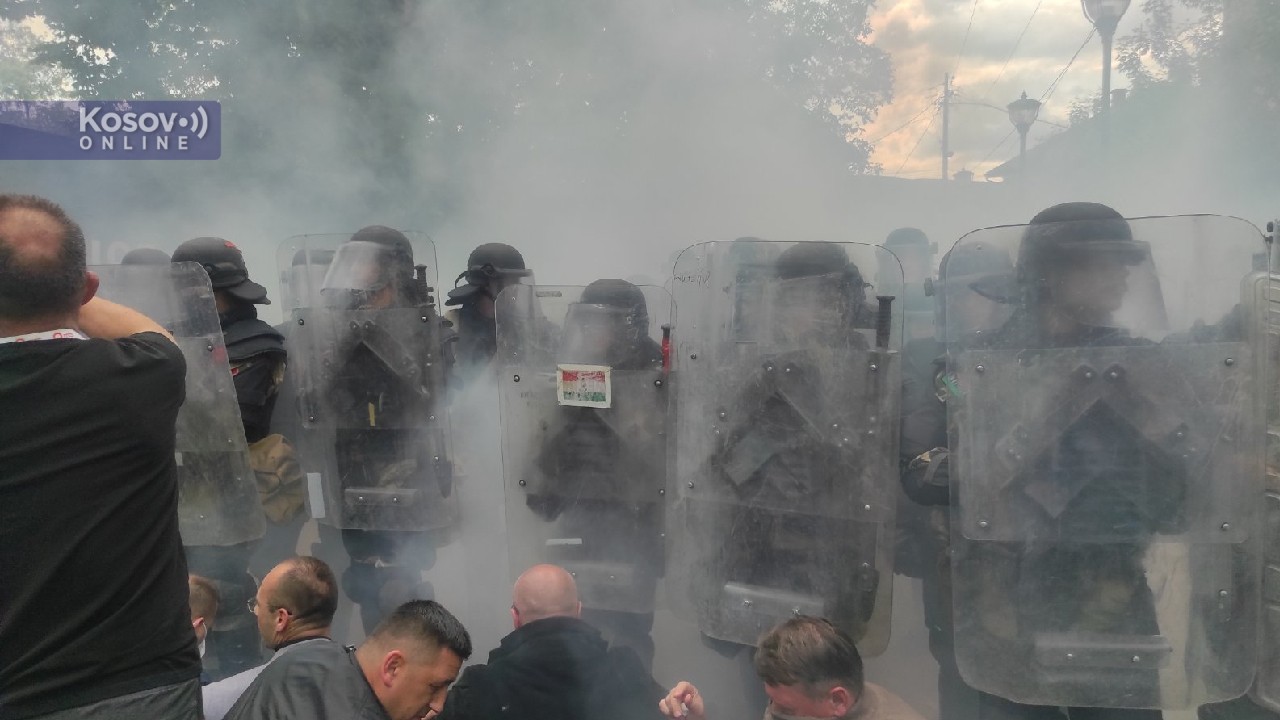
For now, they note, KFOR more or less played the role of "observer" in the last crisis. It keeps “in a circle” the municipal buildings that were invaded by Kosovo Special Forces with tear gas and batons in order to impose illegal mayors elected in elections that were boycotted by the Serbs and in which the turnout was about 3.5 percent.
They also add that they watched without reaction the arrests of the Serbs, and even the last action of the Kosovo police in North Mitrovica, which held random passers-by at gunpoint with long guns while they arrested prominent athlete Milun Milenkovic Lune.
Official Belgrade asked KFOR and the international community to conduct an investigation into the case, stressing that they would provide all the evidence that neither Resolution 1244 of the UN Security Council nor the Military-Technical Agreement had been violated because the Kosovo police officers had been arrested deep in the territory of central Serbia in the area of the village of Gnjilica.
Nemanja Zavisic, an analyst at the Center for Social Stability, tells Kosovo Online that "by arresting Kurti's terrorists, the state of Serbia showed above all its seriousness".
"The Serbian Army and police are fully ready, capable, and motivated to carry out any task that is put before them. The President said that he would provide KFOR with evidence that the arrested persons had been in the territory of central Serbia, almost two kilometers from the administrative line. it is clear that these are people who were sent on a mission, i.e. to scout the position and capacity of our forces. This is proven, among other things, by the equipment that was found with them on that occasion. No normal person can believe Kurti's nonsense about some kind of "kidnapping" on the territory of the province, nor does he provide any evidence for those claims. The fact that Kurti is now even referring to Resolution 1244, that is, pointing to its violation by Belgrade, shows the kind of madness on the Albanian side," Zavisic says.
He adds that "however hypocritical it may sound, it is still good to hear from Kurti a public acknowledgment that Resolution 1244 is a valid international legal document."
"I appeal to KFOR to persuade him to respect the sources of rights that he himself refers to," Zavisic says.
He reminds that according to Resolution 1244, KFOR is the only legal armed military force in Kosovo, which has the basic task of ensuring the safety of all citizens in the province.
"KFOR received that mandate from the UN Security Council and has all the necessary capacities at its disposal for its execution. Therefore, it is only a matter of political decision, i.e. the presence or absence of the will to confront Kurti's terrorists and protect the Serbs from violence. At the same time, it should be recalled that at the end of last year, President Vucic made a formal request to enable the return of a part of our armed forces to the territory of Kosovo and Metohija, which is foreseen by the aforementioned Resolution 1244. Unfortunately, that request was rejected, and accordingly, it is completely clear that KFOR thereby took full responsibility for the security situation in the province," our interlocutor says.
The dramatic events on the ground that we have witnessed in recent days, Zavisic points out, have shown that KFOR is completely biased and that it clearly has no intention of carrying out its mission.
"Unfortunately, the fact is that we could even see the assistance of international forces to Kurti's terrorists in arresting and persecuting the Serbs. The verbal condemnations that the West directed at Kurti in the previous days really seem tragicomic. While he beats, arrests, and holds people at gunpoint, the EU threatens him by canceling meetings. At the same time, even those statements are generally not accompanied by activities on the ground, thus losing any real value. All this tells us that the political West will not give up on its project of creating a 'state of Kosovo' and that we are, as was often the case in history, left to our own devices in this fight. None of us can be so naive as to believe that Kurti is doing all this completely on his own," Zavisic believes.
According to him, in the political sense, the Quint countries are the most responsible for these events.
"We have had the same matrix for years. Albin Kurti announces some moves, we get guarantees from the West that this will not happen and that they will react, and when he makes those moves, we only get verbal condemnation. The preservation of peace is threatened, and it is in the hands of the Quint countries. The onus is on them to keep the peace and how far they will allow Kurti to go," he says.
Retired major-general Mitar Kovac says that until now KFOR has unilaterally approached the entire crisis in the north of Kosovo and that it is high time that the political headquarters of NATO and the Western centers of power arrived at a different approach to the mission, which he reminds, according to the Resolution 1244 of the Security Council has a clear mandate to ensure safety and security in Kosovo and Metohija.
"I think a desirable situation would be one that would return KFOR to its mandate and keep in force Resolution 1244 in terms of the ban on the stay of Kosovo Security Forces and ROSU units, as well as members of paramilitary formations that are increasingly appearing in the north of Kosovo in civilian clothes. That way guarantees peace to the Serbian population and can create normal conditions for the formation of Serbian institutions in the north and the return of Serbian representatives to all government bodies. That would be the desired scenario," Kovac said.
He believes that KFOR will require the central authorities in Kosovo to withdraw all forces that are illegally and illegitimately staying in the north of Kosovo in order to prevent further usurpation of the basic democratic rights and freedoms of the Serbs.
However, he warns that if KFOR continues to be biased towards Pristina, there is a risk of escalation of the crisis, because the Serbs have no other choice but to fight for their basic democratic rights by all legitimate means.
When asked what would encourage KFOR to react immediately, Kovac points out that the change in the attitude of America and the leading NATO countries towards the Pristina authorities would contribute to this.
With that, he points out, an instruction would be given through the institutions of NATO and the EU to curb the illegitimate behavior of Pristina and to curb their terror against the Serbs.
"Unfortunately, KFOR does not receive a firm and precise position from Germany, France, and Great Britain and that mandate of KFOR is now in a sense a support of the authorities in Pristina. They are tolerated as they have been tolerated until now. This is a kind of inertia of NATO relations - and towards the state, they created in 1999. This is a permissive relationship, regardless of the fact that the authorities in Pristina are behaving arbitrarily," Kovac concluded.
The former dean of the Faculty of Security, Radomir Milasinovic, told Kosovo Online that KFOR refused to take control of security in the north of Kosovo because it did not have independent authority, but waited for instructions and orders from headquarters.
He clarifies that KFOR cannot only be thought of in the context of the situation on the ground but the broader picture created by "some from headquarters", that is, NATO and the US, should be looked at. KFOR, he says, has so far done everything contrary to what is contained in the document of the UN and the international community.
"We must be ready for anything. Those who manage KFOR and monitor the security situation in Kosovo experimented on us in 1999, and I'm afraid that's the case even now," Milasinovic says.


0 comments