
Kurti in a "technical mandate" until 2026: Who benefits the most from this scenario?
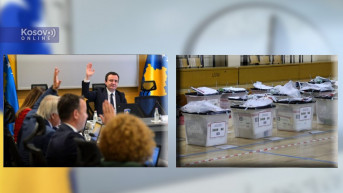
The political deadlock following the February elections in Kosovo has resulted in two possible outcomes: the formation of a new government or new snap elections. However, the leader of the Democratic League of Kosovo (LDK), Lumir Abdixhiku, has proposed a third option—Albin Kurti could remain in power under a "technical mandate" until next year. As absurd as it may sound, due to the upcoming autumn elections and the presidential election early next year, such a scenario would benefit both the Self-Determination Movement (The Self-Determination Movement) and the opposition. A new government with a "thin majority" would not last long anyway, sources told Kosovo Online.
Written by: Djordje Barovic
"With a destructive and obstructive stance on institution formation, we could reach March 2026 with a government in a temporary setup. Theoretically, the election winner can block the Kosovo Assembly, and practically, this has already happened in previous cases in Kosovo," said the president of the Democratic League of Kosovo.
He added that the election winner can theoretically block the Kosovo Assembly, and this has already occurred in practice.
"There are two automatic triggers that lead to elections: the failure to elect a president and the failure to adopt a budget," Abdixhiku stated.
Other opposition parties share a similar view.
"On February 9, citizens passed a democratic test by exercising their right to vote. Since February 10, outgoing Prime Minister Albin Kurti, backed by outgoing President Vjosa Osmani, has been using state institutions to create unjustified delays. These delays are intentional and political. Such postponements only benefit Kurti, as his government operates freely without an oversight mechanism represented by the Kosovo Assembly," said Democratic Party of Kosovo (PDK) member Artan Behrami.
Former Ambassador Gezim Kasapolli offers another perspective.
"There is a tendency for everyone to hide behind mandatory processes, such as result certification… This is all done with a purpose, as it matters who dares to form a government due to the obligations that come with it," Kasapolli warned, adding that the statement by the EU ambassador to Pristina, Aivo Orav, that the Union wants a stable government is merely wishful thinking.
Obstruction Mechanisms
Assistant Professor at the Faculty of Political Sciences in Belgrade, Stefan Surlic, doubts that Kurti could extend his "technical mandate" until next year.
However, he has no doubt that there are numerous mechanisms available to delay the rapid formation of a new Kosovo government.
"I don’t think a technical government until March 2026 is a realistic scenario, but it is clear that Albin Kurti and the Self-Determination Movement are not in favor of quickly forming a government. They have many mechanisms through which they can obstruct the swift and efficient establishment of a majority coalition and government. Primarily, based on the Constitutional Court’s 2014 decision, the Speaker of the Assembly must be elected first, which then allows the president to give the mandate to form a government—first and foremost, to someone from the party that won the most votes," Surlic told Kosovo Online.
As possible obstruction strategies, past experiences are cited where the holding of a constitutive session or the election of the Assembly Speaker was deliberately prevented.
"According to the Constitutional Court's decision, as long as the Assembly is not constituted and as long as there is no Assembly Speaker, the president cannot grant the mandate or allow any candidate to form a government," Surlic emphasizes.
He is convinced that the Self-Determination Movement can use this method to delay the post-election process for several months at most.
"I wouldn't say it can last for a year, but it can certainly delay the process for a few months. However, the question is how long this benefits Kurti and whether prolonging the process could trigger a negative reaction, especially among his own voters, leading to a much worse outcome in a potential repeat election," Surlic states.
He describes the current situation in Kosovo as a “political stalemate”. He notes that the Serb List could act as the deciding factor, but such a coalition would be the least favorable option for The Self-Determination Movement.
"Right now, there's a deadlock between The Self-Determination Movement and the opposition parties, which have formed a kind of 'anti-Kurti' invisible coalition, but they struggle to reach an agreement on forming a government. The final election results show that without the Serb List, The Self-Determination Movement does not have enough votes. There is a possibility of forming a very slim majority with Nisma and other non-majority communities, but this is not an option Kurti prefers," Surlic explains.
He points out that forming a minority government is not a viable option for The Self-Determination Movement, as it would make it harder to implement their policies while giving smaller coalition partners "blackmail potential."
"Kurti is well aware that he cannot implement his policies with a very slim majority in parliament, and that smaller coalition partners would have significant leverage. Therefore, prolonging the process until a new election is the ideal scenario for him," Surlic clarifies.
The People’s Message
Former Central Election Commission President Mazlum Baraliu, however, does not believe in the possibility of a technical government. He stresses that the people sent a message in the February elections that neither the ruling party nor the opposition did enough to earn the right to govern alone.
"The people told both the government and the opposition that they had not worked hard enough to deserve to govern alone, as The Self-Determination Movement had planned by securing more than 50% of the votes. Nor can the opposition take over the government collectively. This is why we have a deadlock. The voters decided this, and both the winning party and the opposition must act accordingly," Baraliu told Kosovo Online.
He recalls that both the ruling coalition and the opposition parties tried to convince voters in Kosovo and the diaspora that they were capable of forming a government independently.
"However, they failed," Baraliu points out.
He doubts that Albin Kurti could prolong the process and remain in a technical mandate until next year.
"A technical government is not a solution because it will not be accepted. We have a winner, regardless of the percentage. Forty-two percent is not a small number. The Self-Determination Movement will try to form a government on its own, as there is no other way. I don’t think the people or the international community, which has strong influence, will allow such an outcome," Baraliu asserts.
He sees the solution in the election “winning team” attempting to form a new government “in the spirit and in accordance with” the Constitution and election laws.
"If that is impossible—which I actually believe will not be the case—there will be an attempt to gather enough MPs for a so-called minority government rather than a technical one. But will it be stable? No. Will it be legal? Certainly," Baraliu concludes.
The Strategy of a “Thin Majority”
On the other hand, historian Stefan Radojkovic believes that it is not unrealistic for the current Kosovo government to continue in a technical mandate, as both the opposition parties and The Self-Determination Movement are aware that any future government would be based on a “thin majority.”
"None of the political factions among Kosovo Albanians achieved the result they had hoped for. Kurti won, he received the most votes, but not enough to form a government on his own. On the other hand, the Albanian opposition won more votes collectively, but still not enough to form a stable majority if they were to establish their own government within Kosovo’s provisional institutions," Radojkovic told Kosovo Online.
He says that all parties are waiting for the CEC report on the exact number of seats won and that only after that will they “formulate a strategy for the next steps.”
"However, since not only are local elections approaching this fall in the municipalities, but also the election of the president of the provisional Pristina administration, they all know that a thin majority—somewhere around 50 percent plus one, two, or three MPs—is not enough to convincingly elect the president of these institutions next year. In this sense, it seems that everyone is content with the current balance of power; the opposition has no major issue with waiting to see how things unfold, and Kurti himself has no strong desire to speed up this process, at least not until the CEC announces the final results," Radojkovic explains.
He points out that a technical government could result from procedural obstructions.
"According to their Constitution, there are ways to obstruct the work and election of a new cabinet, and Kurti could specifically employ these tactics since he still won the most votes and holds the highest percentage. This means that the Speaker of the Assembly would have to come from The Self-Determination Movement. By delaying the election of such a person, he could stall the process indefinitely," Radojkovic emphasizes.
0 comments