
Letter to the Council of Europe: Guarantee for the CSM or a new farce - How much is Kurti's signature worth?
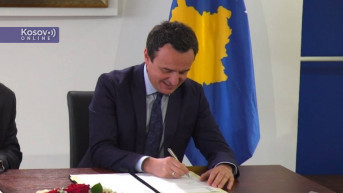
More than a year ago, Kosovo's Prime Minister Albin Kurti promised at a meeting in Brussels to form the Community of Serb-majority Municipalities, and since then, he has repeatedly stated that something is binding only when signed. In a letter to Dora Bakoyannis, rapporteur for Kosovo's membership in the Council of Europe, Kurti recently reiterated his promise of the CSM 'as soon as possible,' this time with a signature. However, few believe he will fulfill the promise, especially the Serbs in Kosovo, while for political analysts, this move confirms his double strategy since taking office.
“In your letter dated March 21, 2024, you offered us 'proposed commitments that Kosovo will have to fulfill when it becomes a part of the Council of Europe.' Your correspondence shows that this list, requiring a response from Kosovo's state institutions, is an integral component of our application process and represents an important step in Kosovo's full membership in the Council of Europe,“ the letter signed by Kurti, President Vjosa Osmani, and Parliament Speaker Glauk Konjufca states, submitted just a day later.
In the appendix attached to the letter, they promised to take 'significant and tangible steps' to implement all the provisions of the Brussels-Ohrid Agreement, including the prompt establishment of the Community of Serb-majority Municipalities.
It was suspected to be a double game as soon as the letter became public. The head of the Self-Determination parliamentary group, Mimoza Kusari-Lila, immediately addressed the voters, claiming that 'the letter is nothing more than a formality.'
Slobodan Stosic, program manager of the NGO Advocacy Center for Democratic Culture from North Mitrovica, says that after such a statement, the ruling coalition will treat that letter accordingly.
“We will not receive any guarantees or consequences after that letter,“ he said to Kosovo Online, emphasizing that for the Serbs in Kosovo, to whom the CSM was promised for the first time 16 years ago, Kurti's signature meant nothing anymore.
"In theory, the signature of an official should be worth a lot, but considering the experience we all know, what happened with the CSM and other obligations from the Brussels agreement, I don't know how much trust the people living here can have in such a statement. His signature, especially among non-majority communities, especially Serbs, is not taken seriously, and they do not think that anything will be resolved by that signature," he says.
Our interlocutor states that Kosovo's entry into the CoE should be conditioned on the formation of the CSM.
"Although I hope for it, I do not expect its formation in the near future. Maybe this year the CSM statute will be submitted to the Constitutional Court for a review of its constitutionality. That is something I expect, and the formation itself will be a lengthy and painful process for both sides," Stosic believes.
Unlike him, an analyst from Pristina Afrim Hoti assesses that the letter of Kosovo leaders to Dora Bakoyannis confirms their readiness to fulfill all the requirements of the international community for accession to the Council of Europe membership, but on the other hand, he also does not believe that the formation of the CSM can happen soon, at least not before the elections.
Hoti states for Kosovo that the decision to return the land to the Visoki Decani Monastery was "somewhat like a precondition for obtaining membership in the Council of Europe."
"It is obvious that with the recent decision of the Kosovo government to give land to the Serbian Decani Monastery, Kosovo has already formally fulfilled the requirement for accession to the Council of Europe. In other words, the letter sent by Kosovo leaders only confirms the readiness of the Kosovo authorities to meet all requirements and to declare themselves as a country that wants to be part of democratic processes and respect for human rights," Hoti says.
When asked about when the formation of the CSM can be expected, Hoti mentions that it is the "most complex requirement" for which he is not optimistic.
"I am quite pessimistic about this issue. I don't think the Association will be formed soon. Perhaps in light of membership in the Council of Europe, it is crucial to start this process. If the authorities in Pristina start the formation, I think that would be the most significant step towards Council of Europe membership," the analyst from Pristina says, adding that it would cost the government of Albin Kurti the elections.
"The formation of the Serbian community would affect the upcoming elections, so I don't think the Association will be addressed before the elections in Kosovo," Hoti concludes.
Dimitrije Milic, the Program Director of the organization "New Third Way," says that the promise made by the three Kosovo leaders ahead of the vote in the Political Committee of the Parliamentary Assembly of the Council of Europe to fulfill all international obligations, including the formation of the Community of Serb-majority Municipalities, was their desire to demonstrate a form of general political will, however, it remains a question whether they will deliver on what they promised, and he says that it still depends on Western pressure.
“The goal was to send a positive message before the elections. Of course, whether it will be realized is another question, but it was, I assume, a desire to demonstrate a form of at least general political will. On the other hand, if they wanted realistic implementation, two things should be considered. On the one hand, the extent of Western pressure and, on the other hand, to what extent Kurti wants to test his capacities. In terms of how far he wants to test the readiness of the West to give him some form of approval for his actions," our interlocutor notes.
This action, as he adds, has faced condemnations but still insufficient condemnations to make Kurti change his political position.
"If we look at some opinion polls that are available, we can see that Self-Determination definitely has lower support than it did in the 2021 elections. So, there are some effects of Western condemnations on Kurti's government. Probably there are also economic issues because due to weak economic indicators, the government has a bigger problem than it does in the foreign policy sphere, where there is much greater support for its actions," Milic assesses.
Regarding the implementation of obligations before the international community and the formation of the CSM, Milic says that it "predominantly depends on Western pressure."
"I believe that currently the West, due to its dispersion across various parts of the world, dealing with issues such as Gaza, the war in Ukraine, and tensions in the South China Sea, is not able to allocate enough political capital and attention to invest in this issue. They are trying to somehow address this issue in passing along with all the other issues happening. So, the Kosovo issue is quite intertwined with Western attention, and that Western attention is linked to general international developments and instabilities in the world that divert attention to much more critical issues because there are much larger regions with much larger populations, threatening many more states currently of higher priority. Therefore, I assume that there is no further focus on this issue," Milic concludes.

0 comments