
New local authorities and old decisions: What can the Serbs in the north change, and what will remain under Pristina’s control?
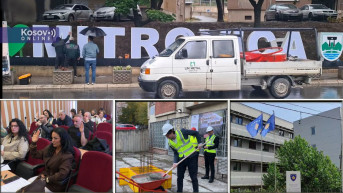
Following the recent local elections in northern Kosovo, one of the key questions has become which decisions made by previous administrations can be annulled once Serbs return to local institutions. Among the most controversial are those touching on issues of identity — from street names and municipal symbols to the transfer of municipal land to central institutions in Pristina. Analysts warn that many competences have, in the meantime, been transferred to the central level of government, leaving open the question of how much real autonomy the new local administrations will have.
Written by: Petar Rosic
Outgoing mayor of North Mitrovica, Erden Atiq, together with acting ministers Xhelal Sveçla and Elbert Krasniqi, laid the foundation stone on Tuesday for another school in North Mitrovica.
Nemanja Biševac, a member of the Presidency of the Serb List, said that Atiq had unlawfully changed the purpose of the land and announced that, following the Serb List’s victory, all decisions harmful to the citizens — including this one — would be revoked.
The school project is only one in a series of decisions that, according to the Serb List, were not in the interest of the local Serbian population. After the renaming of streets, removal of signs reading “North Mitrovica,” and the construction of police stations, another foundation stone was recently laid — this time for a regional office of the Kosovo Tax Administration.
The Serb List had already pledged before the elections that all “disputed” decisions made under Albanian mayors would be annulled. The newly elected mayor of North Mitrovica, Milan Radojevic, reiterated this promise shortly after the outgoing assembly decided to rezone ten plots of municipal land in the Suvi Do settlement from agricultural to construction use.
“It is interesting that all these requests came from Albanian representatives, which directly affects the change of ethnic composition not only in Suvi Do but in North Mitrovica as a whole. All decisions made to the detriment of the majority of citizens of North Mitrovica will be reviewed by the new administration and municipal assembly, which have full legitimacy, and any that are unlawful or contrary to citizens’ interests will be annulled,” Radojevic stated.
However, analysts point out that this will be a complex process in practice, as many competences have since been shifted to Pristina’s central authorities.
Aleksandar Sljuka, from the NGO New Social Initiative, told Kosovo Online that while the intention will be to reverse problematic decisions, it remains uncertain how feasible that will be, given the increased institutional control established by Kosovo authorities in the north.
“I’m primarily referring to institutional oversight of local governments, which falls under the Ministry of Administration and Local Government,” he explained.
Sljuka noted that while local issues should, in theory, fall exclusively under local jurisdiction, in reality, even minor decisions will likely be subject to central oversight and challenge.
“I believe the new administration will focus on decisions related to symbols and identity — restoring the ‘Kosovska Mitrovica’ sign, bringing back the municipal coat of arms, or repainting murals that were previously removed. Many of the changes will be symbolic,” Sljuka said.
He added that some negative practices of the previous administration would likely end automatically with the arrival of new mayors.
“Those excessive inspections of cafés, private clinics, and similar establishments will probably stop once the new local administration takes office,” he noted, while also cautioning that Pristina would still retain supervisory powers.
“The Ministry of Administration and Local Government, and even the Ministry of Interior or Kosovo Police, could decide, for example, that something incites national intolerance or violates Kosovo’s constitutional order,” Sljuka warned.
He added that the Serbian community wants to express its identity — even through symbolic acts like murals — but cautioned that citizens should not expect major changes overnight.
“These matters will still formally fall under local jurisdiction, but with central oversight. This won’t affect areas such as the police or judiciary, where Serbs have yet to return to institutions. People should not have excessive expectations, though small steps may be possible,” he concluded.
Political analyst from Pristina, Nexhmedin Spahiu, agreed that decisions within municipal jurisdiction could be annulled if found illegal, emphasizing that courts play a decisive role in such matters.
“Any municipal decision may be revoked if the law allows it. That is up to the municipal assembly or the mayor. However, decisions such as property sales cannot be reversed if made in accordance with the law — but others can be,” Spahiu explained, adding that if illegality is suspected, it is up to the courts to decide.
“If something is unlawful, the court can annul it — every illegal act can be overturned by the judiciary,” he underlined.
On the other hand, Duško Celic, assistant professor at the Faculty of Law in North Mitrovica, said that the return of Serbs to local self-government was good news — but not cause for euphoria.
“The damage inflicted by the illegitimate Albanian majorities and mayors in the northern Serbian municipalities of Kosovo and Metohija, I’m afraid, is irreversible. What is positive is that local governments will no longer adopt decisions harmful or discriminatory toward Serbs. But expecting that the existing damage will be repaired is unrealistic,” Celic told Kosovo Online.
He believes that acting Prime Minister Albin Kurti anticipated the change and prepared for it.
“Kurti expected this and prepared accordingly. Three years ago, a law was adopted that further centralized power in favor of Pristina, meaning that any significant decision will now require approval from one of the ministries — primarily the Ministry of Local Government. In that sense, I’m not optimistic,” Celic said.
He stressed that it was important to annul all decisions that harmed the Serbian community, of which there are many.
“There were numerous such decisions. The most important thing, in my opinion, is to review whether it’s possible to reverse the transfers of municipal land to central institutions in Pristina — to the Ministry of Interior or other ministries. It’s also important to restore the original street names that reflected the will of the Serbian majority and community in the north. And it would be good to bring back local and national symbols to which Serbs are entitled, even under Pristina’s quasi-legal framework,” Celic concluded.



0 comments