
New question for Constitutional Court: What needs to be clarified, and could waiting for a ruling push back the date of possible elections?
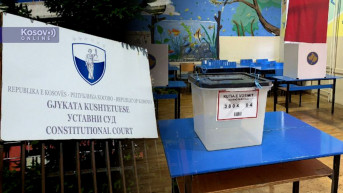
If Kosovo does not elect a new President in the final hours of the deadline set by the Constitutional Court, further political developments in Pristina could once again be shaped by that institution. Acting President Albulena Haxhiu has already said that she is considering referring the matter to the Constitutional Court if Kosovo fails to elect a President with a full mandate, while Kosovo Online’s interlocutors believe that there are several gaps in the legal framework that the judges could be called upon to “fill.”
Written by: Dusica Radeka Djordjevic
Merely referring the matter to the Constitutional Court would probably not bring the date of possible elections closer to the timing preferred by Self-Determination, according to Kosovo Online’s interlocutors. However, they do not rule out the possibility that the party could find a creative way, or resort to political voluntarism, to have elections held at a time that suits it best.
Under the latest decision of the Constitutional Court of Kosovo, issued at the request of Democratic Party of Kosovo MPs, the deadline for electing the President is October 6. If the President is not elected by then, snap elections must be held within 45 days.
Acting President of Kosovo Albulena Haxhiu has raised the possibility of making a new referral to the Constitutional Court, with a new question, if MPs fail to elect a new President. She said her question would concern her mandate as Acting President, since the Constitution provides that the office of Acting President may not be held for longer than six months.
Haxhiu became Acting President on April 4, when the mandate of then-President Vjosa Osmani expired.
The Kosovo Democratic Institute also addressed the issue several days ago, pointing out that the Constitutional Court’s latest decision had not sufficiently clarified the exercise of presidential duties by an Acting President after the six-month period expired.
Vullnet Bugacku of the Institute said that Article 90 of the Constitution used clearly restrictive language and established a maximum period of six months for the exercise of presidential duties by an Acting President.
“This means that this provision is mandatory and does not allow either the function or the time limit to be extended,” Bugacku said.
Political scientist Ognjen Gogic said that the unresolved questions surrounding the Acting President’s mandate included whether Albulena Haxhiu could continue serving as Acting President after October 4 and whether her election as President of the Assembly had triggered a new six-month period. The answers were important, he noted, because it was the President or Acting President who would have to dissolve the Assembly if it failed to elect the President of Kosovo within the deadline set by the Constitutional Court.
“The first open question is whether Albulena Haxhiu can continue serving as Acting President of Kosovo after October 4, because one interpretation is that this position can be held for no longer than six months, and that period expires on that date. Strictly speaking, the constitutional provision containing that rule concerns a situation in which the President is temporarily unable to perform the duties of office, rather than a situation in which a President has not been elected, and that creates a potential gap. The main question is whether the six-month limit applies at all when a President has not been elected, or whether it applies only when the President is temporarily unable to exercise presidential powers,” Gogic told Kosovo Online.
The second question the Court could consider, he said, was whether the six-month period was final or could be renewed.
“Specifically, Albulena Haxhiu was re-elected President of the Assembly in early September, while the office of Acting President of Kosovo is attached not to the individual but to the office. If someone else, for example, had been elected instead of Haxhiu, the question would be whether that person would then have a new six-month period. Another question is whether her re-election as President of the Assembly started a new six-month cycle and whether that time limit even applies to the situation in which Kosovo currently finds itself. This is highly significant because it is the President or Acting President who must dissolve the Assembly if it fails to elect the President within the deadline set by the Constitutional Court,” he said.
Nevertheless, Gogic added, it would be completely counterintuitive to assume that the Constitution and the Constitutional Court envisaged any situation in which the office of President could remain vacant, since the Constitution vested certain powers exclusively in the President.
“It would make no sense for the Constitutional Court to say: ‘No, nobody can perform this function any longer because the six-month period has expired.’ That would mean that some powers assigned to the President could not be exercised at all,” Gogic said.
One possible development—and what he believes Haxhiu may be seeking to achieve—is for the Court to impose an interim measure while considering her referral, should she submit one, suspending the work of the Assembly and thereby stopping the clock on the deadline for electing the President.
“However, that is an unrealistic expectation because the Constitutional Court has previously imposed interim measures only where further action could cause irreparable harm. Here, the Constitutional Court itself defined October 6 as the deadline for electing the President, and it would be contradictory for the Court now to suspend that deadline for some other reason. This is therefore probably merely a political maneuver to test the waters. If Haxhiu had genuinely been uncertain and genuinely intended to submit such a referral to the Constitutional Court, she should have done so much earlier so that the Court could have assessed in good time whether she could dissolve the Assembly,” Gogic said.
Aleksandar Rapajic, Program Director of the North Mitrovica-based NGO Advocacy Center for Democratic Culture, said that if Acting President Albulena Haxhiu referred the question of her mandate to the Constitutional Court, the Court would respond quickly by allowing the President of the Assembly to continue performing the duties of President of Kosovo until a President was elected.
Rapajic said that the rules provided for the President of the Assembly to perform the duties of President of Kosovo for a maximum of six months, on the assumption that a President would be elected during that period, leaving a legal gap for a scenario in which no President was elected.
“We now clearly have a situation in which the President has not been elected, and there is uncertainty over what happens in such circumstances. Does one person continue to perform the duties of President, or should someone else be selected to perform that function? I believe the Constitutional Court will answer this question very quickly simply by extending the mandate of the President of the Assembly to allow her to perform the duties of President of Kosovo until a President is elected, as is also the case under the legislation of many other countries,” he told Kosovo Online.
Could calling elections be delayed?
Another possible referral to the Constitutional Court, this time by Haxhiu, would also raise the question of whether calling elections would be postponed until the judges issued their ruling.
According to Gogic, if Haxhiu submits a referral and the Court neither responds quickly nor imposes an interim measure, the Assembly would still have to be dissolved, meaning that the Court was maintaining its previous position that dissolution must follow once the specified circumstances arose.
“What could happen is that Haxhiu herself refuses to dissolve the Assembly while supposedly waiting for an interim measure or an opinion from the Constitutional Court. We have already seen such a practice because Self-Determination knowingly allowed the constitutional deadline for constituting the Assembly to expire. They set their own new deadline within which they constituted the Assembly, and it turned out that the Constitutional Court did not accept that. The Constitutional Court said that the Assembly had to have been constituted earlier, by August 6, and that the deadline concerning the President began running from that date. What could therefore happen is political voluntarism, with her refusing to dissolve the Assembly and justifying that by saying she is uncertain whether she has the authority to do so,” Gogic said.
He assessed the chances of the Court suspending the Assembly’s further work as low because this would run counter to its previous judgments and the logic underlying them—that the process must move toward establishing functioning institutions and that offices cannot remain vacant.
“It would be absurd for the Court itself to halt everything because of such a question. In theory, however, if it were to suspend the Assembly’s work, that would prolong the period before elections were called, providing additional time and delaying the elections. It would be an attempt to gain additional time and postpone the elections until December, when it is believed that the timing would be more favorable to Self-Determination,” Gogic concluded.
Rapajic does not believe that a referral by Haxhiu to the Constitutional Court would affect the date of elections if the President is not elected.
“It is obvious that Self-Determination wants to organize elections at the end of December, specifically on December 27, because that suits them due to the diaspora returning to Kosovo at that time, and they hope to have strong support among the diaspora. The Constitutional Court, however, was very explicit in its decision and set very strict deadlines: if the President is not elected on October 6, elections must be held within 45 days. I would not be surprised if Self-Determination again found some creative way to circumvent this, but I think that would be very difficult because the Constitutional Court’s decision is very clear and specific and sets an exact deadline in days within which this must be done,” Rapajic said.


0 comments