
The pressure on witnesses in the case of former KLA leaders and the measures taken: shaken or strengthened confidence in the court?
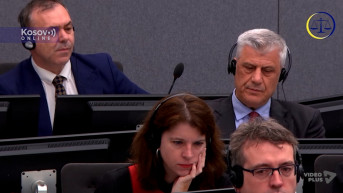
Even about 2,000 kilometers away from Pristina, where the seat of the Specialist Chambers of Kosovo is located, where proceedings against former KLA leaders accused of crimes against humanity and war crimes are being conducted, it seems that it is not far enough to prevent pressure on witnesses.
Although the idea behind having the court's seat outside Kosovo was precisely to protect witnesses, the Office of the Special Prosecutor recently announced that three accused former KLA leaders, Hashim Thaci, Kadri Veseli, and Rexhep Selimi, disclosed the identities of protected witnesses to visitors. It was also found that several witnesses were contacted "by individuals who tried to force them to withdraw or modify their testimony in a way favorable to the three accused”.
Due to all of this, all communications - visits, phone calls, written communication - except with their lawyers, have been temporarily suspended for Thaci, Veseli, and Selimi.
Lawyers, speaking to Kosovo Online, point out that it was expected that there would be pressure on witnesses in cases against former KLA leaders and that all of this has shown that witnesses need to be protected more adequately. Whether the measures taken by this court, following the discovery of an attempt to influence witnesses, will strengthen confidence in its work, opinions are divided.
Lawyer Zoran Zivanovic believes that the measures introduced by the Specialist Chambers of Kosovo in The Hague against the three former KLA leaders are the only correct procedure that could have been implemented.
"In my opinion, these measures somewhat contribute to greater confidence in the work of the court and should be viewed as part of other measures that have been taken. During October and November, three individuals from Kosovo were arrested precisely on the orders of the Specialist Chambers for obstructing the work of the court, i.e., abusing contact with protected witnesses, whom they apparently dishonestly influenced, wanting them to give appropriate statements or potentially refuse to testify", Zivanovic states for Kosovo Online.
As he points out, before the Specialist Chambers of Kosovo, there was a negative experience with the Hague Tribunal, where abuses of influencing witnesses were widespread—revealing their identities and exerting pressure on them.
"I will remind you that in the Haradinaj and Limaj cases before the Hague Tribunal, which were among the main cases, an acquittal was precisely reached because a number of witnesses who had given statements in the previous proceeding incriminating the accused suddenly changed their testimonies during the main trial, no longer incriminating them. Thus, the Prosecution was left without evidence", Zivanovic says.
He recalls that some witnesses in that trial were also liquidated.
"In those cases before the Hague Tribunal, only five people who influenced witnesses were charged, and they received very lenient sentences. One was acquitted, one was sentenced to three months in prison, and one to a fine", the lawyer says, however, he emphasizes that the Specialist Chambers have made a significant turnaround.
"A turnaround occurred when they were trying (Nasim) Haradinaj and another defendant, precisely for violating the prohibition of influencing witnesses. Therefore, the Chambers sentenced them to four and a half years in prison. It is a significant and drastic punishment, but it was necessary because the Specialist Chambers realized that only with such penalties could they somehow prevent the influence on witnesses", Zivanovic says.
He states that it is difficult to predict what will happen with the protected witnesses who were attempted to be influenced in the "Thaci and others" case.
"I think additional protective measures will be applied to them and their family members, which can be different. They may be relocated from Kosovo, their identity may be changed, and they may be settled in another country, not only while testifying but also afterward. But these witnesses may change their minds and decide not to testify. We don't know specific situations or identities, and even if we did, it wouldn't be appropriate for us to reveal them. This doesn't necessarily mean that this will lead to these witnesses not appearing and testifying about what they said in the previous proceeding, undoubtedly incriminating some of the accused, which is why pressure is being exerted on them", Zivanovic says.
He emphasizes that all participants in the proceeding are obliged to keep confidential information, including the identity of protected witnesses.
"The identity of protected witnesses must be disclosed to the defense. It is necessary because it is impossible not to know who the person testifying and incriminating someone is, and the accused may receive a severe punishment. The defense is informed about this. When I say defense, I mean the defense attorney and the entire defense team, but also the accused. That is precisely why the communication ban for the accused from Thaci's group with certain people was introduced—to prevent the disclosure of the identity of protected witnesses and the suggestions they might provide", Zivanovic says.
Speaking about attempts to influence witnesses in the case of three former KLA leaders and whether the measures taken against the accused will contribute to strengthening confidence in the work of this court, lawyer Milorad Konstantinovic tells Kosovo Online that it is too early to give assessments of the work of this judicial mechanism.
As he points out, from the beginning of the proceedings against Hashim Thaci and others before the Specialist Chambers, attempts to pressure witnesses could have been expected.
"The Prosecution received an order from the court shortly after the completion of the investigation to propose measures to protect witnesses. We do not have information about the number of witnesses for whom such measures have been provided and whether the provision of these measures has been requested. Especially in cases of war crimes like this one, there are categories of witnesses who are extremely sensitive and who can even be granted the status of protected witnesses", Konstantinovic says.
He emphasizes that considering the history of legal proceedings before the International Criminal Tribunal for the former Yugoslavia (ICTY) and the events that took place there, attempts to influence witnesses in these proceedings were to be expected.
"It was expected that there would be pressure on witnesses, and maybe even some worse things would be attempted. When we have all the information about how both the court and the prosecution behaved, we will be able to give a general assessment. I believe that for a fair trial and a judgment based on the law, witnesses must be able to testify peacefully and present all their knowledge", Konstantinovic says.
Our interlocutor believes that witnesses had to be provided with adequate protection.
"Certain categories of witnesses should have already had protection, and if it did not happen, there was a significant time frame when they could have been influenced. From the moment the indictment is handed over to the defense of the accused and the accused themselves, they become aware of which individuals are involved. The fact that the judicial regulations prohibit them from influencing witnesses is absolutely not sufficient protection. Some witnesses must be protected more adequately; their identity must be hidden, and they must be relocated. I remind you that precisely for security reasons, the Specialist Chambers, established by the Kosovo Assembly, were located in the Netherlands. It was dislocated from the territory of Kosovo precisely for security reasons, primarily for the safety of the witnesses who were supposed to testify there", Konstantinovic points out.
As he adds, it is an individual assessment of each witness whether they will continue to testify in the proceedings or make a different decision.
"There are people who are so embittered that they have nothing left in life, and they will testify at all costs, even risking their lives if necessary. However, a large number of witnesses will give up; they will be frightened. I must remind you that it is not only about Serbian victims here. The victims of this group of associated criminal enterprises were mostly Albanians, so there is a great need to provide adequate protection to witnesses, and it should have been provided from the very beginning of the proceedings", Konstantinovic concludes.
Thaci, Veseli, and Selimi are charged with crimes committed in the period no later than March 1998 to September 1999 in multiple locations in Kosovo, as well as in Kukes and Cahan in northern Albania. They are accused based on individual criminal responsibility for persecution, imprisonment, torture, murder, arbitrary deprivation of liberty, and cruel treatment. They were arrested on November 5, 2020, in Kosovo and brought to The Hague on the same day, and their trial began on April 3, 2023.


0 comments