
For Pristina, a non-paper; for the EU, a valid document: What is the fate of the EU draft on the CSM?
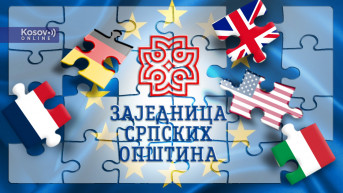
Just when it seemed that the puzzle called the Community of Serbian Municipalities (CSM) had been pieced together with the European draft of its statute, authorities in Pristina stated last week that this puzzle has not even begun to be assembled. Interviewees for Kosovo Online are confident that the new European administration will not easily abandon the proposed CSM statute draft, but they caution that many obstacles remain before it can be realized.
Written by: Arsenije Vuckovic
"Labeling the statute draft as a 'non-paper' ignores the European Council's call to act on it without further delays toward establishing the CSM," said EU spokesperson Peter Stano on Tuesday.
Just a day earlier, he stated that the European draft of the CSM is not merely a non-paper but is supported by all 27 EU member states.
"In its December 2023 conclusions, the European Council welcomed Serbia and Kosovo's readiness to accept the statute draft presented to the parties by the EU envoy. This constitutes formal recognition of the document by all 27 EU member states," Stano said.
This was in response to a statement by Kosovo government spokesperson Perparim Krieziu, who described the European CSM draft as merely one of many proposals and stated that Pristina is not obligated to implement it.
"The EU statute draft bears no signature from either EU High Representative Borrell or his envoy Lajcak, let alone from Prime Minister Kurti. Its status is only that of a non-paper, one of several proposals offered over the years," Krieziu said at the end of last week.
Essentially, he reiterated the positions held by Pristina officials and the Self-Determination movement, maintaining that the CSM's formation is a matter for Kosovo institutions.
"I am the prime minister of a democratic republic; prime ministers do not form Community of Municipalities. We have Community of Kosovo Municipalities. If they want another one, it’s a matter for the municipalities themselves to decide. Were I to do it, it would be imposed," Kurti said a week ago.
Self-Determination MP Fitore Pacolli soon went a step further, asserting that the Kosovo government should draft the CSM statute.
"We believe that the draft we should discuss and implement must be written by the Kosovo government, in line with the Constitution and the Law on Local Self-Government," Pacolli said.
Expectations and Concerns
Security studies researcher Nikola Vujinovic believes that Peter Stano made it clear the EU has not abandoned its CSM statute draft proposal. However, he remains pessimistic about how the new European administration will address this issue.
"We can expect that when the new administration fully takes office, this will be on the agenda. Still, I am not optimistic about the fate of the proposal itself," Vujinovic told Kosovo Online.
He points out that Krieziu’s statement is correct—that the European CSM draft is one of many proposals on how this Community should look—and that the response to this issue will largely depend on the approach of the new EU foreign policy chief, Kaja Kallas.
“It’s one of many proposals on the negotiating table for the CSM. With Ms. Kallas’s arrival, we can expect this to be a topic again, but this time with a much more negative stance toward Serbia. Kallas is one of the most anti-Russian hawks in the European Union, and the fact that Serbia refuses to impose sanctions will be a red flag for her, prompting her to use various means to pressure us as much as possible,” Vujinovic noted.
He believes that the creation of the CSM has been an "excuse" for both Pristina and the EU from the beginning.
“Fundamentally, they fear a new the Republic of Srpska. And we see how the Republic of Srpska, despite its limited powers and constant attacks, maintains a clear political identity. This is what Kosovar Albanians fear, primarily because it would show that the political elite of Mr. Kurti is neither as democratic nor as stable as it claims. Maybe I’m a pessimist, but I don’t see the CSM being established in the future. If it is created, it will just be an empty document, entirely dependent on Albin Kurti,” Vujinovic emphasized.
Political Will
On the other hand, European law professor from Pristina, Avni Mazreku, told Kosovo Online that the issue does not lie in the European or any other CSM proposal, as the Constitutional Court will ultimately decide on it. Rather, the issue is in the political will of Belgrade and Pristina, specifically Serbia’s position that it will not recognize Kosovo even after the CSM is formed.
“Serbia has openly stated that it will not recognize Kosovo as a state even after the CSM is established. This has sparked a heated political debate in Kosovo about whether Serbia will recognize it if the CSM is formed,” Mazreku noted.
He recalls that the Constitutional Court previously made a decision on this issue, and that the interpretation of the CSM statute decision was encouraged by the EU, NATO, and other international actors.
"Neither the Serbian government opposes submitting the CSM statute to the Constitutional Court, the main body deciding if this legal act aligns with its constitutional framework. As long as there is no such obstacle, there is reason to hope for the CSM’s establishment.
"The obstacle, in my view, is the political will of both Serbia and Kosovo regarding the agenda, which had some objections," emphasizes Mazreku.
He notes that the governments which Pristina authorities look up to have legally regulated these matters.
"When representatives of the Serbian Orthodox Church insist on certain guarantees, legal guarantees, they often reference examples from other countries. Why does Kosovo not want to guarantee Serbian churches and monasteries? This is because Kosovo’s society, political elites, and academic elites have been persistently building a narrative of a historical Kosovo that includes only Kosovo’s cultural heritage, asserting that Serbian churches and monasteries are, in fact, Kosovo's—specifically Albanian—and that Serbian rulers in the Middle Ages built these churches and monasteries on existing foundations. For this reason, they don’t want to guarantee Serbian churches and monasteries, as their long-term intention is to claim Serbian cultural heritage as their own," claims Gudzic.
Regarding the formation of the CSM and the possibility of the Serbian community achieving some form of autonomy, this analyst argues that Kosovo’s continuous rejections send a clear message.
“They aim, through pressure and provocations, to make life difficult for Serbs, so that, over time, the fate of Serbs in Kosovo mirrors that of Serbs in Shkodra, becoming a statistical minority or practically disappearing. What do we know today about the historical presence of Serbs in Shkodra? We know from place names and historical documents, but today, there are very few Serbs left there. I fear that the political elites in Kosovo wish for the Serbs in Kosovo to share the fate of those in Shkodra and its surroundings,” Gudzic concludes.
He adds that Serbia’s letter from former Prime Minister Ana Brnabic, refusing to recognize the annex of the Ohrid Agreement, elicited a reaction from Pristina.
"In response, the Kosovo government opposed it, yet it remains unclear whether Kosovo has any other obligation to progress in line with what was achieved in the annex to the Ohrid Agreement. These issues are tied to the political will in both countries," Mazreku believes.
According to him, differing interpretations of the agreement are currently in the interest of both the Serbian and Kosovo governments.
“I think it’s simply political populism. Recognizing Kosovo's independence is unacceptable to the Serbian people, regardless of whether Serbia’s opposition or government understands that the outcome will ultimately be recognition of Kosovo’s independence since there’s no going back. Similarly, Kosovo's opposition knows that new political and institutional organization for Serbs through the CSM is imperative,” Mazreku emphasizes.
He points out that the lack of steps toward normalizing relations harms both the Serbian and Kosovo populations.
“The faster the two governments move, the greater the benefits from EU funds, and the safer it will be. The non-NATO countries include Serbia, Bosnia and Herzegovina, and Kosovo. Articles 4 and 5 of the NATO Charter clearly promote relations among its member states. If these countries were part of the EU and NATO, we wouldn’t have to hear about Mr. Guterres’s report suggesting northern Kosovo as a potential escalation hotspot. Both sides know this is the only and best way forward. But why isn’t it happening? Because of the populism on both the Serbian and Kosovo sides, in both the government and opposition,” Mazreku concludes.
The Fate of Shkodra
Just a few kilometers from Pristina, in Gracanica, the view is quite different.
Historian Aleksandar Gudzic argues that Kosovo’s Albanian political elites, both those currently in power and those previously in power, do not wish for any autonomy for Serbs, including the establishment of the CSM, preferring instead for Serbs to share the fate of their compatriots in Shkodra.
"The Albanian political elites in Kosovo, both those in power now and those in previous administrations, do not want to establish the Community of Serbian Municipalities nor to guarantee Serbian churches and monasteries. Both the demand for the CSM and the guarantees for Serbian churches and monasteries are not foreign concepts in European and global legislation or to European and global states," Gudzic told Kosovo Online.
He emphasizes that the administrations of the countries that the authorities in Pristina look up to have legally regulated these matters.
"When representatives of the Serbian Orthodox Church insist on certain guarantees, legal guarantees, they always refer to examples from other countries. Why does Kosovo not want to provide guarantees for Serbian churches and monasteries? Because Kosovo’s society, its political elites, and scientific elites are persistently building a narrative about some historical Kosovo that exclusively has Kosovo’s cultural heritage, suggesting that Serbian churches and monasteries are, in fact, Kosovo’s or Albanian, and that Serbian rulers in the Middle Ages supposedly built those churches and monasteries on the foundations of earlier ones. For that reason, they are reluctant to provide guarantees for Serbian churches and monasteries, as their long-term intention is to appropriate Serbian cultural heritage," Gudzic claims.
Regarding the formation of the Community of Serb Municipalities (CSM), or the possibility of the Serbian community achieving some form of autonomy, this analyst claims that Kosovo's side, through constant refusals, is sending a clear message.
"They want, through pressure on Serbs, through provocations, to simply make life difficult for Serbs so that, in the future, Serbs in Kosovo and Metohija experience the fate of Serbs in Shkodra, to become a statistical error or practically disappear. What do we know today about the former presence of Serbs in Shkodra? We know from place names and names of villages around Shkodra, from some historical documents, but today there are very few Serbs in Shkodra. So I fear that the desire and intention of Kosovo's political elites is for Serbs in Kosovo and Metohija to meet the fate of Serbs in Shkodra and its surroundings," Gudzic concludes.

0 comments