
Rama in the offensive: What does the Albanian Prime Minister achieve with the demand for punishing Serbia?
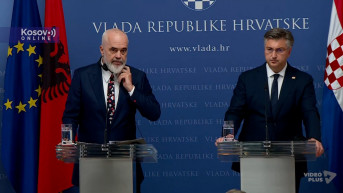
Albanian Prime Minister Edi Rama has quickly shifted from being a strong critic of Albin Kurti, a supporter of the "Open Balkan" initiative, and one of the few regional politicians showing understanding for Belgrade's positions to become the most vocal advocate for the EU to impose measures against Serbia following the tragic events in Banjska. Analysts from Novi Sad and Tirana see several motives behind Rama's "offensive", ranging from an attempt to distance himself from the favorable stance he had towards Belgrade's policies to positioning himself as the leader of all Albanians and forging new partnerships in the region.
In this context, the messages sent by Rama and Croatian Prime Minister Andrej Plenkovic after their meeting in Zagreb on Monday should be considered. The two Prime Ministers strongly condemned the "violence of Serbian paramilitary units in northern Kosovo, as well as their heroization by Belgrade, calling for EU and Western measures against Serbia".
Croatian President expressed confidence that measures would be taken, while Rama urged their implementation without delay because Belgrade's decision to declare a Day of Mourning for those killed in Banjska "leaves no room for different interpretations."
Today, Rama went a step further, with his Socialist Party submitting a resolution proposal to the Albanian Parliament, seeking "condemnation of the armed terrorist attack in northern Kosovo and support for efforts to ensure security and peace in the country and the region".
An analyst from the Center for Social Stability, Ognjen Karanovic, sees Albanian Prime Minister Edi Rama's calls for sanctions against Serbia after the events in Banjska as a part of his attempt to assert himself as the leader of all Albanians.
Karanovic, speaking to Kosovo Online, points out that Rama reiterated his call for measures against Serbia after a meeting with Croatian Prime Minister Andrej Plenkovic in Zagreb on Monday.
"Both Prime Ministers agreed that, for some reason, Serbia deserved strong measures, almost sanctions by the international community, as they interpret it, I presume they mean exclusively the countries of the political West, which is somewhat understandable for their stance. The question arises as to why Edi Rama, who knew how to criticize Albin Kurti in recent years when Kurti was taking steps that could only be described as acts of terrorism, is now doing this. Why is Rama's need to call for punishment against Serbia suddenly arising now? It should be noted that Kurti and Rama have been competing for years for leadership among the Albanians. Both of them pretend to be pan-Albanian leaders. So, they are now competing because it is politically correct, to see who can achieve something first, who can announce some grotesque, sensationalistic statement sooner, and of course, who can better curry favor with their political mentors," Karanovic points out.
He adds that it appears that both Kurti and Rama, as well as Plenkovic, have mentors at the same address, whether that address is in Berlin, Washington, or Brussels.
He points out that the events in Banjska on September 24, when three Serbs and an Albanian policeman were killed, are being exploited to keep Serbia isolated.
"This is just another proof that the entire event in Banjska has been abused. I am sure it was well-prepared and then executed to be abused for political purposes so that Serbia remains isolated; so that it loses Kosovo and Metohija. And so NATO or the political West punishes Belgrade because that is the only chance for them to be more successful than Serbia. The fact is that 63% of all investments coming to the Balkans go to Serbia. This is one of the things that motivated Edi Rama to seek measures against Serbia," Karanovic says.
He also emphasizes that, on the other hand, it should not be surprising that any Albanian politician has such a stance towards Serbia.
"All of them, including Rama, perhaps more than anyone else, dream of a 'Greater Albania'. And on the way to achieving that 'Greater Albania', President Vucic and the state of Serbia are quite a nuisance to them. So in that context, this statement is completely understandable, although it is unacceptable and deserves condemnation," Karanovic concludes.
Journalist and analyst from Tirana, Ben Andoni, says for Kosovo Online that Albanian Prime Minister Edi Rama's call for measures against Serbia after the events in Banjska aimed to achieve several things, including justifying his past favorable attitudes towards Belgrade and forging new partnerships in the Balkans.
"In the eyes of the Albanian public, Rama's demand is reasonable, but it was, in a way, an excuse for all his previous attitudes towards Serbia. Rama's demand, which is in line with the Croatian Prime Minister, shows a new partnership for Albania in the Balkans. It seems that Albania is already distancing itself from Serbia, and it appears that the 'Open Balkan' has completed its mission and is getting closer to the Croatian alternative," Andoni said.
He points out that Rama distanced himself from his previous stance towards Serbia in Croatia, where he was previously in the same position as the European Union.
"After what happened in Banjska, Rama not only went against the European Union but also tried to dictate Brussels' attitude towards Serbia. It must be said that Prime Minister Rama's demand did not have a significant impact on Albanian public opinion. It is important only in a formal sense but does not affect the opinions of the Albanians, and this is due to his previous relationships with Serbian President Aleksandar Vucic, justifying him multiple times, even for his ties with Russia," Andoni believes.


0 comments