
Taravari’s idea of fiscal confederation draws no response in North Macedonia
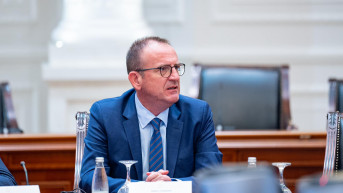
Fiscal decentralization is already underway in North Macedonia, while the idea of fiscal confederation recently reintroduced by Arben Taravari, leader of one wing of the Alliance for Albanians, is not new in his political platform. According to interlocutors of Kosovo Online, he is reviving it at a time when his party is fragmenting and he finds himself in a “stalemate situation.”
Written by: Darko Savanovic
The announcement by Arben Taravari, one of the leaders of the opposition Albanian political bloc in North Macedonia, that he will soon present a proposal for a new agreement between Macedonians and Albanians in the country has not resonated within the Macedonian political public.
Taravari, who left the ruling VLEN coalition with his party in May last year, described the proposed agreement as a fiscal confederation or federation, though not a territorial one. However, he did not elaborate in detail on what this would entail or how it would function.
“Soon we will promote our new agreement on relations between the two ethnic groups living in Macedonia. The main pillar of our next objective will be decentralization — fiscal confederation or federation, not territorial. This would mean municipalities functioning with greater competences and more financial resources,” Taravari said in an interview for the Kohe podcast.
None of the Macedonian political parties, politicians, or media outlets responded to this initiative. Interlocutors of Kosovo Online note that Taravari has raised similar ideas before and that fiscal decentralization is already an ongoing process in a large number of municipalities.
Political analyst Lulzim Farizi from Skopje pointed out that following the signing of the Ohrid Framework Agreement in 2001 and the subsequent constitutional amendments, decentralization was constitutionally guaranteed.
“In addition, fiscal decentralization to a certain degree is regulated by law, though not to the extent envisioned by Arben Taravari. I believe his statement is superficial and even contrary to the Constitution of the Republic of North Macedonia,” Farizi stated.
He recalled that Taravari had previously advocated federalization when he and Zijadin Sela formed the Alliance for Albanians in 2015, but abandoned those ideas when entering government.
“When they entered government in 2017, they forgot about it. Later, when Taravari again became part of the government, he also abandoned the idea of federalizing the state that he had previously promoted. He was part of the ruling majority last year as well, and there were no such proposals then,” Farizi said.
According to Farizi, Taravari is now reviving the idea of fiscal decentralization and federalization in an attempt to preserve his political relevance and prevent the disintegration of his party.
“It should be borne in mind that Taravari is in a stalemate situation and that his party is falling apart. We should also not forget that prior to his statement, his party’s secretary-general resigned. As time passes and his party continues to fragment, he will likely make increasingly grand statements that may not stop at fiscal decentralization or federalization,” Farizi assessed.
He further noted that before making such proposals, especially Taravari, political parties should conduct thorough analyses of the feasibility of fiscal decentralization, particularly in municipalities with Albanian majorities, where, as he put it, “fiscal policies are often conducted in the informal economy.”
“For fiscal decentralization at such a level to be viable, it would first be necessary to address unfair competition and informal practices in those municipalities governed by his party and its coalition partners,” Farizi added.
Analyst Petar Arsovski believes Taravari’s proposal contains two distinct aspects: fiscal decentralization, which Taravari describes as its core pillar, and fiscal confederation.
Arsovski emphasized that fiscal decentralization is a normal and ongoing process in most municipalities and represents the next phase in the development of local self-government legislation.
According to him, this process is positive and beneficial for municipalities, as it would enhance their accountability to citizens.
“It entails strengthening municipalities’ capacity to collect their own-source revenues, introduce new local fees, move beyond reliance solely on communal charges, and exercise full authority over construction land. This would make municipalities less dependent on the central budget and enable them to independently decide on revenue generation and allocation,” Arsovski explained.
However, he interprets the concept of fiscal confederation as implying two separate budgets, two separate systems of public revenue collection, and two separate decision-making frameworks regarding revenue allocation.
Arsovski assessed that such a model would require a broad public debate and would be far more complex to implement. At present, he noted, the state operates through a single mechanism for public revenue collection — the Public Revenue Office.
“Perhaps some form of oversight mechanism for municipalities with majority Albanian populations could be considered, but that is a different domain. It concerns national-level arrangements and the potential division of parallel public finance streams, which is unrelated to municipal governance as such,” Arsovski concluded.



0 comments