
Is the transfer of power in the north enough for de-escalation and the lifting of EU sanctions?
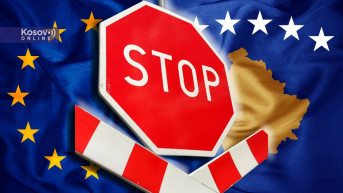
The transfer of authority in northern Kosovo and the start of establishing the Community of Serb-majority Municipalities (CSM) are obligations that, according to the draft enlargement conclusions of the Council of the European Union, Pristina must fulfil in order for the punitive measures introduced by the EU two and a half years ago to be lifted. One of these conditions was met yesterday, when the newly elected mayors and municipal assembly members in the north assumed office. However, interlocutors of Kosovo Online believe that de-escalation in the north cannot be achieved merely by Albanians handing over power, arguing that the problem is far deeper.
Written by: Milena Miladinovic
Gradual lifting of sanctions was announced in May this year during High Representative Kaja Kallas’s visit to Pristina, under the condition that Kosovo reduce tensions in the north. In the draft text of the EU Council seen by Koha, the transfer of power in the northern municipalities following the local elections appears as a key requirement.
The EU Council will meet on 18 and 19 December, and according to analysts interviewed by Kosovo Online, the decision taken on punitive measures will reveal the EU’s stance toward Kosovo and the policies of the caretaker prime minister, Albin Kurti.
While Serbian President Aleksandar Vucic warns that lifting the measures would be a “gift” to Kurti ahead of snap parliamentary elections on 28 December, Koha’s Brussels correspondent Augustin Paljokaj doubts this will happen.
Experts interviewed by Kosovo Online also point out that Kosovo is at a disadvantage because it currently lacks functioning institutions and it is uncertain whether the political crisis will end after the December elections.
Regarding de-escalation in the north, opinions are that the mere assumption of office by Serb mayors and assembly members is insufficient to calm the situation; actions will be required in which the local authorities will need the support of the central government.
A Bigger Problem Than the Transfer of Duties
Security studies researcher Nikola Vujinovic believes the issue of de-escalation is much deeper and that decisions made in northern municipalities over the past three years cannot be reversed by local authorities alone.
“The problem is much deeper and will prove to be far greater than a simple handover of the mayor’s office. A large number of decisions made by the illegitimate mayors over the past three years cannot be undone by local self-government alone. They will need the support of the central authorities in Pristina, and given Kurti’s attitude toward the Serb community, it is unlikely that they will suddenly change their entirely negative view of the community’s ability to manage its own political affairs,” Vujinovic told Kosovo Online.
He stresses that de-escalation requires Serbs’ return to Kosovo institutions—something the EU itself has emphasised—so he does not expect the EU Council to lift sanctions.
“In my view, de-escalation will only be credible once Serb mayors and municipalities begin to make operational changes—whether it is renaming streets, blocking certain expropriations carried out by the central government for police bases, and so on… Likewise, the return of Serb personnel to the prosecutor’s offices and the police. This is something the EU itself has highlighted, which makes me believe the Council will not lift the measures, because a deeper approach is needed,” he added.
According to Vujinovic, the EU’s decision will show whether it supports the policies of caretaker prime minister Albin Kurti, or whether it instead wishes to strengthen the opposition ahead of the formation of a new government.
“What worries me is the timing—this decision comes just before Kosovo’s parliamentary elections. The decision will reveal whom the EU supports. If the EU lifts the measures or announces a gradual lifting over the next three months, this means support for Kurti and for his policy toward the Serbian community. But if they say no, de-escalation is insufficient, and the CSM must at least begin to be addressed, then it will be clear they support the opposition parties, which are increasingly contemplating a broad post-election coalition to form a government,” Vujinovic concluded.
An Active Approach to Dialogue
Director of the Centre for Foreign Policy, Aleksandra Joksimovic, stated that the EU sanctions against Kosovo were never fully implemented, and that aside from de-escalation in the north, an active engagement in the dialogue with Serbia is also required for their removal—something she considers unrealistic given that Kosovo’s institutions have not yet been formed and new elections are imminent.
“First of all, the sanctions imposed on Kosovo were never fully implemented—they were largely symbolic. Beyond de-escalation in the north, a key element is Kosovo’s active engagement in the Belgrade–Pristina dialogue, which remains absent. The lack of institutions after the elections is pushing Kosovo into another electoral cycle. Therefore, at this moment it is unrealistic to expect any significant breakthrough in the dialogue, especially at a higher level,” Joksimovic told Kosovo Online.
She noted that although the Serb community regained control of the municipalities where it forms a majority, this does not automatically mean de-escalation.
According to her, the answer to whether the north will stabilise will emerge in the coming period, but not before the electoral process is completed.
“As for the local elections, the Serb community participated and won as expected, regaining municipalities where it constitutes a majority. Whether this alone is sufficient to expect future de-escalation is a question whose answer will only become clear over time. However, given that the electoral campaign now follows, this topic will again feature prominently, and I am not convinced such de-escalation will occur before the conclusion of the new electoral cycle,” she said.
Asked whether sanctions could be lifted before the December elections, Joksimovic noted that the EU and countries supporting Pristina have long been dissatisfied with caretaker prime minister Albin Kurti.
“It is always difficult to speculate, but it is evident that the EU and countries supportive of Pristina have been dissatisfied with the caretaker prime minister for a long time. I do not see political will to support his option in the upcoming elections,” she emphasised.
No Stability Until May Next Year
Political analyst Shkelzen Maliqi said that stability in Kosovo should not be expected before May next year, noting that the December elections may trigger a new crisis.
Commenting on sanctions, he told Kosovo Online that it is unclear when Kosovo will have a new government.
“The situation around the elections is delicate. We do not know when we will have a new government, as this entire year has been marked by manoeuvres and delays dictated by Kurti. Elections will be held at the end of December; then the counting process and formation of results may take two to three months, and a new crisis may erupt. It is also expected that the President of Kosovo might resign, triggering new elections immediately. There will be many complications, and until May we will not have stability,” Maliqi said.


comments