
What message did Von der Leyen send while speaking of "accepting de facto recognition"?
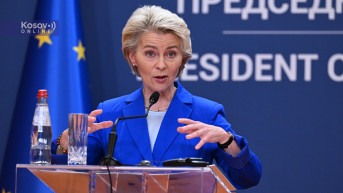
After a several-day visit to the region by the President of the European Commission, Ursula von der Leyen, it seems that her statement from Pristina, directed at Belgrade, has had the strongest impact - that Serbia is expected to accept the de facto recognition of Kosovo, which Serbian President Aleksandar Vucic has clearly rejected as a possibility several times in the past. Analysts believe that no one exactly knows what her message about de facto recognition means, and when this term is used, it actually sounds stricter than it essentially is.
During a joint press conference with President Vucic, Von der Leyen clarified her words from Pristina, stating that she actually meant the implementation of the Ohrid Agreement, which foresaw various steps, the recognition of certain documents, and the necessary formation of the CSM.
On that occasion, Vucic reiterated that Serbia was committed to maintaining peace and stability, knowing its obligations, which it would fulfill, but also making it clear what it could not do, emphasizing that recognition of Kosovo's independence was out of the question for Belgrade.
Interpreting Von der Leyen's message, which contradicts Serbia's firm stance, Stefan Surlic, the Assistant Professor at the Faculty of Political Sciences in Belgrade, says that no one exactly knows what the message the President of the European Commission has sent to Serbia regarding expectations for de facto recognition of Kosovo means. However, it can be discerned based on the points agreed upon in the Franco-German plan and the Ohrid Annex.
"For the first time, we heard that term in the statement of the three most powerful leaders of the EU: German Chancellor Olaf Scholz, French President Emmanuel Macron, and Italian Prime Minister Giorgia Meloni. Actually, no one knows exactly what it means, but based on the points agreed upon in the Franco-German Agreement and the Ohrid annex, we can assume that it refers to the acceptance of documents issued by the institutions in Pristina, presenting Kosovo without an asterisk and the UNMIK label in regional forums, and abandoning the policy of blocking Kosovo on the international stage and continuing the policy of withdrawing recognitions of Kosovo's independence", Surlic says for Kosovo Online.
For analyst Ognjen Gogic, Von der Leyen's message is not a new condition, but he "reads" from it that the EU is no longer using euphemisms and attempts to conceal something.
"What she said is not a new condition; they have actually just reformulated the condition that already exists. So, when you analyze the Franco-German proposal or the Brussels-Ohrid document, if Serbia were to accept that document, if it adhered to it and respected it, it would send a message to everyone that it is de facto or implicitly recognizing Kosovo as an independent state," Gogic says for Kosovo Online.
This is precisely why, he adds, on every occasion during meetings, Vucic explicitly stated that Serbia did not recognize Kosovo, neither de facto nor de jure.
Political scientist Dimitrije Milic believes that the message from the President of the European Commission, Ursula von der Leyen, demanding de facto recognition of Kosovo from Serbia, has been taken too strictly and that it implies recognition in a sense that there is one entity in a technical sense, rather than Serbia recognizing Kosovo as an independent state or sending an ambassador to Kosovo.
That is, he adds, one of her two clear messages she brought - one related to positive economic results and the latest projects, and the other concerning the negotiations between Belgrade and Pristina and what the EU means by de facto recognition of Kosovo.
"If we were to reduce this to practical steps, or rather the expectations the EU has of Serbia, it can largely be said that the wording is too strict compared to the expectations, and the expectations are essentially the recognition of the institutions and documents of so-called Kosovo, so in a sense, when we say de facto recognition, it sounds stricter than it actually is", Milic believes.
He explains that the demand put before Serbia does not imply that Belgrade is expected to recognize Kosovo as a state.
From Von der Leyen's messages, Pristina analyst Leart Hoxha sees that diplomatic pressure on both sides is increasing and that the term "de facto recognition" is what Pristina wants to hear, which means the implementation of the agreements from Brussels and the Ohrid Annex, while he says that even the US does not insist on de jure recognition.
For him, Von der Leyen's messages were expected.
"I think the pressure will continue, will be concretized, and maybe during November, we will have something more concrete. De facto recognition is what Pristina wants to hear, and that will make it easier for everyone, so Pristina works on the Community of Serb-majority Municipalities, which I expect it will try to package as 'self-government' or 'self-management' of the Serbian community, but that is basically the CSM, and it was signed ten years ago", Hoxha said.


0 comments