
What message is Donald Trump sending to the Balkans by appointing Wendt as ambassador to Tirana?
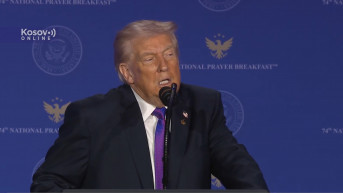
By nominating former special forces officer and lieutenant general Eric Wendt as U.S. Ambassador to Tirana, President Donald Trump is sending a message not only to the region, but also to allies and to Iran, according to interlocutors of Kosovo Online.
Written by: Veljko Nestorovic
If confirmed by the Senate, Wendt will assume the post of U.S. Ambassador to Tirana.
Although his qualifications may not at first glance appear to align with the position, there is little doubt that the arrival of a “seasoned soldier,” loyal above all to Donald Trump, would further draw this part of Europe closer to Washington.
It should also be noted that, at present, much of the region lacks U.S. ambassadors, with diplomatic missions operating at the level of chargés d’affaires.
Wendt was nominated in 2020 for the position of ambassador to Qatar, but unsuccessfully.
The situation in Iran may be one of the reasons behind the nomination of retired Colonel Eric Wendt as U.S. Ambassador to Albania, says Aleksandra Joksimovic, Director of the Center for Foreign Policy in Belgrade, in a statement to Kosovo Online.
Joksimovic also notes the impression that Trump is appointing a significantly higher number of politically affiliated diplomats—individuals close to him—rather than those with extensive diplomatic experience and long-standing careers.
“However, when we speak about Albania, we must take into account an additional factor. Considering current relations with Iran, or rather the crisis with Iran, it should be noted that Albania is one of the countries that does not maintain diplomatic relations with Iran. These were severed in 2022 after the United States asked Albania to receive Iranian Mujahideen, following their departure from Iraq, who act in opposition to Iran. As a result, Iran has referred to Albania as a ‘small and malicious country.’ Following a cyberattack on state institutions in Tirana, which was determined to have originated from the Iranian state, diplomatic relations were severed,” Joksimovic explains.
Diplomat Albert Prenkaj believes that Wendt’s nomination as ambassador to Albania signals renewed U.S. attention to the region, given that since the beginning of the Trump administration, bilateral relations in U.S. embassies across the Western Balkans have largely been maintained by chargés d’affaires.
He also emphasized that Wendt’s nomination must be confirmed by the Senate.
“In a time of paradigm shifts on the international stage, as the United States begins implementing its National Strategy of the ‘Monroe Doctrine/Western Hemisphere,’ while the crisis in the Strait of Hormuz continues and conflict persists between Israel, the United States, and Iran, it appears that the presence of a high-level diplomatic representative in Tirana carries not only symbolic but also political significance. Of course, General Wendt must undergo Senate procedures before assuming office in Tirana,” Prenkaj stated.
Political analyst and editor at the daily Tema in Tirana, Ili Pata, believes that Wendt’s nomination is also linked to the decision to establish a NATO special forces center in Albania.
Pata also points out that Wendt would not be the first ambassador to Albania with a military background, noting that General James Jeffrey previously served in that capacity.
The Kosovo Online interlocutor also recalls that Eric Wendt is an excellent expert on the Middle East.
“President Donald Trump nominated him as ambassador to Qatar, where the largest U.S. bases in the Persian Gulf are located, but he did not receive the necessary votes in the Senate. After that, President Trump—that is, the U.S. administration apparatus—considered transferring him to Tirana for two reasons. Albania, according to a clear, approved, and well-defined plan, has become an operational center for NATO special forces,” Pata says.
Pata believes that Wendt is also being sent to Tirana to coordinate the activities of NATO forces.
“The second reason for his nomination is the following. I believe we are seeing almost the same stance of the United States toward NATO as in 2002 and 2003. Today, we observe a deep division within NATO, that is, between the U.S. and European countries. We forget that this is not happening for the first time. In 2003, Donald Rumsfeld stated from Brussels, from NATO headquarters, that NATO was no longer the alliance it once was and that this had to change. According to him, there were countries that were no longer allies of the United States, as well as those that remained close allies of America. From that point, the creation of the so-called ‘Coalition of the Willing’ began, and in order to wage the war in Iraq, the United States enlisted not only countries such as Albania and others, but also states that had no connection to the Balkans or Europe, but were simply U.S. allies in that new military, that is, geopolitical undertaking,” he said.


0 comments