
What was Sørensen’s track record in 2025?
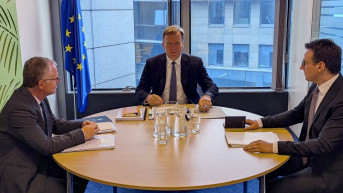
“We have a good start,” was one of the first statements made by Peter Sørensen, the EU Special Representative for the Belgrade–Pristina Dialogue, when he visited Pristina in March last year. Not much progress has been made since that initial moment. Throughout 2025, Kosovo remained in a near-continuous election campaign, and Sørensen had few mechanisms at his disposal to persuade either side to implement the agreements already reached, interlocutors for Kosovo Online assess. Pressure from the United States and the EU was largely absent, and unless the approach changes, 2026 will likely bring a repeat of the same situation.
Written by: Dusica Radeka Djordjevic
The Danish lawyer and diplomat, who took over the “hot seat” from Miroslav Lajcák on 1 February last year, failed to move the dialogue off dead center during nine months in office.
According to his political adviser Andreja Slomšek, from the start of his mandate through the end of November Sørensen held 66 meetings with representatives of Belgrade and Pristina, which, in her assessment, kept lines of communication open, prevented major tensions, and ensured continued focus on dialogue-related obligations.
Sørensen also met with the KFOR Commander, NATO’s Deputy Secretary General, German and French officials, and the foreign ministers of Spain and Finland, among others. However, he did not succeed in bringing the top officials from Belgrade and Pristina together at the same table.
He convened trilateral meetings at the level of chief negotiators only twice—on 10 June and 11 September.
Aleksandar Mitic, Senior Research Fellow at the Institute of International Politics and Economics in Belgrade, told Kosovo Online that Sørensen received his mandate at a time that was far from easy, and that the previous year was not conducive to serious political dialogue between Belgrade and Pristina.
Mitic notes that Sørensen is not a high-profile diplomat and that he clearly sought to work “under the radar,” as did the circumstances themselves.
“The fact is that Pristina did not have a fully functional government and that the election campaign was practically permanent. On the other hand, the policy of discrimination against Serbs continued throughout the year and was, in a sense, partially unblocked in the last quarter of 2025 through local elections and the decision in Brussels to announce the lifting of restrictive measures. So it was not a year for serious political dialogue. It seems that there were contacts with Belgrade and that they were proper, but beyond technical matters there were no particular political breakthroughs,” Mitic says.
He believes it was a good thing that artificial dynamics were not created where they did not exist and could not exist.
“I fear that now, in these changed circumstances, with a different situation in Pristina, we could end up creating some form of artificial momentum and attempts to pressure Belgrade, which is already under pressure on many other issues and will likely be entering an election year,” he adds.
According to Mitic, Sørensen has very few mechanisms at hand to compel both sides to implement agreements already reached.
“The fact is that his role is not of the same profile as Lajcák’s was in the previous period, and it appears that he does not have the pressure instruments that may have existed earlier. His superior, Kaja Kallas, is overwhelmingly focused on addressing other issues—primarily the conflict in Ukraine—and either lacks interest or does not have sufficient time to deal with this matter,” Mitic says.
“Nothing Important Happened”
Political analyst Artan Muhaxhiri from Pristina believes that the EU Special Envoy for the Belgrade–Pristina Dialogue does not have the power to create conditions for resuming the dialogue, as he is merely a mediator. Pressure on Kosovo and Serbian leaders, he says, can only be exerted by the main stakeholders in Washington, Brussels, Paris, and London.
“The international community has done this before in various ways and can do so again if it wants to improve and accelerate the dialogue and achieve important practical results,” Muhaxhiri told Kosovo Online.
As he notes, 2025 was a lost year for the dialogue, during which nothing important happened.
“The EU Is Powerless”
Slobodan Zecevic, Director of the Institute for European Studies in Belgrade, assesses that the normalization process between Belgrade and Pristina has reached a point where the formation of the Community of Serb-Majority Municipalities (CSM) is the key issue, and that during the past year EU Special Envoy Peter Sørensen could do nothing on this front due to the political crisis in Kosovo.
“That key element—the formation and functioning of the CSM, which was supposed to contribute to progress in the dialogue—cannot be realized because Kurti does not want it and because they are constantly in a parliamentary crisis. Sørensen could do nothing there. On the other hand, Belgrade is being asked to recognize their documents,” Zecevic told Kosovo Online.
In his view, the EU is powerless when it comes to the dialogue.
“They do not want to proceed with further sanctions against Kosovo’s institutions; they are waiting for a resolution of the political crisis, and since that is not happening, there is no progress on forming the Community of Serb-Majority Municipalities, which is the crux of the matter. Sørensen could have done two things: either call for stronger sanctions against Kosovo or demand the formation of the CSM, but it is clear that there was tolerance due to the political crisis in Kosovo,” he believes.
What Next?
Muhaxhiri says he sees no way for anything to change this year, noting that the dialogue has always been the result of strong pressure from the United States and the EU.
Those pressures are now lacking on both Kosovo and Serbia, and therefore there is no readiness on the part of either Kosovo or Serbian leaders to continue the dialogue, he believes.
“I do not even see how things could develop under a carrot-and-stick strategy. If the current approach continues, nothing important will happen in 2026 either,” Muhaxhiri emphasizes.
He believes that a major shift and substantial incentives are needed for both Kosovo and Serbia—so that they stand to gain or lose significantly depending on whether they act constructively or destructively in the dialogue.
Asked whether pressure from Brussels on the new government in Pristina can be expected in 2026, Zecevic says that much also depends on the European Union’s stance toward Serbia, since the implementation of the Brussels Agreement is interpreted as something being “done for Serbia.”
“At the same time, they fail to understand that we have in fact made far more painful compromises than the Albanians when it comes to the Brussels Agreement. I believe pressure should be exerted on the new authorities in Pristina, because the normalization process can only be unblocked if the formation of the CSM begins in line with the Brussels agreement,” he stresses.
Mitic notes that it remains to be seen what 2026 will look like, especially if an agreement is reached regarding the conflict in Ukraine and the focus shifts somewhat more toward our region.
“It has been shown that Brussels has certain methods of pressure; they are weak, but in partial cooperation with Washington they can exert some pressure. Perhaps Washington’s decision to suspend the so-called strategic dialogue had a much greater impact on Pristina than anything the EU and Sørensen have up their sleeve,” he assesses. As for Belgrade, he believes it is difficult to exert greater influence than what already exists and is reflected in the European Commission’s assessments regarding the opening of Cluster 3 and overall progress in European integration.
“How the situation will look after new authorities are formed in Pristina remains to be seen—whether we will return to the pre-2025 period and a continuation of Albin Kurti’s policy of unilateral moves and escalation, or whether this period of relative de-escalation will be extended,” Mitic says.
Perhaps the Danish diplomat will have more success in steering the dialogue toward tangible results over the next two years, for which his mandate is expected to be extended, according to diplomatic sources.
After all, he himself recently concluded that normalization of relations “between Kosovo and Serbia is not a one-off result achieved after a meeting, but a continuous process that takes place every day to improve people’s lives.”

0 comments