
McGurk: Serbs in Kosovo concerned about access to justice, property, and services
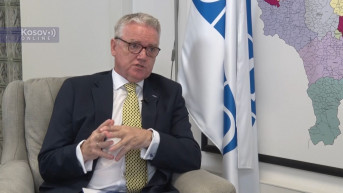
In an interview with Kosovo Online, Head of the OSCE Mission in Kosovo Gerard McGurk said that the images of brutally beaten Nenad Raskovic were horrifying and that the Police Inspectorate and the Ombudsperson Institution had responded swiftly by launching their own investigations. He also stressed that Serbs in Kosovo were particularly concerned about access to justice, property, and services. Regarding the demolition of houses at Gazivode, he said that the strong international reaction had been entirely justified because all legal avenues had not been fully exhausted and concluded, yet enforcement measures had nevertheless been taken.
Written by: Veljko Nestorovic
Regarding Nenad Raskovic, who was brutally beaten, the Kosovo Police Inspectorate recommended the suspension of two police officers.
"First of all, the allegations were shocking. The images published online were horrifying, and it was absolutely right that the Police Inspectorate and the Ombudsperson Institution reacted quickly by launching their own ex officio investigations. In terms of the integrity of the process, the fact that the Police Inspectorate recommended suspension is a good outcome. It demonstrates the integrity of the Police Inspectorate, although, of course, there are certain limitations, as I understand they were unable to speak with Mr. Raskovic. Nevertheless, they were able to reach a reasonable set of conclusions that led to the recommendation to suspend the two police officers concerned. It is now for the Kosovo Police and the Minister of Internal Affairs to consider the matter further, and I would not comment beyond that. I am also waiting to see what the Ombudsperson Institution will say regarding its investigation and the different approach it is taking. I think that the institutions, in terms of how they responded—and these are institutions whose development the OSCE has supported over many decades—responded correctly and appropriately. So, at that level, the response and reaction were appropriate. We will see where the investigations go from here," the Head of the OSCE Mission in Kosovo said.
Are you personally following this case as well?
Yes. Immediately, the following day, I was in direct contact with the Police Inspectorate and the Ombudsperson Institution, and we agreed to remain in formal contact. I do not interfere in their investigations; that is their responsibility. But since we are close partners of both institutions, we are able to provide mutual support where we can. For now, the Police Inspectorate has issued its recommendations, and I am waiting to see what the Ombudsperson will say.
Kosovo is once again facing a serious institutional crisis. Does the OSCE regard this as yet another political crisis, or is it already seriously undermining the functioning of democratic institutions?
You have raised an important issue concerning the continuing absence of political consensus and the fact that, as the Constitutional Court's August 7 deadline for constituting the Assembly approached—and has now expired—concern has continued to grow. This is a matter of great concern to me and to the Mission because, since February last year, there has been very little continuity in terms of governance, parliamentary oversight, decision-making, implementation and drafting of new legislation, as well as the functioning of the Assembly in terms of enabling opposition and other political parties that are not part of the majority to participate in decision-making.
So, I think there are many reasons for concern. On the other hand, dialogue is taking place and discussions are ongoing. I hope that a certain sense of urgency will emerge from that. This is about governance and about political parties taking responsibility for improving people's lives, which I think is what everyone across all communities in Kosovo genuinely wants.
Do you believe that political actors are currently respecting the constitutional framework and the decisions of the Constitutional Court?
The fact that the August 7 deadline has expired without the Assembly being constituted speaks for itself in terms of the reasons for concern that the Constitutional Court's decision has not been respected. I hope that the political parties and those responsible for convening sessions and setting the timetable will return to a path of respecting the Constitution, the Rules of Procedure, and what the people of Kosovo voted for—which is to have an Assembly—even though turnout in the last elections was very low.
I think it is important that, when people speak about the rule of law, we speak about the rule of law in its entirety, not selectively. The rule of law matters because the Constitutional Court is the final arbiter of all these issues. It is important to distinguish between legal competences and matters that clearly fall within the jurisdiction of the Constitutional Court, and political issues that require political solutions, political consensus, and political agreements.
I think the two reinforce one another, but it is clear that the Constitutional Court's decision has not been accepted by some political actors. In that case, the Constitutional Court will determine what happens if the matter is referred to it, including any consequences that may arise. But it is not for me to assess what those consequences should be.
The OSCE has offices and field teams throughout Kosovo. What is the situation in the north? Do Serbs genuinely have reason to be concerned about the institutions dealing with issues that affect them?
Again, you are right. We have regional centers throughout Kosovo, five in total, and many of them have direct contact with the Kosovo Serb community, particularly those in the north. I think trust and confidence go hand in hand when it comes to how all communities perceive the central authorities, the laws being applied, and similar issues.
Regarding the demolition of property you mentioned—the demolition of houses near Gazivode Lake—it was entirely justified that there was a strong international reaction because there appear to have been certain elements that were not properly implemented in terms of adequate communication, clear explanation, and a clear legal justification for the decisions.
There is also the lack of legal remedies, or effective legal remedies. To the best of my knowledge, all legal avenues had not been fully exhausted and concluded, yet enforcement measures were nevertheless taken. In my view, therefore, that does not represent the full package of the rule of law because legal remedies to halt or postpone the demolitions were not available to the people claiming ownership of the houses. That seems to me to be the wrong approach.
Law-enforcement measures should be implemented only after all legal avenues have been exhausted, not before. I think there are many reasons for concern, and I think we have already made clear that enforcement of the law must be fair, proportionate, based on legal facts, decided transparently, communicated in a timely manner, and carried out in consultation with those involved.
I think that in itself contributes to a proper, sustainable, and lawful process that is regarded as fair and credible and that must be applied throughout Kosovo. That is a point I have also made in my public statements, and it concerns the consistent application of these laws throughout Kosovo, because that reduces the perception that one community is being specifically targeted.
That does appear to be the case, but again, I believe that due process and the legal framework must be timely and responsive to the situation on the ground. I know that EULEX is monitoring the situation, as are many other international partners present here. What we are asking for, as I said at the beginning, is a clear legal basis for all of this. Who is responsible? Again, these organizations are not the decision-makers—the central institutions must be. So, who is responsible and on what basis?
I consider the publication of that information and transparency to be very important. But as the OSCE, we are not an executive authority. This is largely the responsibility of the central institutions, and the judicial system must find a way to address it.
The OSCE recently monitored disputes concerning election results and the Serb List's appeal, calling for transparency, equal treatment of candidates, and respect for international electoral standards?
It is worth recalling that the OSCE Mission in Kosovo has not been involved in organizing elections at all since 2019. That has not, however, prevented us from continuing to monitor elections and work closely with the Central Election Commission, providing technical support and advice.
It is important that all political parties respect the rules. We previously discussed how, in the case of your media outlet, your application for accreditation was rejected, but that decision was subsequently overturned by the Election Complaints and Appeals Panel. It is important that decisions are made in a timely manner and that they are clear, because that is also important for the sustainability of the process. For me, the ideal situation is one in which we do not need to resort to legal remedies—that is, institutions make the correct decisions based on the rules and the law.
The Serb List, as I understand it, challenged certain decisions and went through judicial proceedings, and some of its appeals were rejected by the judicial system. I think it is then for the Serb List to consider how it can move closer to a situation in which it is more compliant with the rules.
But that brings us back once again to the absence of an Assembly. If there are to be any electoral reforms aimed at improving the system and taking into account the experience and recommendations of international election monitoring, we need an Assembly—that is, committees capable of discussing and agreeing on how the system can be improved and how recommendations can be implemented more effectively.
We cannot do that while we have this political stalemate with no clear path toward consensus. So, there is a great deal involved here, both in the long term and the short term.
The Draft Law on Public Property provides that municipalities would no longer own municipal property but would merely be its users. Mayors of Serbian-majority municipalities believe that adopting this law would effectively mean the end of Serbian-majority municipalities. Are you familiar with this law?
Yes. On that point, I think I would respectfully disagree with the mayors' assessment. The law, as it currently stands, provides for a clear distinction between municipal and central ownership.
I believe it is Article 16 of the Draft Law that deals with the conditions under which property may be taken without compensation in the public interest. It is therefore important not to overlook the reactions of all mayors, because there have been strong reactions not only from mayors from the Kosovo Serb community but from across Kosovo.
A gathering is expected to take place in September at which all mayors will come together, because they have many legitimate reasons for concern regarding centralization as opposed to the decentralization of authority and responsibility. The OSCE certainly strongly supports greater decentralization—structured and accountable decentralization—to give mayors greater authority to make local decisions that make a difference for their communities.
So, this is something we are aware of and are monitoring. It is important for the institutions to find a way to listen to the legitimate concerns of all mayors because this is not merely a Kosovo Serb political issue—it affects all municipalities.
The public-interest threshold, I believe, needs to be clearly defined, responsibilities must be clear, and legal remedies must also be clear so that, if there are any legal objections, they can be addressed in a credible, consistent, and fair manner. So, this is something we are monitoring.
When we talk about minority communities, what do you see as the biggest problems currently facing Kosovo Serbs and other non-majority communities in Kosovo?
I think that right now, if we look at the various issues—and again, this is the sense we get from our regional centers and through regular dialogue with many Kosovo Serbs, civil society representatives, and political representatives—access to services is certainly among the most important issues.
Language rights, I think, are becoming increasingly important. But there is also the issue of property. So, I think this is about the rule of law, the fair and consistent application of the rule of law, and how the Kosovo Serb community perceives the way it is treated compared with everyone else, including Ashkali, Bosniaks, and other communities.
This therefore goes back to what I said earlier about a fair and sustainable commitment to applying the law equally to all communities. Recent events, as well as the feedback we receive from discussions with many representatives of the Kosovo Serb community, certainly point to problems concerning access to justice, language rights, and access to services.
Of course, having language rights but not actually being able to exercise them is not what I would call the rule of law. Again, this is an area where I think there is considerable room for improvement.
That also includes some basic issues concerning the Language Commissioner, a position that has remained vacant for many years. The Commissioner should play an important role in ensuring and giving effect to the language rights of the Kosovo Serb community. I therefore hope that, at some point in the future, we will have a credible and capable Language Commissioner who can raise these issues at the central level.
As I said, there is a great deal going on, and I think the situation is probably similar for other non-Albanian communities. It is about the rule of law, access to services, and the financing of those services. Many of those services are funded at the local level. The financial model for municipalities and ensuring that they are adequately funded are therefore extremely important.


0 comments