
My Camino to Santiago, via Prizren
Writen: Srđan Garčević
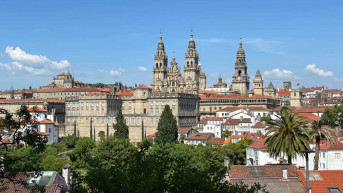
I have planned to make a pilgrimage to Santiago de Compostela since I was a teenager. Despite not being Catholic, I was drawn to the adventure, the ancient towns and castles on the way, and the supposed spiritual benefits.
This June, when I was finally making my way through Galicia's rolling hills and oak forests, which very much reminded me of home, it struck me as funny and sad that, back then, even though I am Serbian Orthodox, it never crossed my mind to do walk on my own to the many churches and monasteries in Kosovo and Metohija. Back then, in the wake of the ethnic cleansing of Serbs in 1999 and 2004, that seemed insane, borderline suicidal.
Coincidentally, as I was setting off from Lugo, I was texting with a friend whose boyfriend had the honour of being the best man at his friend's wedding in Prizren. My friend, a brave young woman in every way, found the prospect of going to Prizren dangerous, which is sadly unsurprising given the constant persecution of Serbs by the Priština authorities.
The ancient, mostly ruined monastery of the Holy Archangels where the wedding was to take place is as impressive and evocative as its history has a very bitter and dark tinge. The monastery was built around the most majestic church built in the Serbian medieval state, which housed the remains of Emperor Dušan. Sadly, this majestic Serbo-Byzantine marble church stood only for just over a century when the Ottomans looted it. It then used its valuable building material for the Sinan Pasha mosque in the town centre.
It was also where one of the grisliest murders of Serbs at the hands of Albanian extremists from UCK happened 25 years ago. Back in mid-June 19999, as Serbian forces were retreating after the Kumanovo Agreement, Hariton Lukić, a 39-year monk, the first to take his vows at this monastery in 550 years, was kidnapped and then tortured and beheaded. He was one of the many Serbian and other civilians to be brutalized by the extremists, despite the fact that KFOR guaranteed their safety. Some of their remains have only been returned to their families now, while Hariton Lukić's head has never been found.
Because of these painful memories, as well as the almost daily persecutions of Serbs by the Kurti regime, a lot of Serbs, like my friend, have a very uneasy feeling about making pilgrimages to their holy sites. Sadly, this deprives us of truly meaningful, lovely experiences and understanding of the situation in Kosovo and Metohija.
However, almost as soon as the hostilities ended in 1999, many brave religious and youth organizations were undeterred and promoted pilgrimages to Kosovo and Metohija.
It was only in 2018 that I decided to find courage and go, encouraged by a friend. I was also moved by an article written by Srđan Šajinović, one of the best Serbian contemporary travel writers, in which he states that any pilgrimage I make without going to Prizren, Dečani, Gračanica and Peć would be an unfulfilling one.
In those two short September days, I realized the true meaning of devotion and perseverance. They also opened my eyes to the realities of life in such an artificially divided society.
When I went to Jerusalem last year, I realized that my Kosovo and Metohija pilgrimage was necessary for me to truly see what Muslims see in Al Aqsa, what the Jews see in the Wailing Wall, and what all Christians see in the Churches of Nativity and the Holy Sepulchre. This year, in Santiago, it was evident to me why it matters so much for the Spanish that every summer, the Spanish Royal Family celebrates the feast of St James in Santiago's otherworldly cathedral.
While the foreign press routinely singles out Serbs' relationship to the "Kosovo myth" as something uniquely strange and delusional, I wonder how, for decades now, they haven't realized it is the same thing that moves hundreds of thousands of pilgrims to Jerusalem, Santiago, Mecca, and similar other places. Every route of the Camino is steeped in Spanish history and lore. Much like the Serbs walk with Miloš Obilić and Prince Lazar at the site of the Kosovo battle at Gazimestan, the Spanish walk the Camino with their kings and heroes, like El Cid. In a disenchanted, chaotic world, the sense of the sacred, rooted and timeless has become neccessary, and it is no wonder that pilgrimages are seeing a massive boost in popularity.
Pilgrimage also offers a rare thing in our mindlessly acquisitive, safety-obsessed culture: the sense of conscious sacrifice. They allow us to understand that there are things worth overcoming our fears and incurring discomfort. Thankfully, despite all of my fears, on all of my pilgrimages, the only real problem I have had was a stomach bug. I got it as I drank the water from the scenic Bistrica by the Holy Archangels, imagining myself as a medieval pilgrim.
When I received my Compostela, my friend told me that the wedding at the Holy Archangels went well, but was sad that she missed it. Walking around the beautiful, ancient Santiago, high on pilgrim excitement, I daydreamed that there would once be a pilgrim route to the Holy Archangels. Maybe, like the Camino, it will attract people worldwide to see not only the monasteries in Kosovo but also stop at Manasija, Žiča, Studenica, and the majestic Maglič fortress. For now, it would be enough for me if daydreaming teenagers in Belgrade had no real reason to fear visiting their holy sites in Kosovo and Metohija.

0 comments