
Summary of the week 23
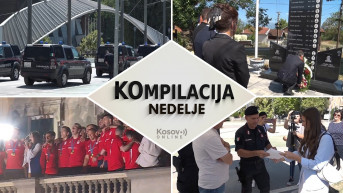
This week brought images that etched scars into hearts, but also those that carved themselves into memory and should remain there. From cause to effect, from sorrow to joy and song—these were the directions in which another week in Kosovo unfolded.
Years pass, the Bistrica River flows, but the true stone under which the answers lie has never been found.
Dragana Srbljak, one of the children wounded in Gorazdevac, continues to relive the same traumas daily. She recalls the promises made in August 2003.
"The then-head of EULEX said they would turn over every stone to find the culprits. However, the investigation was halted in 2010," says Dragana.
No stone, no crime—that logic has comforted no one. Even before that, however, the expectation that justice would ever find its way to Gorazdevac had been abandoned. Therefore, special recognition is due to those who never sought a way out of that place.
"Just the fact that we are determined to stay here comes with a cost," reminds Bishop Teodosije, addressing the residents, many of whom are witnesses to the crime at Bistrica.
Indeed, the cost influences decisions. If they knew its true value, they would also know what to do with the bridge.
Agim Shahini, President of the Kosovo Business Alliance, believes that the consequences, at least the economic ones, are not being sufficiently considered.
"The bridge is symbolic," says Shahini. "However, that decision could have serious consequences, which would be a disaster for Kosovo."
If there were no problems, there would be no consequences. This is probably what they were thinking in Skopje before the Ramadani case unfolded. And when you desire something strongly, it sometimes happens.
"That was certainly a hot potato for Skopje," says Aleksa Grubesic from the Center for Social Stability, responding to the question of who benefited from Ramadani's escape.
He adds, "They were under pressure from both sides—Belgrade, to extradite Ramadani, and Pristina, not to extradite him."
Without pressures and with smaller numbers, it would be easier to calculate. This isn't the official explanation, but it's the suspicion among many who have been waiting months for the census results in Montenegro.
"If we had conducted the census in India and Pakistan, we would have counted by hand by now, but here in Montenegro, we can't seem to count ourselves," says Milan Knezevic, President of the Democratic People's Party. It seems to him, as he says, that someone has a task to reduce the numbers.
For the world, perhaps an illogical situation, but in the region, completely understandable. Women from Kosovo explained this daily reality to KFOR in writing, but also verbally.
"The international community insists on normalizing relations, but every day is abnormal for us," says Milena Stijovic, one of the women who symbolically submitted their request at the bridge on the Ibar.
Residents north of the Ibar will certainly feel more at ease with the new regulations, Pristina believes. They explain that when there are no Serbian licenses, there will be no fines.
"If the documents are from illegal structures, we will treat them as if they don't exist. This means that, as far as we and the law are concerned, these people do not have a driver's license," said Veton Eljsani, Deputy Commander of the Kosovo Police for the North region, in an interview with Kosovo Online, ahead of the deadline for exchanging driver's licenses.
The "what if" game could erase at least half of history. Some images we would like to forget, but others, like this week's celebratory welcome of the Olympians, should not be erased but framed.

comments