
Three quarters of a century and two exhibitions in Paris

By Muharem Bazdulj for Kosovo Online
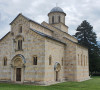
Today, November 25, an exhibition dedicated to Serbian cultural heritage listed as World Heritage in Danger—specifically the monasteries of Decani, Gracanica, Pec Patriarchate, and the Church of the Virgin of Ljevis in Prizren—will open at UNESCO's headquarters in Paris, announced the Ministry of Culture of the Republic of Serbia.
The exhibition marks the 20th anniversary of Decani Monastery's inclusion on the UNESCO World Heritage list as a site of exceptional significance to humanity. Two years later, in 2006, the list was expanded to include three additional cultural monuments in the Autonomous Province of Kosovo and Metohija: the Pec Patriarchate, the Church of the Virgin of Ljevis in Prizren, and Gracanica Monastery. Combining visual art, interactive media, and cultural history, the exhibition aims to convey the profound significance of these sacred sites by immersing visitors in the delicate balance between their spiritual and cultural richness and their current state of endangerment. It showcases both the interior and exterior of these sites, details of their intricate wall paintings, and their importance to Serbian history and the Serbian Orthodox Church. The exhibition will be inaugurated by Serbian Patriarch Porfirije in the presence of Minister of Culture Nikola Selakovic.
The announcement of this exhibition recalls the famous Exhibition of Medieval Art of the Peoples of Yugoslavia, also held in Paris (at the Palais de Trocadéro) in March 1950, accompanied by a catalog with an iconic foreword by Miroslav Krleza. That was a major project of the then-state, featuring a distinguished Honorary Committee that included figures such as Aleksandar Belic and Ivo Andric. There are several parallels between these exhibitions, as the 1950 exhibition also focused on Serbian heritage from Kosovo.
The catalog’s foreword offered an overview of the development of medieval art, particularly Byzantine-style frescoes, sculpture (with pleated ornamentation and tombstones), and architecture (including domed churches in Dalmatia, Romanesque basilicas, and Gothic cathedrals). It also provided fundamental insights into the exhibition's concept, purpose, and the most notable monuments and artists. For Krleza, the centerpiece of the exhibition was Serbian medieval painting, particularly from the pre-Quattrocento period. He highlighted works from Studenica, Decani, and frescoes from the Church of St. Sophia in Ohrid, Nerezi, Sopocani, and Mileseva as evidence that Serbian architects, painters, and sculptors of the time not only adopted Western Mediterranean or Byzantine styles but also developed them in a creatively individual manner.
In a measured critique, as summarized in an encyclopedic entry, Krleza argued against self-satisfied glorification of the past, while asserting that these artistic achievements were proof of the creativity and talent of people working in politically and economically challenging circumstances. He noted that Kosovo's frescoes were “just one part of our medieval painting across the region from the Alps to Serbia and Macedonia.” To underscore their unique value, he referenced authorities such as Jirecek, Kondakov, and French researchers.
Alluding to Ottoman conquests, Krleza stressed that the region’s medieval civilization collapsed in the cycle of wars that enabled Western Europe to thrive and create its unparalleled artistic achievements. He wrote, “Our artists also participated in this effort, and one modest piece of evidence is this exhibition.”
The impact of the 1950 exhibition in France, and beyond, was immense. Its success was one reason why the then-authorities supported Krleza’s founding of a distinct institution, the Lexicographical Institute, which was tasked with continuously researching, documenting, and publishing key achievements in the fields of culture, science, and art.
In today’s entirely different context, one can only hope that the current exhibition will have some positive influence. The times have changed, and this is no longer the same country, but many of Krleza’s artistic and cultural-historical judgments remain relevant. Let us hope that enough people in Paris will have the sensibility to engage with this subject matter.

0 comments