
Adem Demaci - "armed prophet" of the Albanian national movement in Kosovo (5)
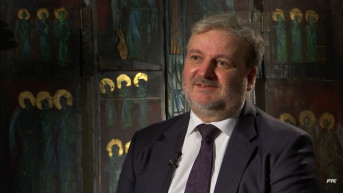
Writing for Kosovo Online: Dragan Bisenic, journalist
The creator and president of the imaginary "Balkania"
After active involvement in the political life of Kosovo, Demaci launched his idea of creating an alliance of Balkan states that he called "Balkania". Demaci proposed this between 1993 and 1998, and he presented this proposal to the Serbian public two weeks before the New York meeting in an authored text by Adem Demaci titled "Temporary Balkania", published in the then-weekly "Nasa Borba" on March 22-23, 1997. The essence of the proposal was to divide Serbia into "Serbia" and "Kosovo" and to form a confederation with Montenegro, creating an alliance of three "states".
This was a significant departure from all of his previous concepts and a complete negation of his earlier calls for violent resistance and active opposition to the Serbian authorities, which was the platform from which he criticized Ibrahim Rugova and his "conciliatory policy". Perhaps this radical change in Demaci's stance was influenced by the war events in the surrounding region and the massive civilian casualties, which convinced him that such a development would be disastrous for Kosovo and should be avoided. On the other hand, at that time, there were several strong actions by the international community seeking to address the future resolution of Balkan issues through strengthening regional connections and alliances. Earlier, Slobodan Milosevic had proposed a confederation with Greece and Turkey, which was a kind of revival of the Balkan Alliance from 1953.
In early 1996, in a series of public appearances, Adem Demaci openly and strongly advocated for the common life of Albanians, Serbs, and Montenegrins in an association or confederation that would include Kosovo, Serbia, and Montenegro as equal state entities.
According to him, this would be a way to avoid a large-scale Albanian-Serbian, and probably wider, bloodshed over the Albanian issue in this part of the Balkans, to comply with the demands of the international community that state borders not be forcibly changed, and to overcome the problems of the historical backwardness of Albanians in the political-legal resolution of their status and relations with neighboring peoples. According to Demaci, Kosovo Albanians would thus abandon their demands for full state independence and entrust the aspirations of their community with Albania to the historical flow of Balkan and European integrations.
Only his Parliamentary Party openly supported the proposal, which issued a statement on April 2, 1997.
The Presidency of the Parliamentary Party of Kosovo announced that it had endorsed the "Balkania" project for a mini-Balkan federation recently proposed by the President of the party, Adem Demaci. The statement noted that Demaci's proposal was "in line with the program and political concept of the Parliamentary Party of Kosovo, and in line with the Referendum on Independence from 1991".
The Balkania project is a "concrete project that can help avoid the pressure and increasingly arrogant attitudes of the international community that Kosovo's issue should be resolved within Serbia's borders, and that Albanians are a minority," the statement said. The party concluded that the Balkania project was one that could certainly garner international community support for Kosovo's independence, evidently conveying the views and arguments of its leader.
In an interview during those days with Kosovo correspondent Dragan Banjac, Demaci discussed some details of his proposal.
Q: Do you perhaps see yourself as the President of Kosovo two years from now?
Demaci: I have no ambition for power, especially to be such a president of an independent Kosovo. But I have accepted to be the president of such a confederation - Balkania. This is also my idea. I was the first to propose the idea of a confederation, and I will work on it. A month ago in Thessaloniki, a Greek person jokingly said to me that it's not a bad idea for the capital of the Balkan Confederation to be Thessaloniki. I told him it's not a bad idea because Thessaloniki is a good city. Still, there's no need to think of a better capital than Belgrade. Why not Belgrade?
Q: Until when?
Demaci: He thought that after a year or two, the Serbian regime would get tired. I can't know what the situation will be like when that regime gets tired, but I'm sure we're in a situation that needs to be discussed. But for me, the minimum is to return to the autonomy of 1974 and be the basis for discussions about the Confederation.
Q: What kind?
Demaci: Between Kosovo, Montenegro, and Serbia. He believed that any other solution would be a waste of time and unnecessary bloodshed. The Albanians are ready for this significant compromise so that we can continue to coexist with the Serbs and the Montenegrins. But not just under Serbia or Montenegro anymore, but together with the Serbs and the Montenegrins as equals.
Q: Balkania?
Demaci: This is a permanent solution. First, Macedonia will join us, then Bosnia and Herzegovina. And later, even Croatia, even though they say we are Europeans and don't want to be in the Balkans. But they are more interested in joining our confederation than staying out of it. If all of this succeeds, it would pave the way for a great Balkan Confederation. When Turkey and Greece reconcile!
Q: Is this a sustainable solution?
Demaci: He thought he lacked nothing. We are all Balkan people; no one can say we are not Balkan, and this is an achievement. Tudjman certainly doesn't want it, but "Tudjman supporters" will soon be gone; he played his role. The Croats have "Croatianized" themselves, even too much. Now they have realized that independence doesn't fix everything, and there's still a great need for others.
Q: What is your Parliamentary Party, and what have you personally committed to?
Demaci: We are committed to extending a hand to the Serbs and resolving problems peacefully. Maybe all of this doesn't depend on me and my party, it doesn't even depend on the Serbs because they have been manipulated and have accepted a policy that leads to bloodshed. You know that my party advocates for something else; I wrote the plan or concept of "Balkania", and from what I know, the Democratic Party of Kosovo still adheres to the idea of an independent republic and liberation, which doesn't align with my stance and the stance of my party regarding my project. My project doesn't go far from a free Kosovo, but it holds that we should build a state: of Kosovo Albanians, Montenegrins, and Serbia, without changing the current borders, and finding a way for no one to remain a minority, to be equal, and to permanently remove Serbian hegemony.
By raising the issue of a community with other nations, Demaci couldn't escape political criticism from all sides. More or less openly, he was practically accused of national betrayal because he abandoned the idea of an independent state of Kosovo, that is, for promoting proposed forms of coexistence with the Serbs and the Montenegrins. On the other hand, partially concealed and mostly covertly, he was accused of allegedly aiming to provoke armed conflicts with the Serbs and Serbia. Taking into account the desires of Albanians, however realistic they may be, to break free from Serbian rule as soon as possible, this propaganda, coupled with other fabrications, hindered the penetration of Demaci's ideas into the Albanian population.
The proposal was rejected, and it was also rejected by the Serbian public for several reasons. Demaci's influence among Kosovo Albanians at the time was weak, and it was estimated that the decision on Kosovo's status could only be made by strong political figures on both sides, such as Milosevic and Rugova (with Washington's mediation and guarantees). There were suspicions that, on the Albanian side, this was only a tactical cover-up for the ultimate goal since the confederation, as a union of states, would be just a transitional stage to full state independence for "Kosovo". In the end, because it was a confederation, introducing a third entity would mean that Serbia could always remain a minority compared to Montenegro and "Kosovo" in future political games.
This proposal of a "triple federation" was raised again after the dissolution of the Federal Republic of Yugoslavia and the creation of the state of Serbia and Montenegro, but it was undermined by the declaration of independence and the secession of Montenegro. If Demaci's "Balkania" had existed, there is no doubt that it would have followed the same path, making it practically the least painful and simplest way for Kosovo Albanians to achieve independence. Demaci was right from that perspective.
Things didn't go in that direction because no sovereign state agreed to have a part of its territory detached without a war. Analysts noted that "it is known that not much time will pass before neighbors want 'more'. Czechoslovakia gave up the Sudetenland by the Munich Agreement in 1938, but just a few months later, Germany, Hungary, and Poland divided Czechoslovakia and made that country disappear from the map.
That's why Serbia did not, in the 1990s or now, give up Kosovo because it is only a matter of time before other neighbors come to claim 'more'.
Tomorrow: Announcement of the final showdown with Rugova



comments