
Nikolic: Kurti is paying the price for his policy of exclusion, terror, and conflict
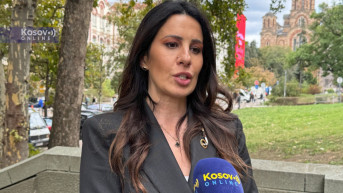
Danijela Nikolic, Chair of the Serbian Parliament's Committee for Kosovo and Metohija, assessed today that the policy of exclusion, terror, conflict, and refusal to compromise has backfired on acting Prime Minister Albin Kurti, adding that he will be unable to form a government and that Pristina is heading toward new elections, Radio Television Gracanica reported.
Nikolic assessed that the 53 seats won by the Self-Determination Movement are insufficient for Kurti to form a government and that Pristina is facing a deep political crisis.
"When you pursue a policy of terror and conflict, that policy eventually begins to consume its own creator. And that is Albin Kurti. You cannot talk to the opposition in the way he did during the campaign, insulting and humiliating them, and then expect them to give in and say, 'Albin, let us now form a government together, we will be partners,' and so on. Regardless of that, even if they somehow reach an agreement, although the August 7 deadline has definitively expired," Nikolic said, as reported by Radio Television Gracanica.
She believes that Pristina is definitely moving toward new elections.
"However, I do not believe that new elections will resolve the crisis, just as the previous ones did not. They only deepened the crisis further, as we have seen, because he has no partners with whom he can form what could be called a stable government, nor can he elect the so-called president of the so-called Kosovo. He simply does not have the support for that," Nikolic assessed.
She stressed that, in addition to his treatment of the opposition, Kurti would also pay the political price for his treatment of the Serbian community, regardless of the fact that, as she said, he enjoys the support of part of the international community.
"The international community has repeatedly called on Albin Kurti and those institutions to finally consolidate themselves and become strong and functional. They are now calling for dialogue and saying that Kurti must sit down and talk with the opposition. Dialogue is clearly necessary, but somehow they are selective and flexible when it comes to the Belgrade-Pristina Dialogue. Those are their double standards. When dialogue is discussed, it somehow becomes optional when it comes to the Community of Serb Municipalities and everything else," Nikolic said.
Regarding the Serbian community, she said that it does not have sufficient political weight or power to significantly influence Albin Kurti's actions.
"We can do what is within our power, and by that I mean on the ground and through the institutions. What we and official Belgrade can and do undertake is to continuously draw attention to Albin Kurti's unilateral actions. Our interlocutor is the international community, as part of our territory is under an international protectorate. It has become clear that there can be no meaningful dialogue with Pristina because Albin Kurti is uncompromising. For him, a policy of compromise, and compromise itself, represents weakness. His own opposition will ultimately make him pay the price for that," Nikolic said.
She pointed out that the latest incident in the Kosovo Assembly, when MP Time Kadrijaj from Ramush Haradinaj's party threw eggs at Kurti, represented a serious blow to him.
"Within their Albanian circles, she is regarded as someone who was in the KLA, someone who has certain merits from what they regard as their liberation wars, and so on. She is very important to them. Therefore, this is quite simply a slap in the face for Albin Kurti, even though he has continuously tried to secure the support of the KLA's hardline wing. What could be worse for him than having her approach him like that and throw eggs at him?" Nikolic said.
She added that Kurti's policies had also been penalized by Washington through the U.S. decision to suspend the Strategic Dialogue with Pristina, describing this as a clear message that Albin Kurti does not enjoy Washington's full support.
"Washington is extremely powerful and, of course, the United States was the first country to officially recognize that false state and has enormous influence over the political scene and political circumstances there. The opposition trusts the United States and, to a certain extent, relies on it, while Albin Kurti has chosen a different political path of support, one that leads toward the countries of the European Union," Nikolic assessed.
She said that if they genuinely wanted to resolve the crisis, the United States, given its considerable political and security influence among Albanians in Kosovo, could do so, as could EU countries.
"The international community can condition Pristina's behavior through financial assistance and other mechanisms. They have the tools when they want to use them, but they have simply allowed them to destroy themselves politically," Nikolic said.
She stressed that even the political elite in Kosovo does not accept what she described as Kurti's policy of terror, although not because of concern for the Serbian people.
"They are essentially united when it comes to Serbs. But the problem here is among the Albanians themselves. The problem is the crisis that exists within their community. Unemployment is high, they live on donations, and many people have left Kosovo and Metohija. Over the past two years, 20 percent of Serbs have left as a result of Albin Kurti's terror, but many Albanians have also left because of a policy that leaves people struggling economically while offering them empty promises," Nikolic stressed.
She said that Kurti believes every attack on Serbs increases his approval ratings, concluding that, if that were really the case, he would now be able to form a government easily and would enjoy the confidence of his political partners.
0 comments