
Weaponized humanitarianism is destroying the world
Written for Kosovo Online by Srdjan Garcevic, founder of The Nutshell Times
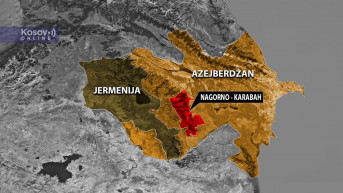
As the last buses with Armenians are leaving Nagorno-Karabakh, I wonder what all those self-righteous apostles of “humanitarian interventions” and “responsibility to protect” are doing. The passionate sermonizing we are so used to from their traditional mainstream media pulpits seems gone.
This silence is not because the plight of Armenians is not known. The Armenian diaspora is large, visible and present in much of the West. Moreover, more than thirty countries have recognized the genocide of Armenians in 1915-16, and this atrocity is so famous that the usual humanitarian bunch must be acquainted with it.
Indeed, the tragedy of around a hundred thousand Armenians being forced to leave their homes and holy sites is precisely what the self-anointed moral priesthood from the strange nexus of Western academia, government, NGOs and media claims is working so tirelessly and selflessly to prevent through all means necessary, and yet there is hardly a pip.
It is equally appalling that other major regional and global powers – Turkey, Israel, Iran, Russia, China – are allowing this ethnic cleansing to happen. Most of them, however, are very much at ease admitting that they are, ultimately, treating global politics as a game of thrones, in which all sorts of alliances and unsavoury actions are permitted to gain the upper hand.
On the other hand, the humanitarian clergy insist that they operate with firm moral boundaries of good and evil. They are constantly engaged in this or that Manichean struggle to protect the weak against the forces of evil and inhumanity and are eager to punish anybody who stands in their way. It is them who film moving videos, write books about problems from hell and emote at lectures or on camera, trying to sell yet another war (usually euphemized as “kinetic action” or something) to end evil, once and for all.
Nobody who ever looked at their track record, let alone those who experienced their beneficence, can believe in their good intentions. For Serbs, it was their callousness towards the ethnic cleansing of Serbs from Croatia in 1995 and most of Kosovo and Metohija in 1999 (followed by constant attacks and property destruction until now) that made us raise our eyebrows whenever this set invoked humanity and humanitarianism.
The point of this article is not to enumerate the instances of hypocrisy by our humanitarian clergy.
In the 19th century, Pierre-Joseph Proudhon realized that whoever invokes humanity does it to cheat, and the stories about the dangers of false moralism have been around since the Pharisees sent Christ to the Romans. Carl Schmitt most sharply explained the opportunistic, devious use of humanitarianism as he warned that “to confiscate the word humanity, to monopolize such a term, probably has certain incalculable effects, such as denying the enemy of being human… a war can thereby be driven to the most extreme inhumanity”.
Whenever I confront a Balkan-focused professional humanitarian with facts showing that the cause they support has an effect of actually reducing tolerance and well-being in the region, I would invariably be hit with more theatrical moralizing. Ultimately, however, as Schmitt predicts, they would confess that one of ethnicities' interests is invalid, dismissing it as a "victimhood complex". “Well, it was a free-for-all all in WWII here”, one of them coldly uttered during one of such discussions and then proceeded to emote about something else.
It is no wonder that humanitarian clergy is filled with diaspora ethnonarcissists with a bone to pick and whose hatred of their nation's enemies is probably only matched by people who actually commit massacres. While the latter are killed or tried, the former can forever sit in comfy office buildings and universities in leafy towns and enjoy pleasant soirées.
It is important to remember that one of the reasons why they are tolerated is that, for societies and international communities to function, there needs to be a veneer of morality and order, even when it is false.
The "never again" of WWII was almost immediately followed by massacres and ethnic cleansings – ask Italians from Istria or Germans from practically the whole of Eastern Europe - however, the consensus around the necessity of limited use of force did keep the world from nuclear destruction. While that consensus was probably more due to the balance of powers, its widespread, global acceptance was found due to the unwillingness to repeat the horrors of WWII, represented by what the Axis forces and their allies did.
Almost eighty years later, however, even this foundational story of global relations is being nipped at by the humanitarian clergy. In the past few years, they expended more energy on proving how SS-affiliated persons were not that bad than on solving the tragic Azeri-Armenian conflict. By trying to blow up the precious little consensus there is, with all the best intentions, they are making the world less safe.
This means that it is high time for accountability: our humanitarians should finally do what they instruct everybody else - take responsibility for their actions and results.
Watching Nagorno-Karabakh reminds me of what happened to Serbs in Croatia in 1995 and what many of our humanitarians would not mind seeing happen to Serbs in Kosovo and Metohija.
In the past forty years, millions of lives have been destroyed by weaponized humanitarianism. Things could have been different: a former Azeri colleague of mine from Baku remarked how his city, back in the 1980s, used to be very mixed, with many of his friends being Armenian. Nevertheless, many great humanitarian leaps forward, led by our humanitarian clergy, led us to even Nagorno-Karabakh being almost entirely Armenian-free.



0 comments