
Blinken: Dialogue is the only way, we want all agreements to be implemented

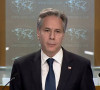
The US Secretary of State Antony Blinken emphasized today in Vienna that the US supported the normalization process of relations between Kosovo and Serbia and stated that all agreements from the dialogue must be implemented.
"We support the improvement of relations between Kosovo and Serbia. Dialogue with EU mediation is the only reliable way to progress in this process. We want to see goodwill and a constructive approach from both sides," Blinken said at a joint press conference with his Austrian counterpart, Alexander Schallenberg.
He conveyed that both sides should avoid tensions, increase transparency, and collaborate with international partners.
"All agreements from the dialogue must be implemented," Blinken emphasized.
He said that the US was cooperating with Austria regarding the Western Balkans and praised Vienna's engagement, particularly highlighting Schallenberg's efforts in stabilizing the situation in the region.
"The Western Balkans is something close to our hearts, especially to President Joe Biden. For the President and me, as well as for the world, the focus in the nineties was on the Balkans, Bosnia and Herzegovina, and Kosovo. What we don't need, especially the citizens of the region, is a return to the past, to go back to the nineties," Blinken emphasized.
He said that thanks to Austria's leadership, the region was progressing towards European integration.
He emphasized that the US supported a democratic, peaceful, and prosperous Western Balkans integrated into the EU.
Therefore, he added, the US supported the recommendation to open EU accession negotiations with Bosnia and Herzegovina.
"We encourage leaders in Bosnia and Herzegovina to bridge divides and implement reforms on the path to the EU," Blinken said.
He added that the US was collaborating with Austria to amplify the voice of the new generations in the Balkans.
"We want to ensure that the voice of the new generation in the Balkans is heard because it is a voice for peace, security, and the future, which means the path to the EU," Blinken emphasized.
Schallenberg conveyed that he and Blinken had also discussed Austria's immediate neighborhood, which was the Western Balkans.
"At a time when a fire is raging in Europe, we must ensure a stable immediate neighborhood. Either we export our way of life or risk instability and insecurity in the neighborhood," Schallenberg warned.
He said that Austria advocated for opening accession negotiations with Bosnia and Herzegovina and reminded that Vienna had always supported the European integration of the Western Balkans.
Asked about Austria's neutral position, regarding the decision of Finland and Sweden to join NATO, Schallenberg said that the history and geographic position of those countries were different.
"Our neutrality is only military, not in terms of values and principles. We are not neutral towards countries that violate the UN Charter and the principles of international law," he added.
Schallenberg recalled that Austria, in 1956, immediately after declaring neutrality, had condemned the entry of Russian tanks into Budapest.
"International laws are not just documents; they make us safe, and therefore it is necessary to respect all international rules," he emphasized.
Schallenberg said that neutrality had enormous support among the population and that 80 percent of Austrians did not want it abolished.

0 comments