
Antony Blinken in Tirana, messages for both Belgrade and Pristina on the table?
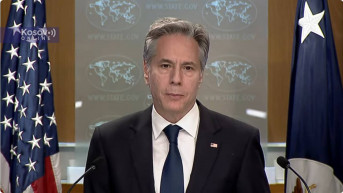
The first visit of the US Secretary of State Antony Blinken to Albania is seen in this country as a confirmation of the very good relations between Tirana and Washington and as proof that Albania is a key partner for the stability of the Western Balkans in the eyes of the United States. Bearing in mind the significance of Blinken's visit for the entire region, the discussions he will have in Tirana, as Kosovo Online interlocutors believe, will also touch upon the relations between Kosovo and Serbia.
Blinken is expected to be in Tirana tomorrow and will meet with Albanian President Bajram Begaj and Prime Minister Edi Rama.
According to the expectations of our interlocutors, Blinken could ask Albanian Prime Minister Edi Rama to influence both Pristina and Belgrade to implement the agreement from Ohrid last year as soon as possible, especially to influence Kosovo Prime Minister Albin Kurti, as Washington, to put it mildly, does not look favorably upon his actions, such as the recent decision regarding the ban on the dinar.
Perhaps the answer to why the US Secretary of State, at least according to the announcements from the State Department, will not use his visit to Europe - to attend the Munich Security Conference and to visit Tirana - for a visit to Kosovo lies in this. Officials from Pristina loudly present Kosovo as the most pro-American oriented in the world, and within KFOR, American soldiers are among the most numerous.
Political analyst from Tirana Aleksander Cipa tells Kosovo Online that the visit of US Secretary of State Antony Blinken to Albania is of exceptional diplomatic and strategic importance and that the US considers cooperation with Albania to be of special geopolitical importance in the region. He states that two issues are expected to be discussed during Blinken's visit - the situation in the region and institutional coordination between the two countries.
"The visit is diplomatically important because Albania is constantly confirming itself as a strategic partner of the USA. Of course, Albania has a strategic alliance with several other countries, but the relationship with the US has a special weight because of what the USA represents in the international arena. The visit is also important in a historical sense because Washington has continuously supported Albania for a hundred years. I would like to remind you of the statement of the former US Secretary of State, Hillary Clinton, during her visit in 2012, that we had been together for 100 years and we would be together for the next hundred years. This is a statement of deep diplomatic meaning, which is very important for our region, which these days has numerous divisions. In this sense, the US considers cooperation with Albania to be of particular geopolitical importance in the region. That is why the US State Department, before Blinken's visit, announced that Albania was a reliable ally that helped stability in the region and which had a pro-Euro-Atlantic approach, an approach that was not so strong in other countries of the region," Cipa says.
He also states that the visit is important concerning the situation in the region, especially in Kosovo, and concerning its relations with Serbia.
"The pressure that Serbia exerts on the northern part of Kosovo and the Serbian pretensions is well known because the status of the north has not been determined yet. Problems also arise due to the discrepancy between reality and UN Resolution 1244. Today, Kosovo has become an independent and functional state. The US, more than anyone else, emphasizes the fact that Kosovo is a functional state. Blinken's visit is also important in connection with the international situation, the war in Ukraine, and the influence of other major powers in the region. Our country is under great pressure and due to the interests of countries such as Turkey, Russia, and others that influence the problems of the region, created by history. It is known that this peninsula has historical inter-ethnic conflicts and disagreements. It is also a delicate situation in Bosnia and Herzegovina, where Russia has a negative influence and where a global power like China is joining with its investments and infrastructure projects," Cipa says.
He points out that during Blinken's visit, the differences between Albania and Kosovo on various issues will be discussed.
"It is known that Prime Minister Kurti has diametrically opposite views on some regional projects from Prime Minister Rama, and this includes the difference in his attitude towards a country like the USA or even the most powerful countries in Europe. The relationship between Kurti and Germany was often very important, but there were also problems, especially in connection with the Franco-German plan for an agreement with Serbia. Kurti had conflicts with Serbian President Aleksandar Vucic over several chapters of the agreement, especially the one related to the Community of Serb-majority Municipalities, i.e. the treatment of Serbia's national currency, the dinar. These issues were discussed at a high level and led to the suspension of the dialogue. Today, there is pressure not only to continue the dialogue, but also to follow up the dialogue, and the talks between Pristina and Belgrade are expected to be more difficult than before. In this sense, Blinken's visit to Tirana brings a message in accordance with the EU position, to influence the relations between the countries of the Western Balkans", Cipa assesses.
Cipa says that it is not surprising that US diplomacy, through its highest representative, the Secretary of State, chooses Germany and Albania to visit.
"Those two countries have specific influences in different regions. Germany has influence on the European continent, and Albania in the Western Balkans. The visit to the Balkans takes on special importance because the USA is interested in the institutional strengthening of the Balkan states, functional democracy, and the rule of law. Several institutions were founded in cooperation with the Americans. Not by chance, Blinken has a meeting in Tirana with the head of the Special Structure for the fight against corruption and organized crime. This institution is a US investment that brought legal stability to Albania, something we lacked in the past. Today is different and striking at high-level corruption is a US strategy. The visit to Germany of course has other purposes, especially in connection with the fact that the US role in NATO has been called into question due to the US election campaign. Blinken brings a message to confirm this alliance between the US and Europe," Cipa says.
Former Serbian Ambassador to the United States, Ivan Vujacic, says that with Secretary of State Antony Blinken's visit to Albania, Washington aims to show the region that Albania is making the most progress in Euro-Atlantic integrations.
"Blinken is coming to Albania because Albania is a NATO member and has EU candidate status, without excessive problems or disputes with others, nor does it have significant internal issues. While there are internal disagreements, they are not as significant as in other parts of the region. They want to confirm their partnership with Albania on one hand, and on the other, effectively show the region that Albania is making the most progress in Euro-Atlantic integrations and potentially toward the EU. Because if the EU decides to admit a country in the near future, they will look at the map and say: This is the country with the fewest problems and the greatest desire. This is probably another support for Albania to move in that direction," Vujacic says to Kosovo Online.
Regarding what messages Blinken could convey to Pristina and Belgrade from Tirana, Vujacic says they will relate to the implementation of the agreement reached in Ohrid last year.
"One of the things that emerges from this visit is a message to both Pristina and Belgrade that Blinken won't engage in discussions with them until something moves forward. This likely influences both Kurti and Vucic to adhere to the Ohrid agreement and implement it as soon as possible because they currently have a bad situation, and according to American perspectives, both Kurti and Vucic are probably to blame: Kurti for delaying his obligations regarding the Community of Serb-majority Municipalities, and Vucic for Banjska and the failure to implement an investigation on that matter. That incident greatly angered Washington and Blinken himself called him because of it. So, the messages will be in the sense of starting to implement what they agreed upon, and I also assume that Blinken will ask Edi Rama to influence both of them in that direction," Vujacic says.
Regarding how it can be interpreted that the US Secretary of State will be close to Kosovo but, at least according to the State Department's announcement, will not visit, Vujacic says it's because America considers Kurti part of the problem.
"They believe he is not constructive, and this is a demonstration toward him. Even at the Security Council, Kurti did not fare as he probably expected, but worse than he thought. He was made aware that they are not satisfied with his attitude toward the Serbs in Kosovo and his obligations," Vujacic notes.
Political commentator and journalist Bosko Jaksic says that during his visit to Tirana, the US Secretary of State Antony Blinken will reaffirm the strength of the friendship with Albania and points out that this is the first visit of a US Secretary of State to Albania in eight years. He adds that it is evidently aimed at expressing US respect for the results achieved by Albania's policy in the region in recent years.
Jaksic emphasizes that Blinken will primarily support the processes of reforms, strengthening institutions, and judicial reform in Tirana, but he believes that the issue of Kosovo's security will undoubtedly occupy a significant part of the agenda.
"Prime Minister Edi Rama stated ahead of the visit that Blinken was coming to Tirana as a place dedicated to regional peace and praised US efforts, along with those of the European Union, for normalizing relations between Belgrade and Pristina. What could be expected and seems quite logical is the support America will seek from Edi Rama to influence Prime Minister Kurti, as Kurti's actions have long been viewed unfavorably in Washington, and it's known how much trouble his decisions, such as the abolition of the dinar as the latest in a series, create for American policy. So, Blinken will likely seek a favor of good will from Prime Minister Rama to try to influence Kurti. Whether he will succeed, considering Kurti's behavior, is another completely uncertain question to which there is currently no answer," Jaksic tells Kosovo Online.
Kosovo was not on Secretary Blinken's agenda, as announced by the State Department, and Jaksic links this to the US stance toward Serbia.
"It is evident that avoiding a visit to Pristina is a deliberate move because its repercussions would signify a negative stance toward Serbia. When we see that all international envoys dealing with Kosovo visit Pristina first and then Belgrade or vice versa, but they go to both locations, then going only to Kosovo would cause an imbalance that America does not want because it would lose its position toward Belgrade," Jaksic assesses.
On the topics that will dominate in Tirana, a political analyst from Pristina Blerim Burjani sees things differently. He believes that Blinken's agenda concerns only Albania and that he will talk about the country's role in NATO, the fight against corruption, and other internal issues.
"The US Envoy will have consultations on major topics such as peace in the Balkans and Albania's role in NATO in these circumstances. Kosovo is not a bigger problem than Republika Srpska and Bosnia and Herzegovina. I think there will also be discussions about the Special Anti-Corruption Structure," Burjani said for Kosovo Online.
Ahead of Blinken's visit to Tirana, State Department spokesperson Matthew Miller stated that Albania had strongly supported the defense of Ukraine's sovereignty and freedom from Russian aggression, and had demonstrated principled leadership during its tenure on the UN Security Council and as Chair of the OSCE in 2020. Regarding Blinken's planned activities in Munich, Miller said that the Secretary of State would have bilateral meetings with global leaders there and would emphasize the importance of the US's continued commitment to NATO during the security conference.



0 comments