
Bozovic: New laws in Kosovo will prevent doctors from working and jeopardize patient transport
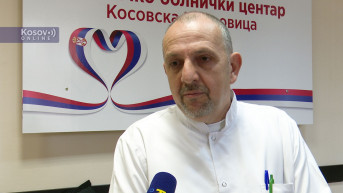
Orthopedic specialist and professor at the Faculty of Medicine, University of Pristina with temporary seat in North Mitrovica, Aleksandar Bozovic, told Kosovo Online that he is concerned ahead of the start of the implementation of the laws on foreigners and vehicles, announced for March 15.
Bozovic points out that these laws affect both employees and patients of the Clinical Hospital Center Kosovska Mitrovica in two ways. The first problem, he says, is that doctors and medical staff who do not have Kosovo documents will not be able to come to work, while the second problem is the transport of patients, because all ambulances have license plates from cities in central Serbia.
“First, a large number of colleagues do not have Kosovo documents and from the 15th they will practically be prevented from performing their work duties. However, a much more important issue is possible patient transport because of the law on traffic, that is, on vehicles, since our ambulance vehicles are registered in Raska or Belgrade, precisely because it is impossible to properly register them within the system of the provisional institutions of Kosovo. So the concern is enormous. The question arises of the proper and adequate 24-hour functioning of the healthcare system,” Bozovic said.
He also emphasizes that patients are very concerned about whether doctors will be able to provide healthcare services adequately and with the same quality as before.
“You know that we have tertiary connections with institutions in Belgrade and other clinical centers in Serbia. So functioning in terms of difficult patient transport with our vehicles further complicates the proper method of treatment. So there are two problems. One is the issue of ID cards, that is, documents of the Republic of Kosovo or the provisional institutions, and the other is adequate transport. The third aspect is the supply of medical materials and everything we need for normal work. My opinion and the opinion of all colleagues employed at the clinical center where I work is that we will certainly remain here to live and work as we have until now and wait for new developments or a new decision related to these laws on vehicles and foreigners,” our interlocutor said.
As a professor at the medical faculty, he believes that strong institutional pressure is being exerted on this institution, where a large number of young people study who are not from Kosovo and who will be directly affected by this measure.
“The university where I work is an officially accredited institution, a member of numerous international associations and university networks, with all possible study programs that are international. It is difficult to carry out such direct institutional pressure on us. But, as at all universities, there is a large number of people, teachers as well as technical staff, who do not have Kosovo documents but are officially employed. So that part of the issue related to their direct presence in ensuring the normal functioning of the university might somehow be compensated. However, what is more subtle is that a huge number of students studying at our university do not live in Kosovo. Considering that under the Law on Foreigners they cannot stay adequately for a certain period of time, you also cannot achieve the full teaching scope. Students and colleagues who cannot be here for the full period required will lose a lot in the teaching process related to practical work with patients, so this is a more subtle way of reducing the level and quality of educational services for our students through their absence,” Bozovic explained.
Although there are fears that classes will be significantly disrupted by the implementation of the Law on Foreigners, Bozovic is certain that everyone who has been doing their job diligently so far, both at the clinical hospital center and at the university, should continue to do so in the coming period, for the benefit of both patients and students.
“We more or less know what we need to do, so we will work even harder and more firmly both with patients and with our students, we will wait for political decisions related both to the political leadership of Serbs and to the political leadership of our country, Serbia, and in accordance with that we will behave, live and work, because we have been doing so for centuries in these areas,” Bozovic concluded.
0 comments