
Brnabic: Spain unwaveringly respects Serbia’s territorial integrity
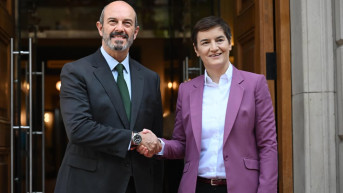
Speaker of the National Assembly of Serbia Ana Brnabic stated today in Madrid, following meetings with Spanish officials, that political and economic relations between Serbia and Spain continue to improve, while expressing gratitude to Spain for its support for Serbia’s territorial integrity. Brnabic also emphasized that the initiative launched by President Aleksandar Vucic for Serbia to join the European Economic Area and the Schengen Area would be the best solution for both citizens and the economy, adding that the integration of the entire Western Balkans would represent the optimal outcome, RTV reported.
During her visit to Madrid, Brnabic met with the President of the Congress of Deputies, Francina Armengol, and began her official visit to Spain with a meeting with the President of the Senate, Pedro Rollán, describing the meetings as cordial and friendly.
“Today we are visiting an exceptionally friendly country, a country that consistently safeguards Serbia’s interests, a country best known to us as one of the five states that do not recognize the so-called Republic of Kosovo,” Brnabic said, according to RTV.
She recalled that Spain, as a member state of both the European Union and NATO, genuinely respects and strictly applies the principles of international law and the Charter of the United Nations.
“It is one of those countries that unwaveringly respects the territorial integrity of the Republic of Serbia. Therefore, I was pleased to have the opportunity to speak with the President of the Senate and the President of the Congress, to thank Spain, the Spanish people, and the Kingdom of Spain for that support, and to ask for their continued backing and for them to remain our voice—and, ultimately, the voice of the Serbs in Kosovo and Metohija—in European institutions, in the European Council, and in the Council of Europe, at a time when the Serbian people are exposed to unprecedented pressure from the institutions in Pristina,” Brnabic stated.
She assessed the visit as particularly important given that this year marks the 110th anniversary of diplomatic relations between the Kingdom of Spain and Serbia.
“Our political and economic relations continue to improve. A turning point was undoubtedly the visit of Spanish Prime Minister Pedro Sánchez to Serbia in July 2022. It was the first-ever visit of a Spanish Prime Minister to the Republic of Serbia. Since then, both political and economic cooperation have gained significant momentum,” Brnabic said.
According to her, 2022 was the first year in which bilateral trade exceeded one billion euros, adding that last year it surpassed one and a half billion euros.
“We are seeing an increasing number of Spanish investments, but Spain is also participating in a growing number of infrastructure projects in Serbia, including the Belgrade Metro, as well as energy projects in the Republic of Serbia. We therefore discussed additional forms of cooperation and how parliamentary cooperation can be used to strengthen and further bring our two countries closer together,” Brnabic said.
She emphasized that Spain has not only confirmed its participation in Expo 2027 but will also be among the twelve countries with the largest pavilions.
“They are already making extensive preparations for their participation and view it as one of their most important foreign policy initiatives and international presentations during 2027. This demonstrates just how important Expo is in terms of international cooperation, diplomacy, and the promotion of Serbia, but also in creating much stronger bilateral ties with countries that are close to us, as well as with those with which we have not previously had particularly close relations,” the Speaker of the National Assembly stated.
As she added, Expo represents an opportunity both to strengthen existing cooperation and to launch new partnerships.
“An exceptionally successful visit—cordial and friendly. Let me conclude by saying that Spain is one of the countries that strongly, directly, and openly supports Serbia on its European path. Spain has given all necessary approvals for the opening of Cluster 3, is always ready to assist, and consistently advocates Serbian interests within European institutions,” Brnabic said.
She added that she thanked Spanish officials for this support and encouraged them to be even more vocal in the future.
“They even proposed joint parliamentary initiatives that could contribute to accelerating Serbia’s European path,” Brnabic underlined.
The Speaker of the National Assembly also stated that it would be a “win-win” situation for both Serbia and the European Union if President Aleksandar Vucic’s initiative for Serbia to join the European Economic Area and the Schengen Area were accepted. She further assessed that the integration of the entire Western Balkans would be the best solution and noted that the EU had, in the past, demonstrated the ability to make such bold political decisions.
Responding to a journalist’s question as to whether Serbia could accelerate its European path through reforms, given the various initiatives concerning the accession of Western Balkan countries to the EU, Brnabic said that Serbia pursues a practical and pragmatic policy focused above all on the interests of its citizens and economy.
“In that regard, I genuinely believe that the initiative launched by President Aleksandar Vucic—for Serbia to effectively become part of the European Economic Area and the Schengen Area—is the best solution for our citizens and businesses. Ultimately, it would significantly increase our competitiveness, create many more jobs, facilitate the attraction of investments, and improve living standards. Therefore, I would focus on initiatives that can be win-win solutions, delivering immediate benefits to our citizens and economy while also benefiting the European Union itself,” Brnabic stated.
She emphasized that she understands the concerns of citizens and businesses in certain EU member states, which, like businesses everywhere, must bear the costs of administrative structures.
“I understand their concerns that enlargement could make decision-making within the European Union even slower and increase the administrative burden, particularly because enlargement would also require an expansion of the European Commission. If every member state must have its own Commissioner, that eventually becomes impractical,” Brnabic assessed.
She stressed that European competitiveness is increasingly suffering as a result and that the EU needs to become both faster and more efficient.
“Decision-making based on veto rights also creates additional challenges. These are issues we must understand, and within a partnership framework we should work together to identify innovative solutions that would suit both the European Union and us as candidate countries,” the Speaker of Parliament said.
She expressed confidence that the integration of the entire Western Balkans would be the best solution, describing it as a bold political decision, while noting that the EU had previously demonstrated the capacity to make such bold decisions.
“We will continue to advocate for that outcome, while remaining pragmatic and demonstrating that we are constructive partners capable of listening to and understanding the concerns, challenges, and apprehensions of our European partners, and responding to them in a manner that remains in the interest of our citizens and economy. This is currently a topic that is being discussed and considered extensively within the European Union,” Brnabic said.
She added that she had discussed the matter with her hosts and that Spain’s position is that every new member state should immediately enjoy full membership rights and obligations within the EU.
“At this moment, Spain’s position is that every new member should immediately gain access to all EU funds, voting rights, veto rights, and the right to nominate a Commissioner. That is Spain’s position. However, this is also a matter of internal reform within the European Union, so we shall see how developments unfold. What is important for us is to maintain a pragmatic approach,” Brnabic concluded.

0 comments