
Djuric welcomes CEI delegations and Minister Mucunski: A great opportunity to strengthen cooperation
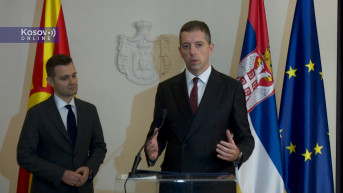
This evening, at a formal dinner held at the Members of Parliament Club in Belgrade, Minister of Foreign Affairs Marko Djuric welcomed the delegations that will participate in the meeting of the foreign ministers of the Central European Initiative (CEI). During the dinner, Djuric held a tête-à-tête meeting with the Minister of Foreign Affairs of North Macedonia, Timco Mucunski, focusing on enhancing bilateral cooperation, regional infrastructure projects, and joint initiatives related to European integration.
Following the meeting with Mucunski, the Serbian Foreign Minister stated that the CEI Foreign Ministers’ Meeting, which will be held tomorrow at the Palace of Serbia, is a valuable opportunity for Serbia and North Macedonia to discuss their relations and mutual support.
“I do not need to emphasize how closely our two countries cooperate and how historically strong our relations are. Nevertheless, in this period, we bear a special responsibility to strengthen both our transport links and our economic activity, as well as cooperation across all segments of society within the broader European agenda,” Djuric said.
The Serbian Foreign Minister added that the two countries strongly support each other on their European paths.
“Serbia supports North Macedonia’s path to the European Union, and our friends from North Macedonia support us. We have many topics relating to regional cooperation,” Djuric stated.
He added that participation in the CEI will be one of the opportunities to discuss all these issues.
“We will also discuss how to intensify our transport connections. In the previous period, we facilitated the movement of people by establishing joint border crossings,” Djuric noted.
Mucunski recalled that Djuric began Serbia’s CEI Chairmanship a few months ago in New York, during the United Nations General Assembly.
Emphasizing that bilateral relations between Serbia and North Macedonia are excellent, Mucunski said that there is still much work ahead.
“Our government’s focus is on investments in Corridor 10. I know that you, on your side, are working intensively on completing the entire project, especially the part concerning railway transport on Corridor 10. We are also currently building a new gas interconnector with Greece, and our next goal is to build a new gas interconnector with the Republic of Serbia as well,” Mucunski said.
He noted that the goal of that project, among other things, is to reduce mutual dependence on gas coming from the Russian Federation and to ensure diversification of gas supply.
He added that work is underway on many other projects and announced that next week a business forum between the two countries will be held in Skopje.
Mucunski stressed that North Macedonia will be pleased to participate in Expo 2027 in Belgrade.
“We are actively working on several joint initiatives related to European integration, such as the ‘green corridors’ initiatives, as well as our joint response to challenges we face in the EU integration process. I would like to stress that we will continue with concrete projects and measures—not only with good political relations, but also good economic and trade relations, and cooperation in education and culture,” Mucunski said.
In this context, he pointed out that an exhibition of several renowned Macedonian artists is opening this evening at the Macedonian Cultural Center in Belgrade.
At the meeting of the foreign ministers of the Central European Initiative, the results of Serbia’s one-year CEI Chairmanship will be reviewed, and the Chairmanship will be handed over to Romania for 2026.
According to the Ministry of Foreign Affairs of Serbia, the event will bring together representatives of all 16 CEI member states, making it one of the most significant regional events of the year.
Serbia took over the annual CEI Chairmanship on 1 January 2025 and, during the past period, focused its activities on four key priorities: supporting the European integration process, the development of artificial intelligence, strengthening regional infrastructure connectivity, and issues related to labor migration.
The CEI, the oldest regional initiative in Central and Southeastern Europe, was founded in 1989 by Italy, Austria, the former SFRY, and Hungary. Today, it brings together EU member states, Western Balkan countries, and the broader neighborhood, connecting them through cooperation in the fields of economy, politics, culture, and youth programs.
The organization’s work in the upcoming period is guided by the 2024–2026 Action Plan, and at the previous ministerial meeting in Tirana, further measures to strengthen the CEI were confirmed.
A particular focus of the initiative remains on cooperation with the European Union and support for EU integration, while regional “project-oriented” cooperation represents the foundation of its functioning.
The Belgrade meeting will provide an opportunity to summarize the results of Serbia’s CEI Chairmanship and set new priorities for the next cycle of cooperation within the framework of the CEI.


comments