
Humanitarian Law Center: 50 cases against 154 members of Serbian forces for war crimes last year
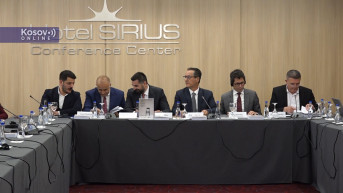
The Humanitarian Law Center (HLC) presented its report on monitoring war crimes trials in Kosovo during 2025, stating that criminal proceedings were conducted or initiated in 50 cases against 154 members of Serbian forces accused of war crimes. During the same period, 15 indictments were filed for these offences, ten of which were issued in absentia.
The author of the report “Trials in Absentia for War Crimes: Between Statistics and the Reality of Justice,” Amer Alija of the Humanitarian Law Center, noted that 182 court hearings were monitored.
“The report indicates that during 2025, criminal proceedings were conducted in 50 cases against 154 members of Serbian forces accused of war crimes. This includes 24 indictments in absentia against 120 defendants tried in absentia. During 2025, the Special Prosecution Office of the Republic of Kosovo filed 15 new indictments. Of these, ten were indictments in absentia,” Alija said.
During 2025, the Special Department of the Basic Court in Pristina also issued ten war crimes judgments, he added.
“One individual was acquitted. It should be noted that in three of these cases, the accused were convicted in absentia and sentenced to the maximum prison term of 15 years. This visible increase in the number of proceedings in absentia makes it necessary for both society and institutions to examine more deeply whether these processes truly achieve the goal of justice—establishing the truth and ensuring justice for victims—or whether they create a reality in which justice remains largely formal and procedural,” he stated.
As he emphasized, trials in absentia require particular attention, as justice cannot be measured solely by the number of indictments, which, he added, is on the rise.
“The report also records important developments in the judicial system, including the strengthening of the War Crimes Investigation Directorate within the Kosovo Police, as well as work on dozens of cases within the Special Department of the Basic Court in Pristina.
A particularly prominent issue is the conduct of trials in absentia which, although permitted by law and increasingly applied, remains an instrument that requires special scrutiny. Justice cannot be measured only by the number of indictments or judgments, but by the confidence that the process was fair, comprehensive, and understandable to victims and society as a whole,” Alija stated.
The Chair of the Humanitarian Law Center and moderator of the roundtable, Bekim Blakaj, pointed out that continuous efforts to address this issue have faced numerous challenges.
“From a lack of capacity and difficulties in securing evidence to insufficient inter-institutional and international cooperation. These challenges have directly affected the quality of justice delivered to victims. However, in recent years, and particularly during 2025, there has been a significant increase in the number of indictments in absentia. This has opened a new chapter in addressing war crimes cases, but has also raised important legal and practical dilemmas, especially regarding fair trial standards and the rights of the accused,” Blakaj said.
As he added, in addressing war crimes through trials in absentia, time is not an ally of justice.
“In that context, it is essential to raise key questions: are we managing to balance the need for justice with respect for international standards, and are victims being offered more than mere promises of efficient and reliable justice after more than two decades? At its core, this is not only a legal issue, but a matter of justice for victims, their families, and society as a whole. After more than two decades, it is clear that time is no longer an ally of justice; on the contrary, achieving justice is becoming increasingly difficult. For that very reason, it is important to make maximum efforts reflected in institutional commitment,” he added.
The Ambassador of Switzerland to Kosovo, Jürg Sprecher, stressed that a higher number of indictments does not necessarily equate to justice.
“Today’s discussion reflects the results achieved, but also highlights a key issue. While we see a greater number of indictments, which may suggest institutional activity and progress, this alone does not necessarily mean that justice is being achieved,” he emphasized.
As he added, the key question is whether these processes lead to accountability, fair trials, and a genuine sense of justice.
“Trials in absentia should be used only in exceptional circumstances, in accordance with standards established at the level of the international community and the European Court of Human Rights. Safeguards must be ensured, such as effective legal representation for the defence. War and human rights violations leave lasting scars. Switzerland has also supported efforts to deal with the past. We believe such initiatives are essential to building an inclusive society. These efforts should continue and contribute to healing wounds and laying the foundation for lasting peace,” the ambassador said.
Judge of the Court of Appeals, Valon Kurtaj, emphasized that with the development of Kosovo’s legal framework, courts and prosecution offices began addressing the issue of trials in absentia.
“The Court of Appeals has established standards and criteria that must be met regarding public information campaigns, ensuring that the accused is informed of how trials in absentia may proceed, particularly if they are indeed in hiding. We have established these standards not hesitantly, but professionally, and with the support of the Humanitarian Law Center itself. We have held several roundtables, inviting judges from Strasbourg to understand their practice regarding trials in absentia and the standards required to ensure that such proceedings are not considered violations of human rights or the Convention. We have harmonized our practices and legislation, and I believe this has opened the way for our legal system to allow, at any moment upon arrest, any person convicted in absentia to request a retrial—an important feature of a democratic judiciary based on sound principles,” Kurtaj stated.
He added that justice does exist in such cases.
“Do we have justice in these cases? I believe we do, as the Special Department—where I previously served—has been very careful and diligent, and I believe the same applies at the level of the Court of Appeals where I now serve. Whether compensation will be provided to victims is something we can discuss, but this is certainly not a failure of our institutions. The best form of justice is when the accused sits in the dock,” Kurtaj concluded.


0 comments