
Kabasic: Setting up cameras in the north is political control of the people
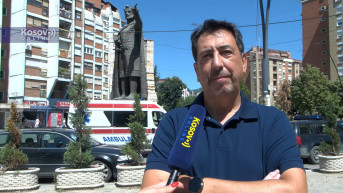
Former judge of the Higher Court in Kosovska Mitrovica, Nikola Kabasic, says for Kosovo Online that while the Kosovo Police have the right to install video surveillance in public spaces if there is a legal basis, the recent increase in the number of cameras installed in North Mitrovica does not make citizens feel safer. As he says, it is more about political control of the population in a territory.
"This is perceived as a form of pressure. The message being sent to citizens is: You are under surveillance, we are watching you, and whatever you do, you could be held criminally responsible," Kabasic says.
He explains that there are two laws in Kosovo regulating video surveillance and that Article 24 of the Law on Police states that there must be a clear purpose for recording, and the population must be clearly informed about the reasons for installing cameras, the duration of the recordings, and what will be done with the data collected in this way.
The same regulation, he adds, also states that cameras can be installed in places where crimes have frequently occurred in the past or where there is a reasonable suspicion that crimes may occur.
"The general law regulating this issue was written by the Agency for Privacy and Information, and it details how cameras and video surveillance should be installed, whether by the police, businesses, or citizens, and what limitations should be observed to protect the right to privacy. On one hand, there is a general interest in the safety of citizens, in reducing crime, and in detecting crimes and their perpetrators, which is legitimate in any territory, and the police have the right to do that. On the other hand, there must be reasons and proportionality," Kabasic says.
He reminds that in April, a series of cameras began to be installed at several main intersections in North Mitrovica, and at that time, it was stated that the reasons were to increase citizens' safety and fight crime.
"However, they did not adhere to the law because that decision must be in written form, and citizens must be publicly informed, explaining the purpose of the recording. We don't know if there are legal reasons for the recordings; the police did not publicly inform the citizens, they only stated the number of cameras that would be installed. It is also unclear if the increased security measure could have been achieved in another way, such as by improving public lighting, increasing the number of police patrols, or similar methods. None of that happened. On none of the poles where cameras were installed is there any public explanation, notice, or sign saying 'this area is under video surveillance,' which is a legal requirement," Kabasic explains.
He points out that it is the obligation of anyone installing cameras, including the police, to strictly handle the footage obtained, as recording infringes on the privacy rights everyone has, and it is not known whether the cameras are aimed solely at the streets or also at apartments.
"We had experiences with Lune and Orlovic, who were recorded by police cameras, and later those recordings showing them in a very humiliating position were published in Albanian media. There is great concern among citizens about what will be done with the footage, especially if they are just walking down the street. The police must clearly state who will handle that data, for what purpose, and within what timeframe the footage will be deleted. The Law on Police states that it should be within 15 days, and the law from the Agency for Privacy and Information allows up to 30 days. However, the Law on Police gives them the possibility to use the footage if it can lead to the detection of a crime. These cameras have high resolution, and there are likely some software programs for facial and vehicle recognition, and later they can combine these recordings with others to match who was where and with whom," Kabasic explains.
He adds that the situation is similar in other municipalities in the north, with a total of 18 control points.
"We also have occasional patrols and plainclothes officers. This feeling of surveillance, of control over the population, far exceeds the publicly stated reasons – that it is about fighting crime. It is more about political control of the people and the daily control of freedom. Our experiences with the police show that there are arrests for all sorts of things in the north: either you are a war criminal, a participant in an attack on the police, on KFOR, or you are inciting racial and national hatred. Anyone can be targeted. So, we don't consider these cameras to be a measure used by the police to make us safer. Because we are not," Kabasic says.
He also notes that with the increased presence of police and cameras in the north, there has been an increase in the number of Albanians coming to the north solely to provoke and insult.
"Young Albanians come to the city, provocatively driving with Albanian flags and blasting national music from their cars, circling around the roundabout, making indecent remarks to girls and women in both Serbian and Albanian, swearing at them... The police are present, but nothing is done to prevent or sanction such behavior. The cameras do not make citizens feel safe, but instead, there is a kind of resistance to them. There is no interaction between the police and the citizens. The police do not want to explain any of their actions to the citizens, and in the north, they have long exceeded their mandate. They act as building inspectors, as sanitation inspectors, and as market inspectors. They conduct preventive searches of apartments and houses under the pretext that they don't need a warrant because neighbors reported that you have cryptocurrency mining equipment in your apartment. Or neighbors reported that you have weapons in your apartment. Here, the police are an extended arm of the current Kosovo government's politics," Kabasic concludes.

0 comments