
Kurti: The community in the agreement, everything signed so far must be implemented
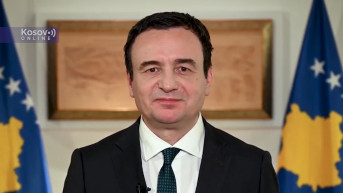
Kosovo's Prime Minister Albin Kurti confirmed this evening that the agreement reached in Ohrid, between Kosovo and Serbia, includes as a condition the establishment of the Community of Serb-majority Municipalities, Kosovo media reported.
In an interview for RTK, Kurti pointed out that the agreement is not the best for Kosovo, but it is an opportunity to move forward.
He said that Article 10 of the European proposal states that both parties confirm that all previous agreements must be implemented.
"There is an association in the agreement. Article 10 says that both parties must implement previous agreements that are binding. So there are 39 agreements that must be implemented. There are agreements like the one for the return of cadastral books, which is fifth on the list," Kurti explained.
As he said, he does not deny such a thing, but adds that Article 7, which talks about the Serbian community, is about services and not structures.
"The level of self-governance, without jeopardizing the constitutional order of Kosovo", added Kurti and indicated that he had several proposals, but that, he claims, the other side threatened to end the talks.
Kurti also said that he offered three pillars for the Association's statute.
"I asked for the three pillars of the Association. If we agree, in accordance with the Constitution and the court's decision, with the European and American position on these three pillars, tomorrow I will bring you a draft of the statute. On the morning of March 19, everyone could have had a draft based on these three pillar. That's what the self-government of the Serbian community says, not the Serbian municipalities in Kosovo," Kurti said.
According to him, when the self-government of the Serbian community is mentioned, it exists within the framework of the protection of national minorities.
He repeated that Serbia refused to sign the agreement in Ohrid, because, as he said, it has no will to implement it.
Kurti stated that he has always been constructive and that, according to him, there is equality between the two parties in the latest agreement.
"We already had indications and even facts that they are violating the agreement. I expect the EU to judge and condemn Serbia's unconstructive behavior," Kurti said.
He added that he always asks for more than what is offered, because he thinks that more belongs to Kosovo.
Kurti also said that the Ohrid Agreement is "a de facto recognition of Kosovo by Serbia".
"I read the texts well and when I see that there are such universal concepts, when independence, territorial integrity, equality of parties are taken into account, then I am constructive. But, the more active and creative I was, the more resistance arose from the other side, which was crowned by not signing, because they also know, as I do, that this is a de facto recognition of Kosovo," Kurti said.
He also stated that relations between Kosovo and Serbia cannot be normalized without solving the crimes committed during the war.
"In my strong belief, overcoming, dealing with the legacy of the past is a generic term that must be translated into many things that are problematic between our two countries. Relations cannot be normalized without solving the crimes committed during the war and many other issues not related to the war. In the annex, we already have the issue of the missing as urgent," Kurti said.
He stated that, regarding the Serbian Orthodox Church, the agreement states "formalization of the status", and that this does not mean a change, but that "you have something, but you want it to be formalized".
"I said in Ohrid that, as far as I know, Serbia is a secular state. So, in order to formalize the status, I said that I was interested in talking openly with the Patriarch of the Serbian Orthodox Church Porfirije," explained Kurti and added that he told the European mediators and the President of Serbia that it makes no sense for a religious institution to be represented by officials of a secular state.
As he says, he was told "that the patriarch refuses to meet with him".
Speaking about the positions of the opposition, he says that the actions of the PDK and LDK leaders led to this situation.
"I often think about how the dialogue process would have looked if they had not signed these agreements," Kurti said, adding that he was ready to provide answers in parliament.

0 comments