
Nagavci: We voted for amendments to Law on Specialist Chambers, but doubt they will have an effect
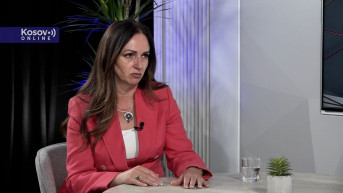
Self-Determination parliamentary group leader Arberie Nagavci said that the party had voted for the amendments to the Law on the Specialist Chambers relying on the expertise of the PDK, which had proposed them, but expressed doubts that the amendments would produce the expected effects, given that uncertainty remained as to whether the changes would have any impact on the judicial proceedings in The Hague, Radio Free Europe reported.
Nagavci recalled that the amendments could not have been adopted by the Assembly without Self-Determination’s votes, but stressed that the party had expressed reservations about both their substance and the urgency with which th0eir adoption had been sought.
“We had our doubts and skepticism. We said so publicly, both in our meetings with the PDK and in our statements,” Nagavci told RFE.
According to her, the PDK had insisted that the proposed amendments had been prepared by its experts and that they could be of assistance following the judgment against the four KLA leaders.
“We saw that the Democratic Party believed in this draft law, in the form in which it had drawn it up, and we supported it by placing our trust in their confidence in the proposal,” Nagavci said.
However, she is not convinced that the amendments will meet expectations regarding the release of the KLA leaders.
“Despite our desire and willingness, we doubt that the law will produce significant results,” Nagavci said.
The amendments proposed by the PDK are intended to limit the jurisdiction of the Specialist Chambers, which form part of Kosovo’s judicial system but operate in The Hague.
Among other things, they provide for prison sentences to be capped at 15 years, a narrowing of the Court’s jurisdiction in terms of criminal offenses, temporal scope and territory, as well as the possibility for cases to be reviewed by the Kosovo Supreme Court. The amendments also provide for sentences to be served in Kosovo and for the President of Kosovo to exercise powers relating to pardons.
Nagavci said that these very issues had been at the center of the Self-Determination Movement’s reservations.
“Can a law regulate issues that have already been defined by the Constitution? Can a draft law override international agreements as well?” she asked.
She also referred to the 2014 exchange of letters between then-President of Kosovo Atifete Jahjaga and EU High Representative Catherine Ashton, which preceded the establishment of the Court.
Nagavci said she hoped that the experts engaged by the PDK had considered these issues, stressing that responsibility for the consequences of the law extended beyond any single political party.
Asked whether Self-Determination had taken possible international warnings into account ahead of the vote, Nagavci said that preserving relations with allies was important, but that there also had to be certainty regarding the law’s legal sustainability.
She did not specifically explain how those warnings had been assessed before the vote.
According to her, the concerns that had been raised should be considered professionally, even though the amendments had already been adopted.
Nagavci said the PDK bore part of the responsibility for providing answers both to international partners and to citizens who expected results from the law.
“Here, responsibility lies first and foremost with the MPs themselves and the PDK structures, not only in relation to our partners, but above all in relation to the citizens of the Republic of Kosovo, who had very high expectations regarding this draft law,” Nagavci said.
Following the adoption of the law, Justina Shiroka Pula was also elected President of Kosovo. Although both votes took place as part of a political compromise, Nagavci denied that support for the law had been a condition for the election of the President.
“That was not a condition. Rather, it was necessary for us to have stable institutions, precisely so that we could also face the battle that awaits us in the appeals proceedings,” she said.
According to Nagavci, adopting the law without electing a President would have left Kosovo facing the possibility of the Assembly being dissolved and new elections being called.
“There was no justification, no logic whatsoever, in insisting and demanding that only the law be put to a vote while we dissolved the Assembly and were left without stable institutions,” the head of the Self-Determination parliamentary group added.
Nagavci said that, in addition to the legislative amendments, a strategy was also needed for the appeals stage following the judgment in The Hague.
According to her, institutions, legal experts, the defense teams of those convicted, civil society and international partners should all be involved in that process.
Asked by RFE whether any concrete institutional coordination had begun, Nagavci did not confirm that any specific action had been taken. She said she believed that the Government had begun engaging in that direction, but that this would become clearer soon.




0 comments