
Protests in Kosovo: A battle over the KLA legacy or fear of new indictments?
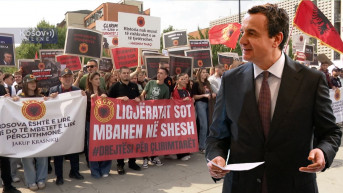
Protests by KLA supporters following the guilty verdict against the former leaders of that organization are an attempt to preserve the “KLA legacy” and reject any association with war crimes, Kosovo Online’s interlocutors agree. However, they differ in their interpretations of Kosovo Prime Minister Albin Kurti’s decision to agree to amendments to the Law on the Specialist Chambers. While some see him as the winner of Kosovo’s political battles following the election of the President, others point out that he himself could potentially face accusations of obstructing justice before the Court in The Hague.
Written by: Ivana Sanjevic
Protests by KLA supporters have been taking place since September 16, when the Specialist Chambers delivered a first-instance guilty verdict against the former leaders of the armed formation—Hashim Thaci, Kadri Veseli, Rexhep Selimi and Jakup Krasniqi.
KLA supporters in Kosovo and in the diaspora have demanded amendments to the Law on the Specialist Chambers, political and financial support for the convicted former KLA leaders, as well as the dismissal of Justice Minister Donika Gervalla. One of their demands has been met—the Law on the Specialist Chambers has been amended.
Former Constitutional Court President Enver Hasani said that it was precisely the protests that forced Prime Minister Albin Kurti to make concessions regarding the Law on the Specialist Chambers, and that the compromise over the election of the new President had also been reached thanks to public pressure.
Analyst Arton Muhaxheri likewise assessed that Kurti had been frightened by the protests and had reacted at the last moment.
“Kurti was afraid of the protests; he was under enormous pressure. I do not know what would have happened if the law had not passed. I do not believe this would have ended peacefully. Kurti knows how protests work, and he reacted at the last moment,” Muhaxheri said.
PDK capitalized on the protests
Security studies researcher Nikola Vujinovic told Kosovo Online that the Democratic Party of Kosovo, as the political wing of the KLA, had used the protests to exert pressure on Kurti to secure the adoption of amendments to the Law on the Specialist Chambers.
Vujinovic added that those organizing the protests wanted to defend the KLA legacy and prevent the armed formation from being associated with crimes, because that would undermine the foundations of the “so-called Republic of Kosovo.”
He claimed that the protests would continue, among other reasons, in order to force Kurti to clearly state how he intended to respond to the judgments against the former KLA leaders.
“Over the past three weeks, we have seen that these protests are not homogeneous. Some NGOs are among the initiators of the protests, but KLA veterans’ organizations are also involved. They are not united in their positions, and we have even seen violence between them,” he said.
Political scientist Ivan Tomic somewhat disagrees with Vujinovic, believing that the protests by KLA supporters will not continue because their principal demand was met with the adoption of the amendments to the Law on the Specialist Chambers.
Tomic added, however, that it would be interesting to see how the new legislation would be implemented.
“We know that the Specialist Chambers were established in such a way that the international community acts as the guarantor of the Court, that Pristina agreed to their establishment, and that as long as the Constitution is not amended and the EU does not consent to their abolition or some form of change—which will not happen—the adoption of this law will be used for domestic political purposes,” Tomic claimed.
Analyst Nexhmedin Spahiu told Kosovo Online that Kosovo Prime Minister Albin Kurti had taken a considerable risk by supporting the amendments to the Law on the Specialist Chambers and had placed himself in a situation in which he could potentially be accused before that judicial institution of obstructing justice.
Spahiu believes that Kurti made a concession to the Democratic Party of Kosovo by adopting the amendments, but claims that through this maneuver the Kosovo Prime Minister had made “fools” of everyone because he secured the election of a person who suited him as President.
“He achieved his objective. He made a concession to the PDK by allowing the law to pass, but while manipulating the domestic political scene, he personally took a considerable risk, because the Specialist Chambers in The Hague could now accuse him of obstructing justice because he supported the adoption of the law,” Spahiu warned.
Fear of new indictments
Speaking about the PDK, Vujinovic stressed that party leader Bedri Hamza believed he could mobilize the political force that had emerged from the protests in support of the former KLA leaders.
“I think he is mistaken, because every protest has considerable energy at the beginning, but as time passes that energy will diminish and the aforementioned disagreements among the actors leading the protests will become apparent,” Vujinovic predicted.
He reiterated that this was not a spontaneous protest by dissatisfied citizens, but a clearly organized protest by people who supported the KLA legacy, Hashim Thaci and the other convicted individuals, “as well as those whom they fear may appear before the Court.”
Spahiu believes that, in essence, the adoption of the amendments has no significance for the Specialist Chambers because they can be annulled by the Constitutional Court of Kosovo in The Hague, but that they do represent a threat to certain future witnesses.
“As the Specialist Court has announced, there may be further indictments in addition to those involving the individuals who have already been convicted. That would amount to witness intimidation, and I think Kurti could be called to account by the Court for obstructing justice,” Spahiu reiterated.
Spahiu pointed out that the amendments to the Law on the Specialist Chambers were suspicious because it was unclear who had drafted them—whether a foreigner or one of the PDK’s lawyers. He also believes that the protests by KLA supporters will have no impact whatsoever on the work of the Court.
“That law affects nothing, nor does it benefit those awaiting the second-instance judgment in The Hague,” he assessed, adding that the Specialist Chambers and their judges in The Hague were “far removed from a country of two million inhabitants, where they could be subjected to pressure or blackmail.”
The KLA War Veterans Organization asked the Kosovo Assembly to include a special amendment in the Law on the Specialist Chambers.
According to the KLA War Veterans Organization, the amendment should clearly establish a prohibition on reopening cases concerning the same material facts and circumstances that have already been examined and finally adjudicated by the ICTY, UNMIK, EULEX or other competent courts.
The Organization believes that such a legal guarantee is necessary to ensure legal certainty and respect for the principle of ne bis in idem, under which no one should face repeated criminal proceedings concerning the same facts for which a final decision already exists.
“This issue is of particular importance because the former KLA leaders were found guilty at first instance in cases that had previously been adjudicated in various domestic and international judicial proceedings,” the KLA War Veterans Organization stated in its request.
Former diplomat Zoran Milivojevic believes that the amendments to the Law on the Specialist Chambers in Pristina and the demonstrations accompanying that process were part of a political struggle and an attempt to create conditions for Hashim Thaci to be released following the appeals proceedings.
“The pressure and the use of the KLA demonstrate how unstable that society is, on the one hand, and, on the other, how burdened it remains and how the KLA is in fact a symbol of a Greater Albanian policy and an instrument of pressure,” Milivojevic told RTS.
Protests and Kosovo’s independence
Vujinovic assessed that the guilty verdict against the former KLA leaders and the protests by their supporters were not “shaking the foundations of the so-called state of Kosovo,” because those who support Kosovo’s independence also support the Specialist Chambers.
“That Court, like all the courts established across the former Yugoslavia with the aim of delivering some form of transitional justice and reconciliation, is in fact a political instrument. There is a major opportunity that we must make use of—Belgrade and the Serbian community in Kosovo, Serbia and Republika Srpska—to use this as an argument against new recognitions, against EU membership and against UN membership,” he stressed.

0 comments