
Osmani: I hope that Kosovo will become a member of the OSCE as soon as possible
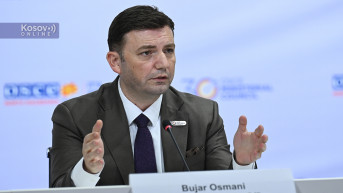
The Minister of Foreign Affairs of North Macedonia and the current OSCE Chairperson-in-Office, Bujar Osmani, stated today that he hoped Kosovo would become a member of the OSCE.
Osmani, after the conclusion of the OSCE Ministerial Council, responded to a question about what the OSCE had done to hold Serbia accountable for the aggression against Kosovo and the provocation of ethnic tensions in the Balkans. He stated that he could present the national stance, which was clear – North Macedonia had recognized Kosovo.
"We have recognized Kosovo and hosted the meeting in Ohrid that resulted in the Ohrid Agreement, which we consider to be the only way to make progress towards an agreement between Serbia and Kosovo with the goal of mutual recognition. That is the stance of North Macedonia. We also offer ourselves as a place for dialogue because we have good relations with both countries and experience with compromises. The Kosovo-Serbia dispute is a wound for the entire region", he explained.
As the OSCE Chairperson, he highlighted the organization's engagement in Kosovo and Serbia, where it had its missions.
He recalled that currently, the largest mission was in Pristina, after the closure of the mission in Ukraine.
He stated that he had visited Belgrade and Pristina and had even presented a plan for de-escalation in northern Kosovo, which, he said, had become a plan accepted by the EU and the US, as well as by the governments in Belgrade and Pristina.
"I hope that Kosovo will soon become a member of the OSCE. However, consensus is needed for that. If Kosovo were an OSCE member, it could use all its instruments", he added.
Osmani stated at a press conference that it had been unanimously decided at the OSCE Ministerial Council that Malta would assume the chairmanship of the OSCE in the coming year.
He also conveyed that the mandate of the OSCE Secretary General, the Director of the Office for Democratic Institutions and Human Rights (ODIHR), as well as the Representative on Freedom of the Media and the High Commissioner for Human Rights, would be extended.
"The Council was held in extraordinary circumstances, with the war raging in Ukraine and when the concept of multilateralism is under attack. However, we managed to make important decisions", Osmani said.
He emphasized that the vast majority of members had stressed the importance of the principles of the OSCE and the Helsinki Charter and once again condemned Russia's war against a sovereign neighbor. The meeting, he assessed, had underscored the significance and need for the OSCE for the future.
He also stated that the importance of compromise, necessary for the continuation of the OSCE's work, had been underscored.
"Compromises are often difficult and painful, but they pave the way for the future. I think we can be proud of the achieved success", Osmani explained.
The future chairman, Malta's Minister of Foreign Affairs, Trade, and European Affairs, Ian Borg, stated that the unanimous decision to award his country the chairmanship of the OSCE was proof of the members' commitment to preserving and strengthening the organization.
"The OSCE is an inclusive platform for effective dialogue. We must focus on ending wars and conflicts. The Russian war against Ukraine must be stopped. As the OSCE Chairperson, I will work together with all our partners and remain committed to multilateralism, which can be the difference we need", he said.
Osmani, when asked whether consensus had been reached on trade with Russia, emphasized that the consensus was the DNA of the OSCE, and from the beginning of his chairmanship, he stated that he would be a guardian of the principles of the organization, and there was no negotiation around them.
"There was no trade or negotiation on principles. We condemned the aggressor who caused great suffering in Ukraine. Every week, the member states of the organization in Vienna spoke the truth to the Russian representative at the Permanent Council meeting. There was no trade with principles", he underscored.
Asked about progress on the OSCE budget, he said that unfortunately, the budget for the current year had not been adopted because Russia had blocked it.
He emphasized that the OSCE was "bleeding" due to the non-adoption of the budget, as it still operated based on the 2021 budget, which meant there had been no adjustment for inflation or the possibility of hiring new people to ensure effectiveness.
"We had problems with the other two member states, which we resolved, but in the end, only Russia remained that blocked the budget. We reached a consensus on the figures, but Russia blocked the budget over a text that is not even a part of the procedure. We have a few weeks left until the end of the year, and I think we should continue discussions. In the coming days, we will try to reach an agreement on the budget for this year. This budget would contribute to the adoption of the budget for the next year", Osmani said.
He appealed to Russia to enable consensus because missions in Moldova, Kosovo, Bosnia and Herzegovina, and North Macedonia were suffering as a result.
On the question of whether the OSCE is now closer to deciding to introduce the "minus 1" consensus to exclude Russia, he pointed out that there had been a debate about it, as a consequence of violating the basic principles of the organization.
"However, there are two arguments why this is not possible - one legal and one political. Legally, the decision on the 'minus 1' consensus was made once in 1992 when Yugoslavia was excluded due to human rights violations. But I think that wouldn't work today. Politically, the OSCE was established as a platform for dialogue for countries that do not share the same position, and it should remain so", he added.
He also stated that the Russian Foreign Minister, Sergey Lavrov, had not visited North Macedonia, had not met with him, but had come to the OSCE, just as he went to the UN in New York.
comments