
Otasevic: Political changes in France will not significantly affect the Belgrade-Pristina dialogue
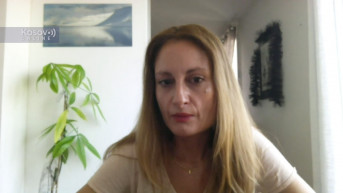
Journalist Ana Otasevic, a contributor to Le Monde Diplomatique, says for Kosovo Online that the parliamentary elections in France, whose first round takes place tomorrow, are seen as historic because, according to predictions, for the first time a large number of radical right-wing forces will enter the parliament. This will, as she says, change the character of the political landscape in France, which will, she notes, certainly influence the policy towards the Balkans and the European Union.
To what extent, she adds, remains to be seen, as it will depend on whether the right wing wins an absolute majority.
The main characteristic of the party now gaining significant support from the French, the National Rally, in terms of foreign policy, is its opposition to the expansion of the European Union.
"If one of the main ideas is that the EU is against national policies, this hints at how this option will relate to further EU expansion and consequently to the Belgrade-Pristina dialogue, even though this dialogue is not directly related to them because it is led by European representatives. I don't believe this policy will significantly impact the established form of the dialogue going forward. I don't think political changes in France will significantly affect this dialogue because it is conducted at the European level, but the general tendency could lead to its dilution or relativization if the European perspective is not clearly defined and is called into question. Marine Le Pen, about ten years ago when I interviewed her, said that Serbia had no reason to join the European Union. She also thought the same about the whole region. This is the idea that the EU is a prison of nations, that it is anti-national and destroys national identity," Otasevic says.
She explains that there are currently three main political forces in France – Macron's centrist party, the People's Front coalition of left-wing parties, and the far right, which has absorbed many members of the traditional Gaullist right-wing.
"This is a different situation from the past in French political life because for decades we had two sides sharing the values of De Gaulle's Fifth Republic, and political life took place between these two poles. Now, an extreme option has broken into this tradition of political life, which could change much in terms of the logic of political life as we know it, with measures that are contrary to the Constitution or European laws. In European politics, there is definitely a trend of closing off, strengthening borders, fear, and, I would say, distrust towards the nearest surroundings, including the Balkan countries. This is the essence of the policy not only of this far-right party in France but also of others," Otasevic points out.
The upcoming elections in France, she emphasizes, could lead to cohabitation, which some even consider desirable because President Emmanuel Macron's policies have been rejected and he has long been unpopular in France.
"His idea of Macronism, a strong center that would unite both left and right republican forces, has failed, and now political life is being constituted in a different way. One of the main proposals of the National Rally, led by Jordan Bardella, who is seen as the future prime minister after these parliamentary elections, is to introduce 'double borders,' meaning to ban foreign nationals from moving freely within the Schengen Zone, to establish much stronger control at the EU borders, and to prevent illegal migrants from entering or approaching EU borders to seek asylum, which is against both European and international laws," Otasevic says.
However, the right-wing, she adds, will still have to fight within France to prove they are capable of governing and to confirm their legitimacy, and they will primarily try to do this on issues related to domestic rather than foreign policy.
"In this campaign, foreign policy is almost off the radar, although two topics significantly affect political life in France: the war in Ukraine and the Israeli attack on Gaza. These are the issues that polarize the French. The Balkans are not mentioned, and expansion is not mentioned; we see in the case of Ukraine that the issue of EU expansion is a geopolitical question. The main message to voters is about issues related to citizens' security – the impression that the French are not safe in their own country, that migrants almost call their survival into question if we listen to the far-right parties, including the National Rally. According to them, France is in serious danger of losing its identity, being 'consumed' by migrants of different faiths, civilizations, and cultures. These are the main topics and what they gain points on," our interlocutor emphasizes.
As for the foreign policy plan, she says that France is shaken today, its international role weakened, and it will not have the role it wanted because Macron's idea to position himself as a leader after Angela Merkel's departure has collapsed.
"The president leads foreign policy, but the prime minister will also have a significant role, and they will have to find a way to cooperate. If they don't find it, the country will be in serious deadlock. I expect this will lead to a kind of restraint from France, that it will no longer be the factor influencing the Balkans as much as it pretended to be in recent years. France will likely focus first on stabilizing the internal situation, and only then will it be able to influence European policy," Otasevic concludes.



0 comments