
Panel on Racak: A tragic example of the West's attitude towards the Serbs
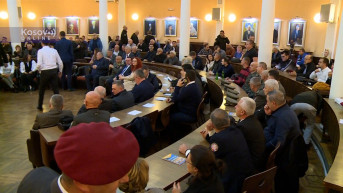
The Association of Descendants of Serbian Warriors organized a panel last night at the University of Nis titled "The Truth about Racak," featuring former Commander of the Pristina Corps of the Yugoslav Army, General Vladimir Lazarevic, the then-Commander of the Special Units of the Serbian Ministry of the Interior, General Goran Radosavljevic Guri, investigative judge from Pristina, Danica Marinkovic, and historian, Professor Dr. Dejan Antic.
Former Commander of the Pristina Corps of the Yugoslav Army, General Vladimir Lazarevic, assessed that the "Racak case" was a tragic example of the West's attitude toward the Serbs. He recalled an article in the French magazine Le Monde, which, he claimed, had been writing since 2019 that over 20 years, the case had evolved from a massacre of civilians to the greatest lie of the 20th century.
Lazarevic, who was tried at the Hague Tribunal, highlighted some facts related to the "Racak case".
"A collaborator in this deception and crime was the chief Finnish pathologist, Dr. Helena Ranta, who, after the autopsy and agreeing with our investigative authorities, eventually stated, I quote, 'Civilians were killed in Racak'. Later, she admitted that she had to say that due to immense pressure from American, European, and NATO officials. In June 2000, Ranta stated that there had been no signs of execution on the bodies, that they had been brought from other locations, and that NATO had falsified the Racak report. For the Hague Tribunal, Racak became the first charge in the indictment of crimes against the authorities in Serbia and the Presidents of Serbia and the Federal Republic of Yugoslavia, military and police commanders, and officials. So, the West, with its NATO Alliance, sentenced our country with the help of a criminal, the director Walker", Lazarevic said.
As he stated, Walker first claimed that it had been a military and then a military-police action.
"They claimed that the army used tanks in that action, that it used artillery. The truth is that the army did not directly participate in Racak. The truth is that the Commander of the Corps was not informed that a typical anti-terrorist action was taking place in a part of the corps zone; the Commander of the 243rd brigade knew because it was directly in his zone, and at that moment, he had the army at two or three positions along that Crnojeviska gorge", Lazarevic recalled.
Former Commander of the Special Police Units, General Goran Radosavljevic, explained that after extensive preparations, the Serbian Ministry of Internal Affairs had decided to carry out an anti-terrorist action in Racak.
He recounted that in the village near Urosevac, there lived the Bujota family, which was responsible for roadblocks, attacks on the main road between Stimlje and Prizren, shooting at armed forces, attacking citizens, and kidnapping people.
"The headquarters in Pristina decided, based on all this information, to carry out an anti-terrorist action to try to reach those terrorists in the village and try to bring them to justice. However, it later turned out, and we already knew this from reconnaissance, that there were a large number of armed people in the village", he stated.
As he points out, the basic rule in anti-terrorist actions is that they should be carried out unexpectedly, on unexpected routes.
According to him, they realized that in large movements, when a unit of 500 people and equipment is mobilized, it is visible, and they also knew, based on previous reconnaissance, that terrorists had informants.
Therefore, they opted for operational groups that had multiple functions and operated in the field, in this specific case in Urosevac.
As the first group included people from the Secretariat in Urosevac, they, due to their good knowledge of the terrain, were designated to be patrol leaders.
"We planned to start at a time when we were not expected, around three or four in the morning, it was winter, January 15, and before that, we knew that there were no civilians in the village. At that time, about 3,000 people lived in that village, and imagine that there was no smoke from any house, no traces in the snow. It was clear to us that only terrorists remained in one building. We decided to come to their territory so that it wouldn't catch their eye why trucks were moving. We came behind them, and found the trenches they made, which we knew from earlier reconnaissance", Radosavljevic said.
In addition to reconnaissance, as Radosavljevic stated, the statements of two captives had also helped them in planning.
However, Radosavljevic points out that in such actions, unexpected things often happen, almost always, and here one of the captives tried to escape.
"Of course, people reacted, he was liquidated, but it was heard, and all of them went to the trenches they prepared to defend themselves from the Serbian Police. There were members of the operational groups, and a confrontation ensued that lasted a long time; it started at dawn. Among the casualties was a woman, but she was in uniform, armed, a female terrorist. The action lasted until late afternoon, and a documentary film was made about that action", he recounted.
He emphasizes that in that action, a much larger number of terrorists were liquidated than was shown.
As he says, it was not in their interest to show people in uniforms, and they managed to take them away, bringing people in civilian clothing.
Thus, among the casualties was a decapitated man in a white shirt, but, as Radosavljevic points out, without blood on the shirt and without blood where he lay.
When the investigative judge and members of the Criminal Police came to conduct an investigation, they could not do so because, as Radosavljevic notes, terrorists received reinforcements from surrounding villages.
"The pressure from the terrorists was so great that one unit had to withdraw, and Walker took advantage of that and was brought in because of that. Then they managed to bring in civilians who were not even from that territory. What is most talked about regarding Racak is that first day which was not the end, it was just the first day, and the next day, the pressures of the whole world began. Pictures of the massacre in Racak were published, and we at the headquarters deliberated for a long time on what to do next. It was clear that they did not want to hear the truth; the truth was known from the beginning, they knew it from the 15th onwards, and representatives of the OSCE, whom we informed, who stood on the main road in jeeps and watched, they knew everything, it was not something that could be hidden, but the West was not interested in the truth; the West was interested in propaganda to find a pretext to bomb the Federal Republic of Yugoslavia", Radosavljevic points out.
As he notes, if this had not been exploited, a pretext for bombing would have been found two or three days later.
"They did not spare their own; they were ready to sacrifice their wives and children to stage the bombing. It was clear that no one would believe us on our word, and after my insistence, it was decided to carry out another action, to retrieve the bodies and bring them to forensic medicine to show what really happened. That action was carried out the next day. We thought about how to do it, and we decided to do it the same way, and they were surprised. There were fights; we had casualties, but we managed to do it, to get to the bodies", he recounted.
They had information that the bodies were placed in a mosque, where the investigative judge and others who conducted the investigation arrived, and then the bodies were transported to Pristina for forensic examination.
"When the third day of the action was over, we had material evidence that we were right. Let's not fool ourselves - the West will never admit that it was a legitimate action, that innocent civilians did not die, but terrorists who did not want to surrender", Radosavljevic notes.
Stating that he was invited by the then Secretary-General of NATO to Brussels and then to the base in Stuttgart, where the late General Krstic, Nebojsa Covic, and the then US Ambassador Montgomery were present, Radosavljevic tells how, at one point, the Secretary-General showed them a book in front of 250 NATO members.
"He told us then - 'I have to tell you that your actions Racak and Orao are included in this book'. NATO has a habit of putting all actions from around the world that were not done according to their standards in that textbook so that, as he told us then, similar situations can be resolved in a similar way. It was clear to us that they knew everything and proof of that is that Racak was removed from the indictment against Serbian generals in The Hague", he added.
Radosavljevic states that it was a great personal satisfaction for him, but also satisfaction for, as he says, his country, for the people who fought with him.
As he added, the Secretary-General of NATO had not given him the book because, as he himself had told him, it contained other actions organized around the world that had not been done according to their standards.
A former investigative judge from Pristina who testified at the Hague Tribunal about the Racak case, Danica Marinkovic, described the details of the investigation that Serbian judicial authorities initiated on January 15.
"On January 15 at noon, we entered the village of Racak, and in the very center of the village, we found a place where weapons had been gathered, which the police picked up from the field. I, as an investigative judge, on January 16 and 17, tried to enter Racak with my colleagues. We failed because halfway there, gunfire was opened on us. They were shooting from all sides. We couldn't approach the entrance to the village, let alone conduct an on-site investigation. The foreigners knew all of this, and those two days, on January 16 and 17, Walker's associates came. However, they did not want to cooperate at all, nor did they want to accept what I, as an investigative judge, proposed and said was according to the law. They first tried to persuade me that I must not go there, that it is risky, that innocent villagers are there, and that there will be victims if I enter. When the villagers see the police with weapons. We talked to them for hours, were fair, and explained to them by law what the role of an investigative judge is, what their rights are, and what they can do – observe. They cannot command me, they cannot decide with whom I will go to the field and conduct an investigation. If they want to come as observers, they can", Marinkovic stated, adding that Serbian investigative authorities had attempted to conduct an on-site investigation on January 18, and on that day, collaborators of William Walker had been present, as well as a large group of foreign and domestic media.
"We all move in a column and enter the village of Racak, and as soon as we entered the village, one police officer said to me, 'Judge, come to the mosque to see; we found the bodies of the deceased there'. As I entered the mosque first, the whole column behind me, asked if they could enter. I allowed everyone to see what I saw; everyone who was there that day saw it. Nothing was forbidden to them; nothing was hidden. We did everything transparently. Whatever we saw, they saw too", Marinkovic said. She added that she, together with the pathologist, Professor Slavisa Dobricanin, had conducted a visual examination of the bodies to check for "massacre traces".
"We found 40 bodies, 39 men, one woman, and one 17-year-old boy. KLA members were killed exclusively by firearms while in motion. There were no other traces of injuries before or after death. No traces of any other weapons or tools. Among the killed were warriors from other countries or instructors. With Finnish pathologists, we agreed to the last detail with all 40 autopsies. Therefore, Albanian terrorists in Racak were killed in battle exclusively with firearms. Death occurred from injuries inflicted by firearms. There was no massacre", Danica Marinkovic concluded.
"From the beginning, everyone knew, but it didn't suit them. Now I'm telling you, even though 23 years have passed, I can reconstruct the investigation, and draw everything I saw and where I saw it. That is never forgotten, and that is our truth, which we will never give up", she added.
Professor Dr. Dejan Antic pointed out that all anti-terrorist actions by members of the Yugoslav Armed Forces had been aimed at suppressing terrorism, preserving the constitutional order of the Federal Republic of Yugoslavia, and ensuring peace for all citizens in Kosovo.
"The Racak Operation on January 15, 1999, had the same goal and did not differ in any way from the operations carried out by the Serbian Armed Forces in 1997 and 1998. In the confrontation with Albanian terrorists, the Special Police Units led by General Goran Radosavljevic managed to neutralize 45 terrorists and break up the terrorist core after hours of fighting. The next day, on January 16, William Walker and the Verification Mission arrived, and Walker claimed that the Serbian armed forces had committed a massacre of civilians. Despite all the claims by Yugoslav, Finnish, and Belarusian investigators that it was not a massacre of civilians, they needed a reason to bomb Serbia, to deal with the FRY, and to support Albanian irredentism", Dr. Antic concluded.
0 comments