
Prenkaj: Brussels and Pristina should reach agreement on Law on Specialist Chambers through dialogue
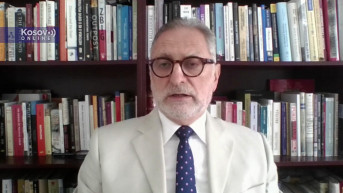
Diplomat Albert Prenkaj believes that dialogue should lead to an agreement on coordinating joint activities between Pristina and Brussels so that amendments to the Law on the Specialist Chambers are consistent with the principle of establishing close ties of solidarity and forms of cooperation between the parties.
Prenkaj views the European Union’s official statements, particularly the statement by Enlargement Commissioner Marta Kos describing the amendments to the Law on the Specialist Chambers as unacceptable, as a form of diplomatic rebuke which, he says, official Brussels is directing at an aspirant that has not yet even opened a dialogue on the European integration process.
“In the recent past, we have witnessed how a lack of coordination with Brussels resulted in Kosovo being penalized through sanctions and financial restrictions,” Prenkaj told Kosovo Online.
He added that, in Brussels diplomatic circles, it is acknowledged that the Specialist Court, in the absence of facts and evidence, failed to pursue the key issue for which it was established.
“This concerns ‘organ trafficking,’ an issue raised by Senator Dick Marty, which ultimately proved to be unfounded,” the diplomat said.
According to Prenkaj, given that the EU is the principal financier of this judicial structure, established on the basis of an exchange of letters and a law which, following its adoption by the Kosovo Assembly, assumed the form of an international agreement, the EU’s strong reaction to the amendments to the Law on the Specialist Chambers is the result of the Kosovo side’s insistence that the matter be treated in public discourse as an international agreement.
“By contrast, the EU views this structure in the context of relocated judicial proceedings conducted on the territory of a member state, namely the Netherlands, which has recognized Kosovo,” Prenkaj said.
Prenkaj noted that dialogue is one of the EU’s essential instruments for building consensus among member states, social partners and international actors. Therefore, instead of what he described as disproportionately harsh diplomatic language coming from the highest levels of official Brussels, he believes the discourse should return to dialogue with Kosovo.
“Dialogue, or negotiations, should lead to an agreement on coordinating the joint activities of official Pristina and Brussels so that amendments to the Law on the Specialist Chambers are consistent with the principle of ‘establishing close ties of solidarity and forms of cooperation between the parties,’” Prenkaj said.
According to him, the EU should not draw conclusions or adopt positions on the basis of the reverberations of public, populist statements coming from Kosovo, but rather on the basis of the substance and legal effects of the law in question.
“In my assessment, this law does not affect the first-instance judgment, nor does it prejudge the outcome of the proceedings before the Court of Appeals. Its purpose is to preserve the judicial structure within Kosovo’s own institutions, that is, its state institutions. Let us recall the letter that EU High Representative Catherine Ashton sent to Kosovo President Atifete Jahjaga in 2014 in response to a letter previously sent to her by the President, which stated, among other things: This approach shaped a political and social consensus in Kosovo, of which the law in question was also a result,” Prenkaj said.
In his view, the amendments to the law do not undermine EU standards concerning alignment with the European Union acquis, one of the key elements of the European integration process.
He is convinced that Kosovo President Justina Shiroka-Pula’s decision to return the law, at the PDK’s insistence, amounts to buying the time needed for consultations and negotiations between official Brussels and Pristina.
“Pacta sunt servanda in international law means that agreements must be respected and implemented in good faith. At the same time, however, international agreements may be amended in the forms and in accordance with the procedures provided for under the Vienna Convention on the Law of Treaties,” Prenkaj said.
He added that the key provision states: “A treaty may be amended by agreement between the parties.”
“This means that amendments to the Law on the Specialist Chambers are subject to agreement or coordination between Pristina and Brussels. At present, the law, which was passed by a majority of votes in conjunction with the election of the new President, Justina Shiroka-Pula, remains stalled in the Assembly in the hope that it will be reconsidered,” Prenkaj said.

0 comments