
Tanaskovic: All indications suggest that the Holy See has no substantial motives to change its position on Kosovo’s statehood
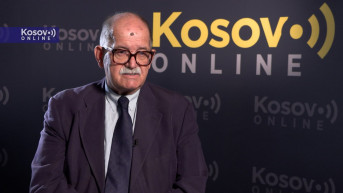
It is impossible to reliably predict the direction of Vatican diplomacy, particularly under a new pope, but for now all indications suggest that the Holy See has no substantial motives that would prompt it to change its long-standing position on Kosovo’s statehood—at least not in the near future, Darko Tanaskovic, former Ambassador to the Vatican, told Kosovo Online.
Kosovo President Vjosa Osmani visited the Vatican late last week, where she was granted a private audience with Pope Leo XIV. Following the meeting, she expressed hope that the Holy See would finally recognize Kosovo. She also referred to Kosovo’s “historical ties with Christianity,” emphasizing that Dardania had given the world prominent figures such as Gjergj Kastrioti Skanderbeg, Saint Mother Teresa, Emperors Constantine and Justinian, as well as other important figures in the history of humanism and European civilization.
According to Tanaskovic, Osmani’s brief statement after her audience with Pope Leo XIV contains nothing warranting serious comment, beyond noting that the meeting with the head of the Roman Catholic Church took place, that she expressed hope the Holy See would finally recognize the independence of her “para-state,” and that such recognition would be beneficial for the people of “Kosovo.”
“Everything else she said would have been better left unsaid—especially the announcement of a possible change of the name ‘Kosovo’ to Dardania. We learned nothing about what the pope said, as official Vatican communications remain silent regarding the audience with the Kosovo president,” Tanaskovic observes.
He recalls that Vjosa Osmani also visited the late Pope Francis on 23 January 2023, after which she likewise expressed hope that Vatican recognition of Kosovo’s independence would soon follow. Earlier, the former ambassador notes, similar hopes had been voiced by Hashim Thaçi—and not only by him.
“If it were up to officials in Pristina, ‘Kosovo’ would have received recognition from the Holy See several times over by now. It is impossible to reliably predict the intentions of Vatican diplomacy, particularly under a new pope, but for now all indications suggest that the Holy See has no substantial motives to change its established position on Kosovo’s statehood—at least not anytime soon. Vjosa Osmani is probably aware of this, which is why her statement was markedly general and reduced to expressions of desire and hope—primarily for domestic consumption,” Tanaskovic assesses.
Even more vacuous, he adds, is the comment by former Kosovo ambassador to Italy Albert Prenkaj, in which the only noteworthy element, in his view, is the comical formulation about the mutual respect between “the two leaders.”
“Nevertheless, this is a sensitive issue which—especially in light of the current upheavals and shifts in global and regional international relations—must be closely monitored and approached proactively, in order to prevent any potential unpleasant surprises,” Tanaskovic warns.
As for references to the intention to rename Kosovo as Dardania, Tanaskovic notes that some—but not all—in Pristina advocate this idea, and that it is not a new development, as a petition to collect 10,000 signatures for such a change was launched some time ago. He also points out that, following an initiative by Ibrahim Rugova, guests are received in the presidential office in front of an emblem intended to represent the flag of Dardania.
That contemporary Albanians and “Kosovars,” apart from inhabiting part of the same territory, have absolutely no connection whatsoever with the ancient Kingdom of Dardania, which existed until the first half of the second century BCE, is not something that needs to be demonstrated to any reasonable observer, he argues.
“It is sufficient, for example, to note that the name Dardania is not mentioned even once in such a serious and authoritative study as The Albanians – From the Middle Ages to the Present by the German scholar Peter Bartl. At the same time, Bartl observes that ‘the image created by Albanian scholarship of the early history of its own people is simplified, uncritical, and appears constructed.’ If this is the case with scholarship, is there any reason to be surprised that a politician of a multiply problematic ‘state’ behaves with such ease? During one of her future visits abroad—perhaps not in Rome—we may learn that, in addition to Skanderbeg, Saint Mother Teresa, and Emperors Constantine and Justinian, Dardania (that is, ‘Kosovo’) has also given the world Jesus Christ himself,” Tanaskovic concludes.
0 comments