
Vucevic: We are disappointed with KFOR's reaction; they stood aside and allowed the hunt on the Serbs
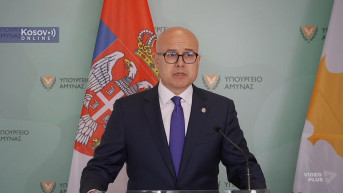
Minister of Defense of Serbia, Milos Vucevic, says that following the conflict in Banjska, an assessment of exactly what happened is underway. He emphasizes that many are rushing to conclusions and points out that a different reaction was expected from KFOR, which has a base nearby. He states that KFOR stood aside and allowed well-armed Albanian police officers to continue hunting down the Serbs.
He mentions that three days after the conflict in Banjska, it is known that lives have been lost, there have been casualties, and arrests have been made.
"What follows is determining all the details of what happened and all relevant facts. I see that many people in Serbia are rushing to conclusions about what happened on Sunday in Banjska. I must note that since 1999, Serbia has not had effective control over Kosovo and Metohija, which makes it much more difficult for us and our authorities to gather all the facts," Vucevic said on RTS.
He emphasizes that this is not a moment for anyone to compete in media attractiveness with statements but rather a time to "protect the lives of the Serbs in Kosovo and Metohija and to protect Serbia."
"This scenario that we have seen from Sunday until yesterday's meetings leads in the direction that Serbia is the initiator or sponsor of some kind of terrorist acts, that the Serbs in Kosovo and Metohija are criminals and terrorists, and that the scenario from the 1990s is being prepared again. Once again, this role is assigned to Serbia to be the bad guys," the Minister said.
He points out that the most concerning issue is the position of the Serbs in Kosovo, especially in the north.
"Kurti's regime has declared the entire north a zone of anti-terrorist action, which allows them to do what they do outside all rules and procedures. It's not just a matter of persecution, shooting, literally shooting Serbs, but also breaking into houses, maltreatment, mass arrests, and the continuation of everything that has been going on against the Serbs for months," Vucevic emphasizes.
He highlights the key issue is who allowed the Kosovo Police from the south to come to northern Kosovo, which is contrary to the Brussels Agreement.
"Somebody allowed that. Somebody is allowing Albin Kurti to build bases for Special Police Forces, to increase their presence, and to send heavily armed police officers with special vehicles. Somebody allowed the charade of elections and for someone to become mayor with two or three percent of the votes. Somebody allowed the removal of the head of the regional police center North. Somebody allowed no sanctions for the violation of the Brussels Agreement," Vucevic points out.
He stresses that Belgrade condemned the killing of an Albanian police officer and does not want any conflicts. He emphasizes that he understands the pain of every family and every nation.
"What happened afterward was terrible; the Serbs were persecuted and hunted like animals in the forests around Banjska. You can see that someone prepared this well when you see the videos they have been releasing successively," Vucevic said.
Asked who was preparing this, he says, "someone was preparing it".
"Whether they are only Albanians or not, that is now a question that requires further investigation," the Minister emphasizes.
He points out that a different reaction was expected from KFOR.
"Serbia expected a different reaction, let's not say we are to a great extent disappointed by the reaction of KFOR. For us, KFOR had to be activated simultaneously because it is the first to respond in such situations and prevent further bloodshed and further human casualties. EULEX had to get involved, and if someone needs to be prosecuted, if there are elements of criminal liability and elements for investigation, it had to be done with the support of EULEX and, first and foremost, with the support of KFOR, which had to stop further shooting," Vucevic said.
He adds that KFOR has a base nearby and could have reacted.
"They came out, but it was as if they stood aside and allowed well-armed Albanian police officers to continue hunting Serbs in the vicinity of Banjska," Vucevic says.
When asked if it was possible to trust KFOR today, Vucevic said it was not a matter of whether we trusted them or not.
"The question is if we are conditioned to communicate with KFOR, even at the lowest technical level, but to talk to KFOR, which we see as the only legitimate force in the province," Vucevic said.
Speaking about whether they communicate with KFOR, Vucevic says, "At the lowest technical level."
"But we cannot sever cooperation because that would be dangerous for the Serbs in Kosovo and Metohija and would be bad for Serbia. However, that level has been reduced to literally an elementary technical level. We truly expect KFOR to assume a much more active role, not to position itself as an observer on some hill and watch now how far Albanian police will go in killing the Serbs or whether they will respond or whatever is happening," Vucevic noted.
It is simply incredible that there was not a stronger reaction from KFOR, Vucevic states.
He points out that everyone is talking about the consequences, not the causes.
"The causes are the violation, i.e., the non-implementation of the Brussels Agreement, without any sanctions for the party that is not implementing it, and Pristina was not implementing it. The causes are that the Community of Serb-majority Municipalities has not been formed. The causes are that the Serb police commanders were suspended. The causes are that the Kosovo Police, of Albanian ethnic origin, are constantly entering the north, building new bases, and mistreating people. The causes are that they shot six Serbs this year, including an 11-year-old boy. The causes are that nobody is responsible for that. The causes are that the person who shot the boy is a member of the Kosovo Security Forces, that he is released pending trial and he is practically declared a hero," Vucevic says.
Unfortunately, Serbian President Aleksandar Vucic was right on this issue - that this could happen and will happen.
"Serbia, its state leadership, has been warning for months that the situation is such that it can escalate. That Serbs can no longer endure this pressure. People there are facing a matter of life and death," Vucevic emphasizes.
Speaking about how much this incident undermines the dialogue and Belgrade's position, Vucevic says that the situation is certainly more complex for us today.
"A not a small number of representatives of the international community began on Sunday with the narrative that the Serb are terrorists, that Serbia is a sponsor of terrorism, that it should be sanctioned, punished. There were statements that we should be bombed again, that it is time for a reaction like we had in 1998 and 1999 against our country. You can see that they have again pulled out all those textbooks, all those scenarios they wrote in the 1990s, and very quickly refreshed them only with new dates and new names, but as far as the people and the state are concerned, Serbia and the Serbs are to blame again," Vucevic points out.
He adds that this makes the role or position of Serbia much more serious.
"That is why I am asking all citizens of Serbia, as much as they can, to understand the position of our people in Kosovo and Metohija, to understand the position of Serbia, the whole of Serbia. That this is not a time for who will be crazier and more impolite on some social network. The question is, first of all, to empathize with the pain of families, people who have lost their lives, and to preserve the state," Vucevic said.

comments