
Vucic: A large part of the world will no longer turn a blind eye and tell Pristina you can do whatever you want
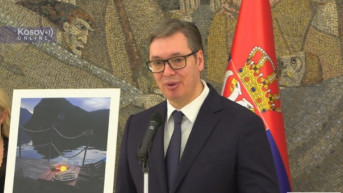
A large part of people in the world who are trying to see the situation in Kosovo will no longer turn a blind eye and say to Pristina: "you can do what you want", and these are advances, not in a strategic sense but in a tactical sense, Serbian President Aleksandar Vucic emphasized today.
Vucic said in a statement to the media that he had discussed Kosovo and the region and relations between the two countries with the State Department's Counselor, Derek Chollet.
He emphasized that it was important for everyone to know that Pristina had caused all the tensions with unilateral moves.
"There is not a single event and all the topics that existed were unilaterally imposed by Pristina. A large part of people in the world who are trying to look at the situation in Kosovo will not always turn a blind eye and say 'you can do whatever you want', and that is progress," Vucic underlined.
Chollet showed respect for Serbia
Chollet, he says, is a very intelligent and extremely insightful politician who understands well the opportunities in the world and the region.
"Will America change its attitude towards Kosovo - no, but did Chollet want to hear what Serbia had to say yesterday - yes," Vucic said.
He said that as much as he had been listening carefully to the representative of great power, Chollet had showed as much respect for Serbia and had wanted to listen to what Serbia had to say.
That was good, and Vucic thanked US Ambassador Christopher Hill that he and the American representatives wanted to hear what Serbia thought and what the expectations of Serbia and the Serbs were.
He said that he had spoken with Chollet about the Franco-German plan and pointed out the red lines of Serbia, which had been delivered in non-paper form to the document drafters.
"Those red lines are any form of recognition of Kosovo, formal or informal, granting membership in international organizations. We don't want to talk about that. We can discuss everything else and see what Serbia gets and what someone else gets," Vucic explained.
He said that they also had discussed the Community of Serb-majority Municipalities (CSM) and that it was clear that it was impossible to make progress when someone referred to their own legal acts because the dialogue had no meaning then.
He thanked the US delegation for insisting on the Brussels Agreement implementation, which was a good message, as he noted.
It is clear that the CSM must be implemented, but not how
"When you insist that something must be in accordance with the constitution of so-called Kosovo, why did we negotiate? What did we negotiate? We shouldn't have negotiated if something was aligned with your legal system. If it has to be coordinated, we can do that without dialogue and difficult negotiations. Rather, we conducted negotiations precisely because it was not always possible to achieve something following the legal acts and legislation of one, the other, or a third party. That's what I told Chollet yesterday," Vucic underlined.
He said that he did not know how they intended to carry it out or how they thought to explain how the CSM should look like. That is the question for the management team, as he underlines, but above all for the Serbs and, of course, the Albanians as well.
"It will not be easy, but it is good that it is completely clear that the CSM must be formed," Vucic said.
He stated that on the same day when he had gone to Vienna, Albin Kurti had said that he was not interested in the formation of communities on an ethnic basis, which meant that he was not interested in the CSM.
"He said earlier that he was not satisfied with the Franco-German plan, and I said that it was not true, and yesterday he said that he fully accepted it. We knew that from the beginning because that plan was based on everything they were looking for and wanted. They say that they accept everything only to avoid the previous obligation to form the CSM", Vucic said, adding that it would be difficult because Serbia had no allies, but also there were not many choices.
A big meeting awaited him on January 20, as he said, and before that, he was also going to Davos, where he would welcome the EU envoy for the dialogue, as well as the Balkans envoys.
In response to Chollet's statement that there were no prerequisites for a meeting between Vucic and Kurti, Vucic said that there never had been any but that Serbia had been always ready to talk and had not shied away from dialogue, and it was another question of how expedient it would be.
0 comments