
At the site of the Monastery of the Holy Mother of God in Hvosno: Roman Catholic Religious Ceremony held without the knowledge of the Serbian Orthodox Church – Diocese requests protection
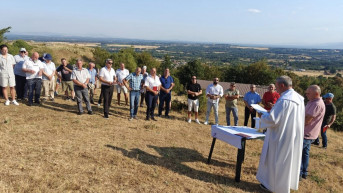
The Raska-Prizren Diocese has raised serious concerns following a public gathering with a religious ritual conducted on Wednesday, July 23, at the archaeological site of the medieval Monastery of the Holy Mother of God in Hvosno, located in the village of Studenica near Istok, within a legally designated Special Protective Zone. The event was held without the knowledge or consent of the Serbian Orthodox Church (SOC), in direct violation of the Law on Special Protective Zones.
According to the Diocese, during the ceremony, Roman Catholic priest Fran Kolaj from Kosovo delivered a speech containing overtly nationalist messages and inflammatory language, promoting interethnic and interreligious hatred. The speech, the Diocese states, was clearly intended to distort well-documented historical facts and to appropriate the heritage of the SOC.
The Diocese strongly condemned this grave legal violation as part of a series of ongoing provocations targeting the Serbian Orthodox Church. It urgently called on international actors to engage proactively in the protection of the endangered religious and cultural heritage of the SOC and to ensure reliable international guarantees for the Church amid the increasing disregard for legal norms and the lack of adequate response from Kosovo institutions.
The Diocese recalled that the medieval Monastery of the Holy Mother of God in Hvosno was reconstructed in the third decade of the 13th century on the foundations of an older basilica. Built in the distinctive Raska architectural style, the monastery was established under church patronage after the founding of the Serbian Orthodox Diocese of Hvosno in 1219 by Saint Sava.
The monastery remained in continuous liturgical use until the late 17th century, as evidenced by numerous preserved documents and church artifacts. Following a period of historical turmoil, the site fell into disrepair and much of the building material was gradually removed.
Today, only the remains of the large medieval church, associated buildings, and fortifications are preserved. The site has been thoroughly explored by leading archaeologists over recent decades, with extensive documentation preserved. Numerous medieval inscriptions and 13th-century records testify to the spiritual and historical significance of this sacred location.
Given the importance of the site, a Special Protective Zone was established around the remains of the Monastery of the Holy Mother of God on June 4, 2008, with a radius of 100 meters, in accordance with the Law on Special Protective Zones. This zone is one of more than 40 such protected areas surrounding Serbian medieval churches and monasteries.
Within such zones, no restricted or prohibited activities, including public gatherings, may be conducted without prior approval from the SOC and the Implementation and Monitoring Council.
Nevertheless, the Diocese notes that publicly available evidence, including photos and video footage, clearly shows that on July 23, a group of Kosovo Albanians led by Roman Catholic priest Fran Kolaj conducted an unauthorized religious ritual at the archaeological site of the medieval Serbian Orthodox church, within the Special Protective Zone.
"During this act, Father Kolaj delivered a politically charged speech with strongly nationalist content, promoting intolerance towards individuals who are not of Albanian ethnicity or Roman Catholic faith, and directing particular hostility toward Orthodox Serbs and Muslims. He described the well-documented Serbian Orthodox monastery as 'ethnically Albanian and Illyrian'—a claim that lacks any historical or legal basis," the Diocese stated, releasing a full transcript of Kolaj’s speech.
The Diocese also observed that the individuals present resembled political followers more than religious worshippers, rendering the event a blatant desecration of a sacred site.
It warned that this incident represents a serious abuse of religious service for political and nationalist purposes.
"It remains unclear whether this latest provocative misuse of religious ritual and sacred space was conducted with the knowledge or approval of the Catholic bishop in Kosovo," the statement added.
The Diocese further recalled a similar provocative act in 2018 at the archaeological site of a Serbian Orthodox church in Novo Brdo, also within a Special Protective Zone.
"Following that incident, the Patriarchate of the SOC sent an official letter to the Vatican expressing deep concern over the misuse of religion in Kosovo and Metohija for the purpose of inciting religious intolerance and division, and over the provocative use of archaeological sites and Special Protective Zones," the statement reads.
The Diocese stressed that this is only the latest in a series of incidents highlighting the alarming erosion of its rights and freedoms, which are either openly disregarded or arbitrarily interpreted.
"Many such incidents have been met with no legal response from Kosovo institutions, or have been entirely ignored. Meanwhile, open attacks on the SOC in certain media outlets and on social networks foster a climate of impunity for illegal acts targeting the Church and its heritage in Kosovo and Metohija. Unfortunately, after two decades of relentless public defamation, historical revisionism, the promotion of provocative nationalist narratives, false representation, denial of identity, ongoing hate speech against the Serbian Orthodox Church, as well as violent intrusions into churches and repeated violations of the Law on Special Protective Zones—zones that were originally established to safeguard the cultural and religious heritage of the SOC—such unlawful acts are increasingly being carried out without any legal consequences," the Diocese warned.
The Serbian Orthodox Church, the statement adds, will thoroughly consider all available legal options to initiate proceedings against those responsible for this act, which may constitute a criminal offense as well as a violation of the Law on Special Protective Zones.
"However, due to years of institutional neglect and selective enforcement of laws pertaining to acts of violence against SOC property, there is serious concern that this latest incident will also go unpunished. This unfortunate event, along with other recent developments that increasingly infringe upon the Church’s guaranteed rights, demonstrates the extent to which the legal framework regulating the SOC’s presence has been undermined. These events underscore the urgent need to strengthen the legal status of the SOC in Kosovo in accordance with international initiatives, to ensure the continued presence and security of its clergy, monastics, and faithful, as well as the effective protection of its religious and cultural heritage under robust international guarantees," the Raska-Prizren Diocese concluded.
0 comments