
Synod of the Serbian Orthodox Church: Concern over the Law on Foreigners and increasing challenges facing our people and holy sites in Kosovo and Metohija
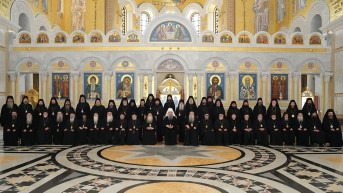
The Holy Assembly of Bishops of the Serbian Orthodox Church (SOC) expressed concern over the implementation of the Law on Foreigners in Kosovo, as well as the increasingly frequent challenges faced by the faithful people, as well as holy sites and monastic communities.
The report on the situation in Kosovo was also included on the agenda of this year’s regular session of the highest ecclesiastical body of the SOC.
In its statement, the Assembly reaffirmed its enduring and unwavering spiritual care and responsibility for the faithful people, clergy, monastics, and holy shrines of the ancient seat of the Serbian patriarchs and archbishops — the Patriarchate of Pec — and of the Raska-Prizren Diocese in Kosovo, an area of particular spiritual and historical significance for the SOC.
“The Assembly is following with particular concern the latest developments and the announced implementation of the controversial Law on Foreigners, which seriously jeopardizes the survival and unhindered functioning of educational and healthcare institutions of essential importance to the life of the Serbian people in Kosovo and Metohija, as well as the increasingly frequent challenges faced by our faithful people, our holy shrines, and monastic communities, which, even in difficult circumstances, persevere in preserving the living spiritual and liturgical presence of the Church in this area,” the statement noted.
It further stated that it is particularly encouraging that the ancient holy sites, despite numerous trials, continue to gather large numbers of pilgrims from the country and abroad, testifying that they are not merely cultural monuments but, above all, living centers of worship, spiritual life, and ecclesiastical existence.
The Assembly expressed full support for Metropolitan of Raska and Prizren Teodosije, the clergy, monastics, and the faithful people in their efforts to preserve, despite constant pressures and uncertainties, their centuries-old presence and their spiritual, cultural, and historical identity. It emphasized the need to continue, before both domestic and international representatives and with additional dedication, to bear witness, in the spirit of the Gospel of Christ, to the necessity of protecting the human, religious, and property rights of the SOC and the faithful people in Kosovo, and to strengthen their position for the survival of the people and the unique Christian culture and civilization in the historical and spiritual heartland of the Serbian people.
During the Assembly sessions, reports on the work of the Holy Synod, the Grand Ecclesiastical Court, and diocesan bishops were analyzed, along with reports by bishops responsible for military chaplains in the Serbian Armed Forces and the Armed Forces of Bosnia and Herzegovina. Reports were also reviewed regarding the work of the Patriarchal Administrative Board, the Patriarchal Library, the Museum and Archives of the SOC, the charitable foundation “Covekoljublje,” the pilgrimage agency “Dobrocinstvo,” and other foundations, institutions, and services of the SOC concerning their activities in the previous year.
The Assembly devoted particular attention to reports on the pastoral work of bishops in the diaspora, with special focus on the circumstances in SOC dioceses in the United States, Australia, and the British Isles.
The Assembly also analyzed the state and challenges of church education and heard reports on the work of all educational institutions of the Church.
During the session, activities initiated last year concerning the reform of curricula and programs in Serbian Orthodox seminaries continued, and for that purpose a new Regulation on Seminaries was adopted, along with new four-year seminary education programs.
A report was also heard regarding activities aimed at improving the educational process and elevating the Higher School – Academy for Arts and Conservation of the SOC to the rank of a faculty, which will henceforth operate as the “Despot Stefan Lazarevic” Faculty.
The Assembly devoted special attention to the topic of establishing the Serbian Orthodox University “Saint Sava.”
“Church universities and higher education institutions founded or supported by Christian churches are by no means a novelty in the European and global educational sphere. On the contrary, they represent one of its oldest and most significant forms. Many of Europe’s most distinguished universities originated within the Church or with its direct support. Saint Sava himself, while still an archimandrite, founded a monastic school in Studenica, and later, as archbishop, a cathedral school in Zica. His sermons in Studenica and Zica constitute distinctive programs of Saint Sava-inspired education with clearly defined spiritual, educational, and pedagogical goals. The Assembly concluded that the idea of establishing a church university represents an expression of responsibility and care for all those who wish to acquire their education within the embrace of the Church, particularly in light of the fact that education and enlightenment, learning and study, are interpreted not primarily as a process of acquiring specific knowledge, but above all as the cultivation of virtue and the path toward the knowledge of God,” the SOC statement said.
The sessions also included a detailed analysis of the situation in the Zica Diocese, its material and financial operations, and the issue of the responsibility of the competent diocesan bishop. In order to restore regular ecclesiastical and canonical order in the diocese, the Assembly decided to relieve Metropolitan Justin of further administration of the Zica Diocese.
The statement recalled that this year’s session of the Assembly was enriched by the ceremonial opening of the exhibition “Saint Sava,” organized by the Museum of the Serbian Orthodox Church at the SANU Gallery, marking the jubilee of the 850th anniversary of the birth of Rastko Nemanjic, later the first Serbian enlightener and archbishop.
During the Assembly, congratulations and greetings were sent to the newly elected Georgian Patriarch-Catholicos, Shio (Simeon). Representatives of the SOC — Bishops Stefan of Remesiana and Nikon of Jenopolje — were delegated to attend his first official liturgical service in his new office at the Holy Trinity Cathedral in Tbilisi.
In addition to the numerous topics addressed by the bishops at the Assembly, particular attention was devoted to relations with other sister Orthodox churches. Among other matters, the consequences of the non-canonical activities of various religious groupings on the canonical territory of the SOC were discussed, as well as the SOC’s relations with non-Orthodox churches and religious communities, both in the region and worldwide.
The Assembly also discussed the spiritual and geopolitical consequences of wars and crises around the world.
“In this regard, the still-current issue of the suffering of the Ukrainian Orthodox Church at the hands of the current authorities in Kyiv was considered, including the confiscation of its property, churches, and monasteries, and the persecution of bishops, priests, and monks of this only canonical Church in Ukraine, who have been deprived of the basic human rights and freedoms guaranteed by international conventions. Therefore, the Assembly once again raises its voice in defense of its disenfranchised and persecuted Orthodox brethren and appeals to all relevant international institutions not to turn a blind eye to this great injustice,” the statement said.
During the Assembly, a session of the Central Body for the Completion of the Memorial Church of Saint Sava on Vracar was also held, during which a report was presented on all works completed thus far through donations from the faithful people and with the assistance of the Serbian state, as well as on the remaining works on the Church.
The mandates of Metropolitan Fotije of Zvornik and Tuzla and Metropolitan Teodosije of Raska and Prizren in the Synod have expired, and they will serve as deputy members of this body for the next one-year term. Metropolitan Irinej of Backa and Metropolitan Metodije of Budimlje and Niksic remain members of the Synod for the remainder of their one-year term, while Metropolitan Jovan of Sumadija and Metropolitan Ilarion of Timok were elected as new members for the upcoming two-year term.
This year’s regular session of the Assembly of Bishops of the Serbian Orthodox Church began with the Holy Liturgy and the “Invocation of the Holy Spirit” at the Church of Saint Sava on Vracar on Wednesday, May 13, presided over by Serbian Patriarch Porfirije, concelebrated by 24 bishops and attended in prayer by four additional bishops of the SOC from the homeland and the diaspora.
0 comments